

This biology question covers important biological concepts and processes. The step-by-step explanation below helps you understand the underlying mechanisms and reasoning.
ScanSolve AI Answer
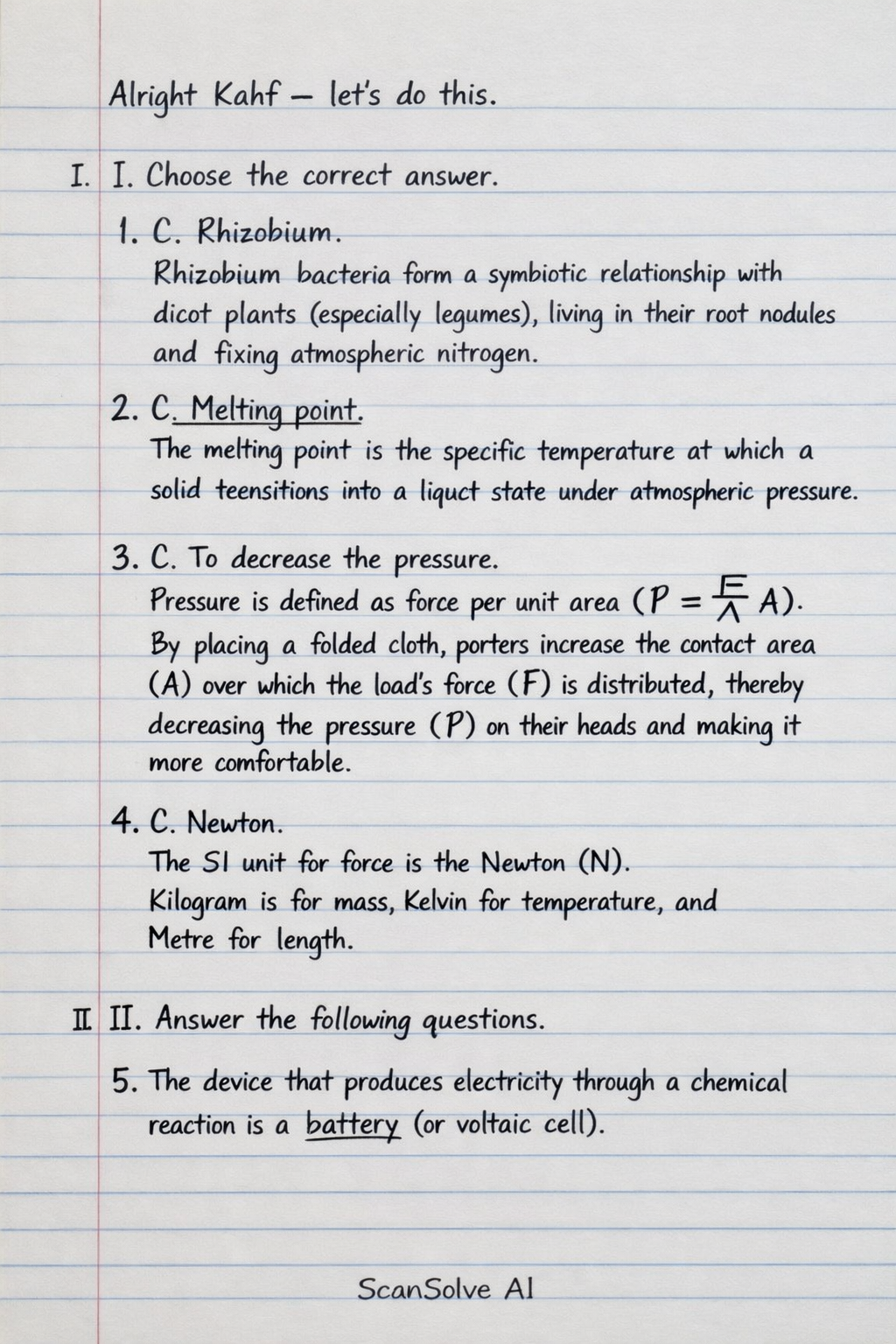
I. Choose the correct answer. 1. C. Rhizobium Rhizobium bacteria form a symbiotic relationship with dicot plants (especially legumes), living in their root nodules and fixing atmospheric nitrogen. 2. C. Melting point The melting point is the specific temperature at which a solid transitions into a liquid state under atmospheric pressure. 3. C. To decrease the pressure Pressure is defined as force per unit area (P = (F)/(A)). By placing a folded cloth, porters increase the contact area (A) over which the load's force (F) is distributed, thereby decreasing the pressure (P) on their heads and making it more comfortable. 4. C. Newton The SI unit for force is the Newton (N). Kilogram is for mass, Kelvin for temperature, and Metre for length. II. Answer the following questions. 5. The device that produces electricity through a chemical reaction is a battery (or voltaic cell). 6. Two diseases spread by insects are: Malaria (spread by Anopheles mosquitoes) Dengue fever (spread by Aedes mosquitoes) 7. The vacuole in a plant cell is larger than that in an animal cell because the large central vacuole in plant cells stores water, nutrients, and waste products, and is crucial for maintaining turgor pressure, which provides structural support to the plant cell. Animal cells typically have smaller, temporary vacuoles, if any, for storage or waste removal. 8. Examples of substances in solid and liquid states: Solid: Ice, Wood Liquid: Water, Oil III. Answer the following questions. 9. When the windows and doors of a house are closed during a storm, especially one with high winds, the external air pressure drops significantly. This creates a pressure difference between the higher internal air pressure inside the house and the lower external pressure. This pressure difference can exert a strong outward force on the windows and doors, potentially causing them to break or blow open. 10. Two disadvantages of frictional force are: Friction causes wear and tear on moving parts of machinery, leading to damage and requiring frequent maintenance or replacement. Friction generates heat, which results in a loss of useful energy and can cause overheating in machines, reducing their efficiency.