
We read your photo as:
Multiple choice questions about microscopy: focusing mechanisms, illumination, and applications of Darkfield microscopy.
ScanSolve AI Answer
Answer
Here are the answers to the multiple-choice questions:
-
One of the following microscopes focusing mechanism has a dual concentric knob for coarse and fine adjustment; The dual concentric knob for coarse and fine adjustment is a characteristic feature of light microscopes. Among the given options, an inverted microscope is a type of light microscope that utilizes these focusing mechanisms.
- A. Electron microscope
- B. Inverted microscope
- C. Scanning microscope
- D. Confocal microscope The correct option is B.
-
Oblique light rays illuminate the specimen in which microscope; Darkfield microscopy uses a special condenser with an opaque disc that blocks direct light, allowing only oblique light rays to illuminate the specimen. This makes the specimen appear bright against a dark background.
- A. Inverted microscope
- B. Confocal microscope
- C. Darkfield microscope
- D. Scanning microscope The correct option is C.
-
Which statement is not correct regarding Dark field microscopy? Darkfield microscopy is primarily used to visualize live, unstained microorganisms that are invisible or very difficult to see with an ordinary brightfield microscope due to their transparency. Statement C claims it's used for microorganisms that are visible in an ordinary light microscope, which contradicts its main purpose.
- A. Illuminate the sample with light that will not be collected by the objective lens
- B. Enhances the contrast in samples that are transparent and absorb little or no light
- C. Used to examine live microorganisms that are visible in the ordinary light microscope
- D. A better result at low magnification can be achieved if the condenser is oiled The incorrect statement is C.
-
Which components differentiate Phase contrast microscope from the normal microscope? Phase contrast microscopy converts phase shifts in light into brightness differences, making transparent specimens visible without staining. This is achieved by two main components: an annular diaphragm (or annulus) in the condenser and a phase plate in the objective lens. The sub-stage annular diaphragm is one of these key differentiating components.
- A. Optical tube length
- B. Sub stage condenser
- C. Mechanical tube length
- D. Sub stage annular diaphragm The correct option is D.
-
One of the following microscopes allows specific and sensitive staining of a specimen in order to detect the distribution of proteins or other molecules of interest; Fluorescence microscopy uses fluorochromes (fluorescent dyes) that bind specifically to target molecules (like proteins, often via antibodies). These fluorochromes emit light when excited by a specific wavelength, allowing for highly sensitive and specific detection and localization of molecules within a sample.
- A. Dissecting microscope
- B. Fluorescence microscopy
- C. Phase contrast microscope
- D. Compound light microscope The correct option is B.
Try one yourself
A new problem that tests the same skill.
Still stuck on this one?
Ask a follow-up, and the answer starts from this question.
More Biology Questions
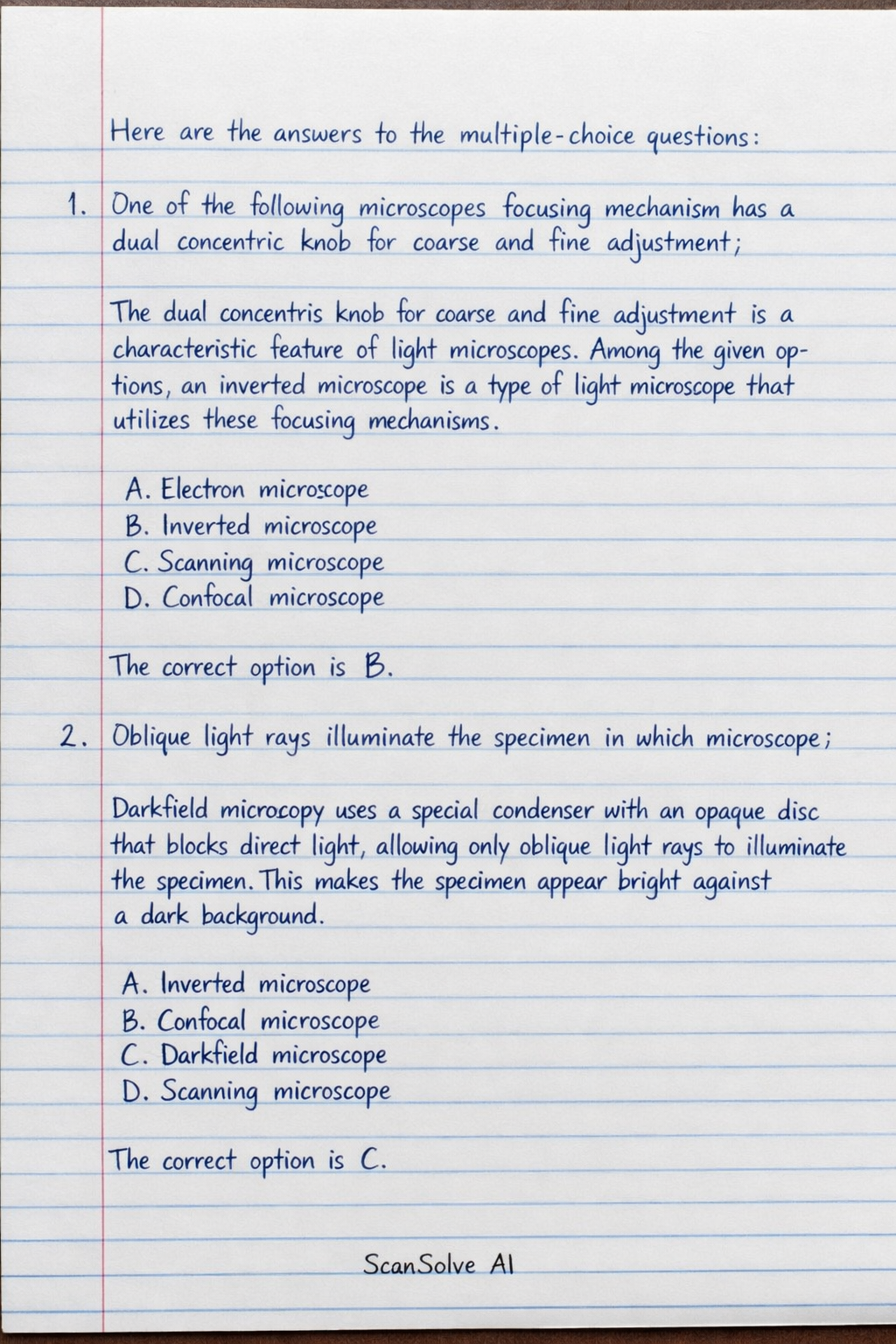
Handwritten Step-by-Step Solution
Get this as a handwritten image on WhatsApp — like a tutor wrote it for you.
Try on WhatsApp