
We read your photo as:
Define an endocrine gland.
ScanSolve AI Answer
Step-by-step solution
4 stepsDefine an endocrine gland.
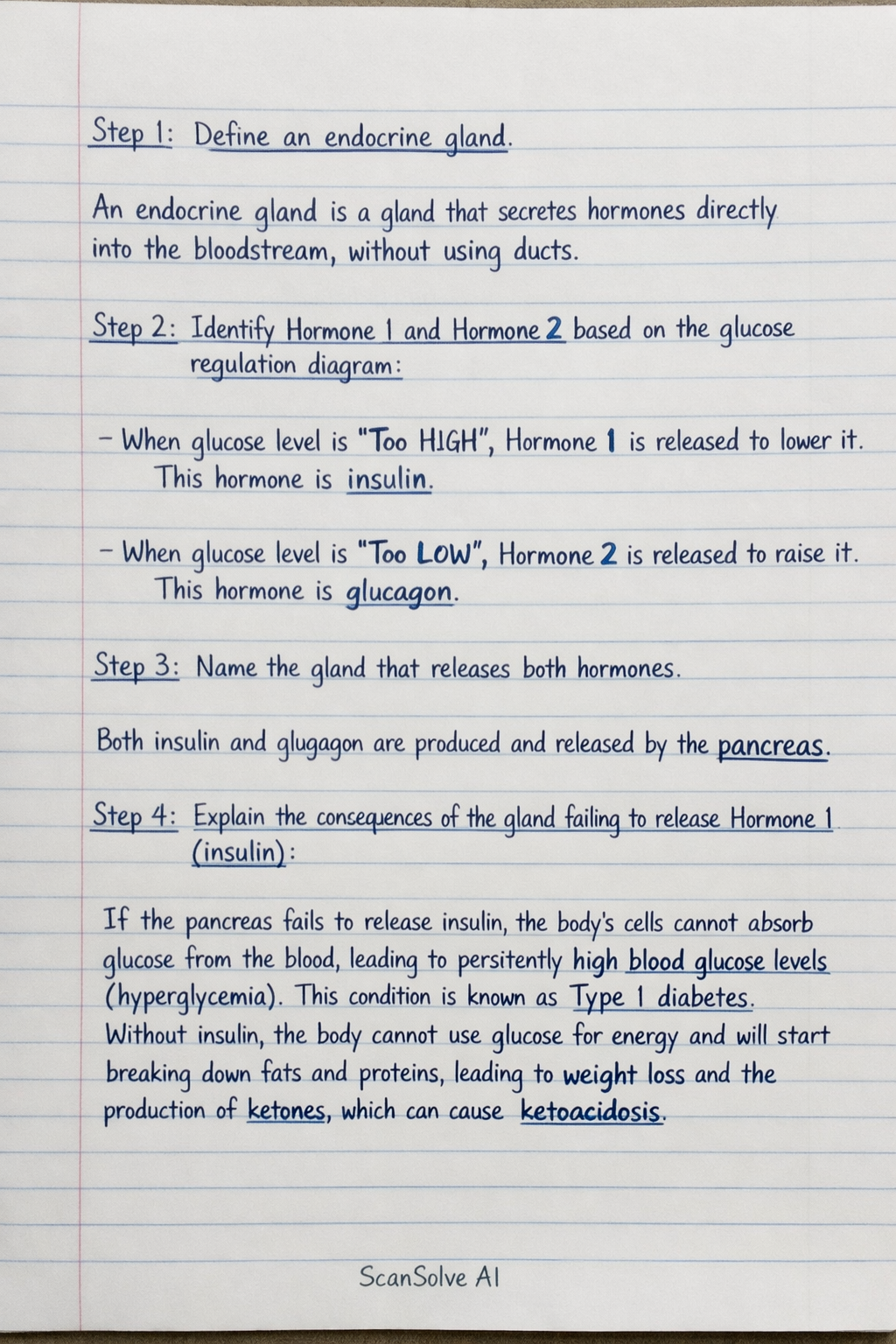
An endocrine gland is a gland that secretes hormones directly into the bloodstream, without using ducts.
Identify Hormone 1 and Hormone 2 based on the glucose regulation diagram.
- When glucose level is "Too HIGH", Hormone 1 is released to lower it. This hormone is insulin.
- When glucose level is "Too LOW", Hormone 2 is released to raise it. This hormone is glucagon.
Name the gland that releases both hormones.
Both insulin and glucagon are produced and released by the pancreas.
Explain the consequences of the gland failing to release Hormone 1 (insulin).
If the pancreas fails to release insulin, the body's cells cannot absorb glucose from the blood, leading to persistently high blood glucose levels (hyperglycemia). This condition is known as Type 1 diabetes. Without insulin, the body cannot use glucose for energy and will start breaking down fats and proteins, leading to weight loss and the production of ketones, which can cause ketoacidosis.
3.3.1 Define the term endocrine gland.
An endocrine gland is a gland that secretes hormones directly into the bloodstream.3.3.2 Identify:
*a) Hormone 1: Insulin
*b) Hormone 2: Glucagon
3.3.3 Name the gland that releases hormone 1 and hormone 2.
Pancreas3.3.4 Explain the consequences for a person if the gland mentioned in QUESTION 3.3.3 fails to release hormone 1.
If the pancreas fails to release insulin, blood glucose levels will remain very high because cells cannot absorb glucose. This leads to Type 1 diabetes, where the body cannot use glucose for energy and instead breaks down fats and proteins, causing weight loss and potentially dangerous ketoacidosis.
Still stuck on this one?
Ask a follow-up, and the answer starts from this question.
More Biology Questions
Handwritten Step-by-Step Solution
Get this as a handwritten image on WhatsApp — like a tutor wrote it for you.
Try on WhatsApp