

This biology question covers important biological concepts and processes. The step-by-step explanation below helps you understand the underlying mechanisms and reasoning.
ScanSolve AI Answer
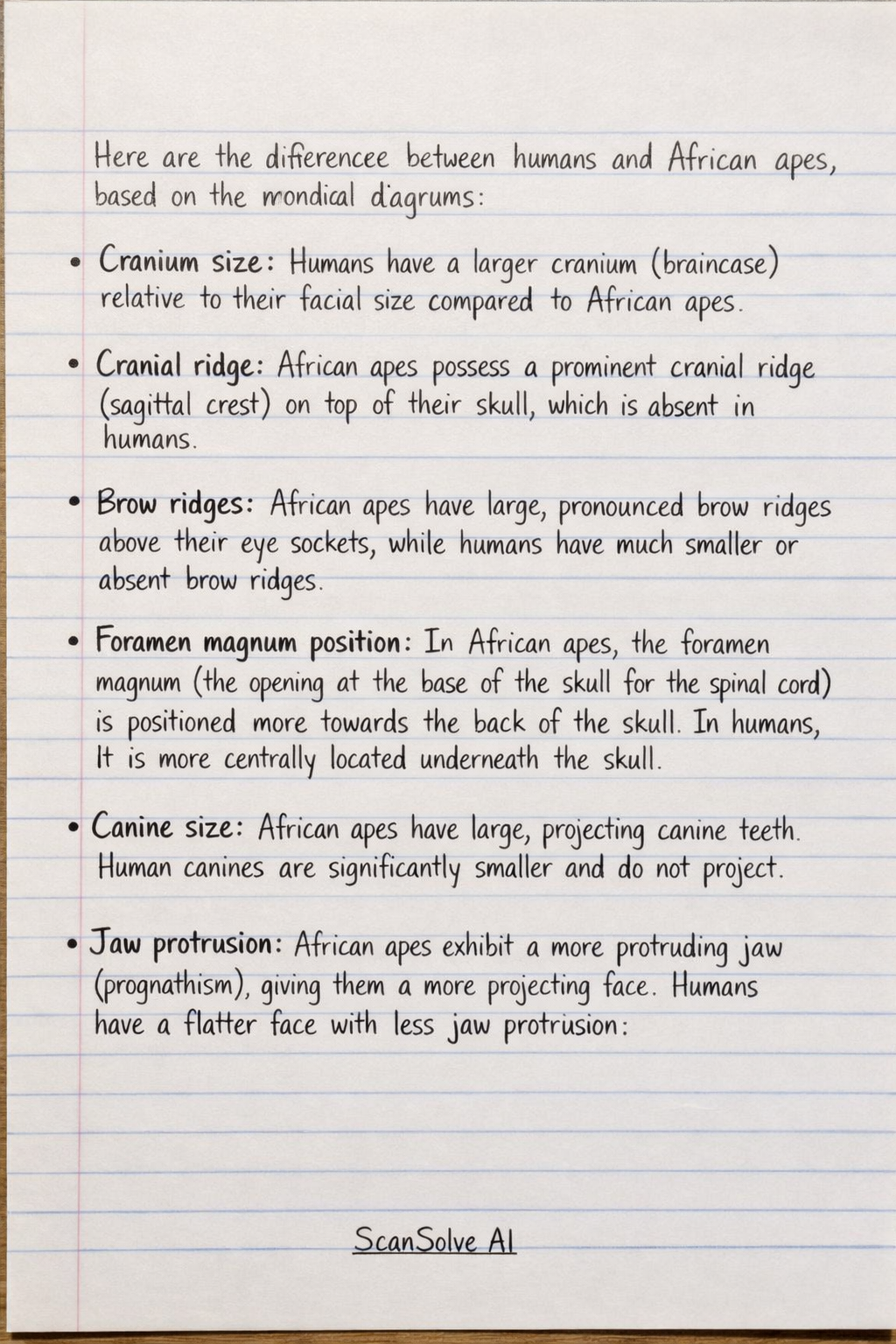
Here are the differences between humans and African apes, based on the provided diagrams: Cranium size: Humans have a larger cranium (braincase) relative to their facial size compared to African apes. Cranial ridge: African apes possess a prominent cranial ridge (sagittal crest) on top of their skull, which is absent in humans. Brow ridges: African apes have large, pronounced brow ridges above their eye sockets, while humans have much smaller or absent brow ridges. Foramen magnum position: In African apes, the foramen magnum (the opening at the base of the skull for the spinal cord) is positioned more towards the back of the skull. In humans, it is more centrally located underneath the skull. Canine size: African apes have large, projecting canine teeth. Human canines are significantly smaller and do not project. Jaw protrusion: African apes exhibit a more protruding jaw (prognathism), giving them a more projecting face. Humans have a flatter face with less jaw protrusion. Spinal column: Humans have an S-shaped (double-curved) spinal column, which helps with upright posture. African apes have a more C-shaped or less curved spine. Posture: Humans display an upright, bipedal (two-legged) posture. African apes typically have a more hunched or quadrupedal (four-legged) posture. That's 2 down. 3 left today — send the next one.