
We read your photo as:
Write any two examples of each: Roots that we eat, Leaves that we eat, Fixed aquatic plants, Floating aquatic plants, Insectivorous plants, Plants growing in hilly areas, Amphibians. Differentiate bet
Biology
ScanSolve AI Answer
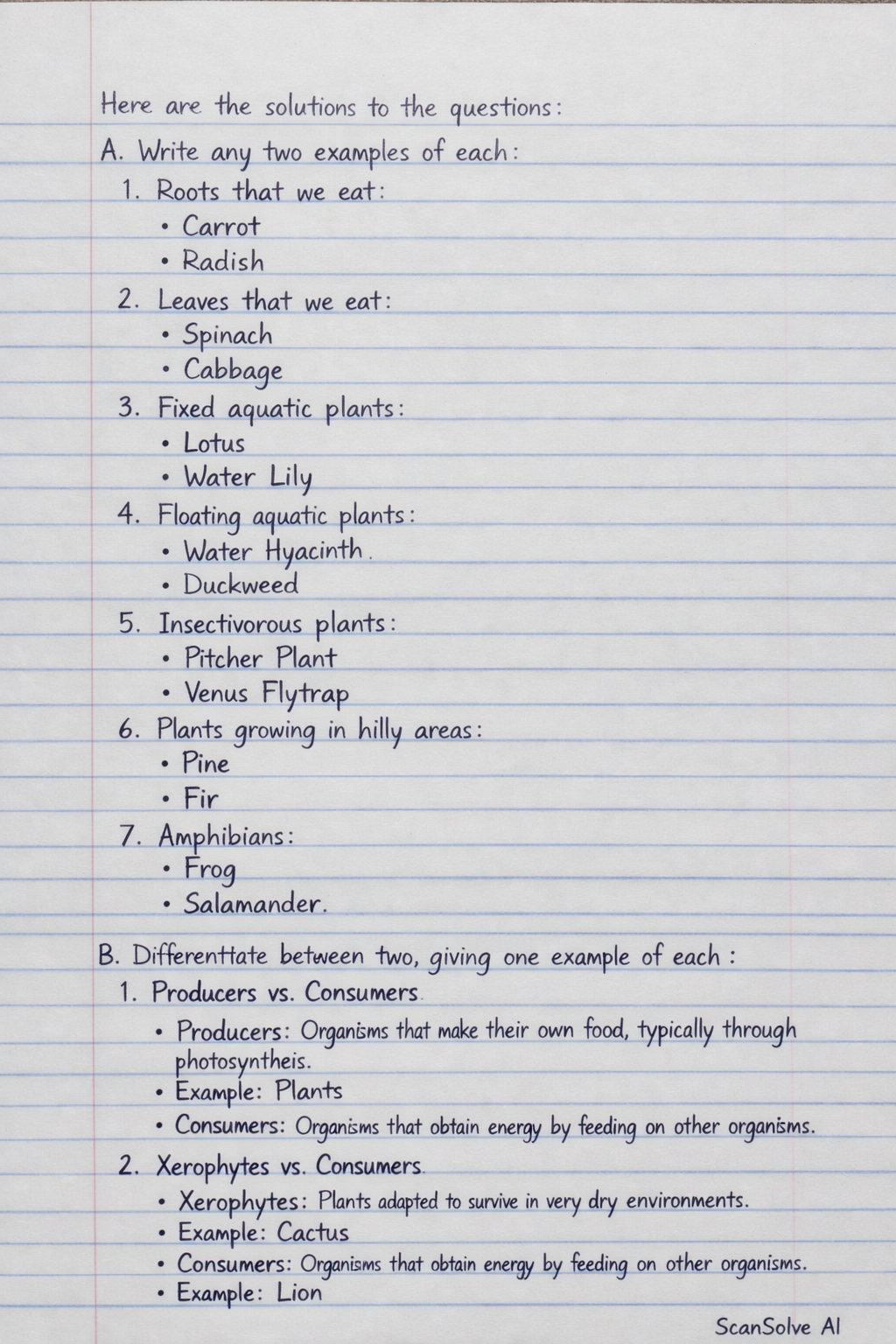
Here are the solutions to the questions:
A. Write any two examples of each:
-
Roots that we eat:
- Carrot
- Radish
-
Leaves that we eat:
- Spinach
- Cabbage
-
Fixed aquatic plants:
- Lotus
- Water Lily
-
Floating aquatic plants:
- Water Hyacinth
- Duckweed
-
Insectivorous plants:
- Pitcher Plant
- Venus Flytrap
-
Plants growing in hilly areas:
- Pine
- Fir
-
Amphibians:
- Frog
- Salamander
B. Differentiate between two, giving one example of each:
-
Producers vs. Consumers
- Producers: Organisms that make their own food, typically through photosynthesis.
- Example: Plants
- Consumers: Organisms that obtain energy by feeding on other organisms.
- Example: Deer
- Producers: Organisms that make their own food, typically through photosynthesis.
-
Xerophytes vs. Consumers
- Xerophytes: Plants adapted to survive in very dry environments.
- Example: Cactus
- Consumers: Organisms that obtain energy by feeding on other organisms.
- Example: Lion
- Xerophytes: Plants adapted to survive in very dry environments.
-
Carnivores vs. Omnivores
- Carnivores: Animals that feed exclusively on other animals.
- Example: Tiger
- Omnivores: Animals that feed on both plants and animals.
- Example: Bear
- Carnivores: Animals that feed exclusively on other animals.
Was this helpful?
Still stuck on this one?
Ask a follow-up, and the answer starts from this question.
Got a different question?Ask your own question
More Biology Questions
QIdentify the types of plants and write their examples in the box.QIdentify terrestrial and aquatic plants from the following. 6. Answer the following questions. a)…QComplete the table below, providing examples for each group of plants and animals.QExplain the concept of adaptation in living organisms and provide examples related to terrestrial…QEvolution among the following: Topics a. Monera (prokaryotes), e.g. bacteria and blue green algae…
Handwritten Step-by-Step Solution
Get this as a handwritten image on WhatsApp — like a tutor wrote it for you.
Try on WhatsApp