
We read your photo as:
Which of the following accounts for the loss of heat in the newborn? I.Differences in temperature between intra and extra uterine environment II.Large surface area III.Insufficient food and fluid intake IV.Thin subcutaneous fat
ScanSolve AI Answer
Answer
I, II and IV
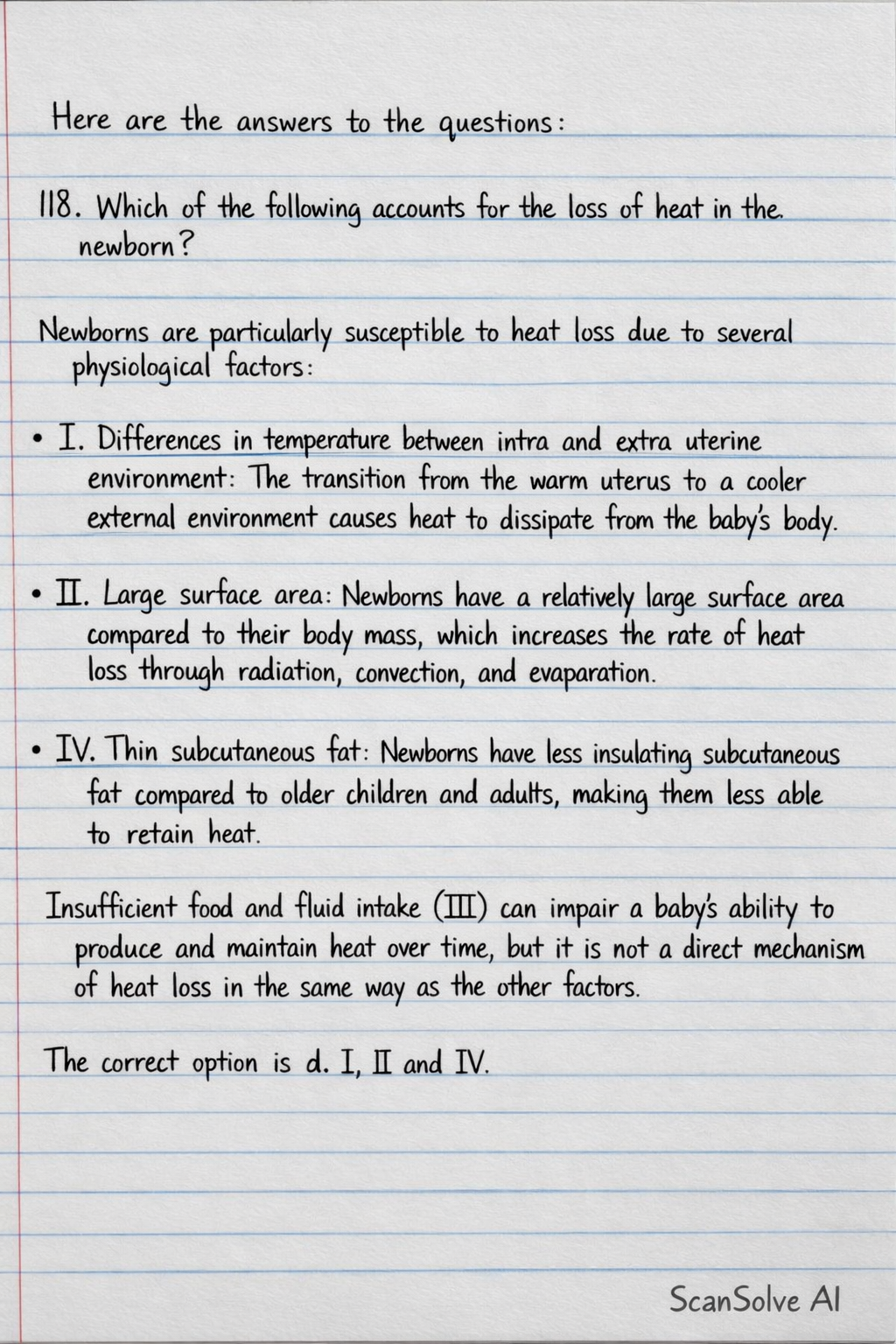
Here are the answers to the questions:
118. Which of the following accounts for the loss of heat in the newborn?
Newborns are particularly susceptible to heat loss due to several physiological factors:
-
I. Differences in temperature between intra and extra uterine environment: The transition from the warm uterus to a cooler external environment causes heat to dissipate from the baby's body.
-
II. Large surface area: Newborns have a relatively large surface area compared to their body mass, which increases the rate of heat loss through radiation, convection, and evaporation.
-
IV. Thin subcutaneous fat: Newborns have less insulating subcutaneous fat compared to older children and adults, making them less able to retain heat.
-
Insufficient food and fluid intake (III) can impair a baby's ability to produce and maintain heat over time, but it is not a direct mechanism of heat loss in the same way as the other factors.
-
The correct option is d. I, II and IV.
119. Which of the following immunoglobulin protects the newborn against respiratory and gastro-intestinal infections?
-
IgA (Immunoglobulin A) is the primary antibody found in mucous membranes, saliva, tears, and breast milk. It plays a crucial role in mucosal immunity, providing localized protection against pathogens in the respiratory and gastrointestinal tracts. When a newborn is breastfed, IgA from breast milk is vital for protecting these systems.
-
The correct option is a. Ig A.
120. Which of the under-listed reflexes is important for breast feeding?
-
The rooting reflex is essential for breastfeeding. When a newborn's cheek or the corner of their mouth is stroked, they will turn their head towards the stimulus and open their mouth, searching for the nipple. This reflex helps the baby locate and latch onto the breast.
-
The correct option is d. Rooting.
121. Within 3 minutes after birth the normal heart rate of the infant may range between:
The normal heart rate for a newborn infant is typically higher than that of an adult. Immediately after birth, and during periods of activity or crying, the heart rate can be quite elevated. A widely accepted normal range for a newborn's heart rate is between 100 and 180 beats per minute.
- The correct option is b. 100 and 180.
Try one yourself
A new problem that tests the same skill.
Still stuck on this one?
Ask a follow-up, and the answer starts from this question.
More Biology Questions
Handwritten Step-by-Step Solution
Get this as a handwritten image on WhatsApp — like a tutor wrote it for you.
Try on WhatsApp