
We read your photo as:
Which of the following are the main components of the secondary plant cell wall? What is the term for reasoning from specific observations to broader generalizations? Approximately how much energy is
ScanSolve AI Answer
-
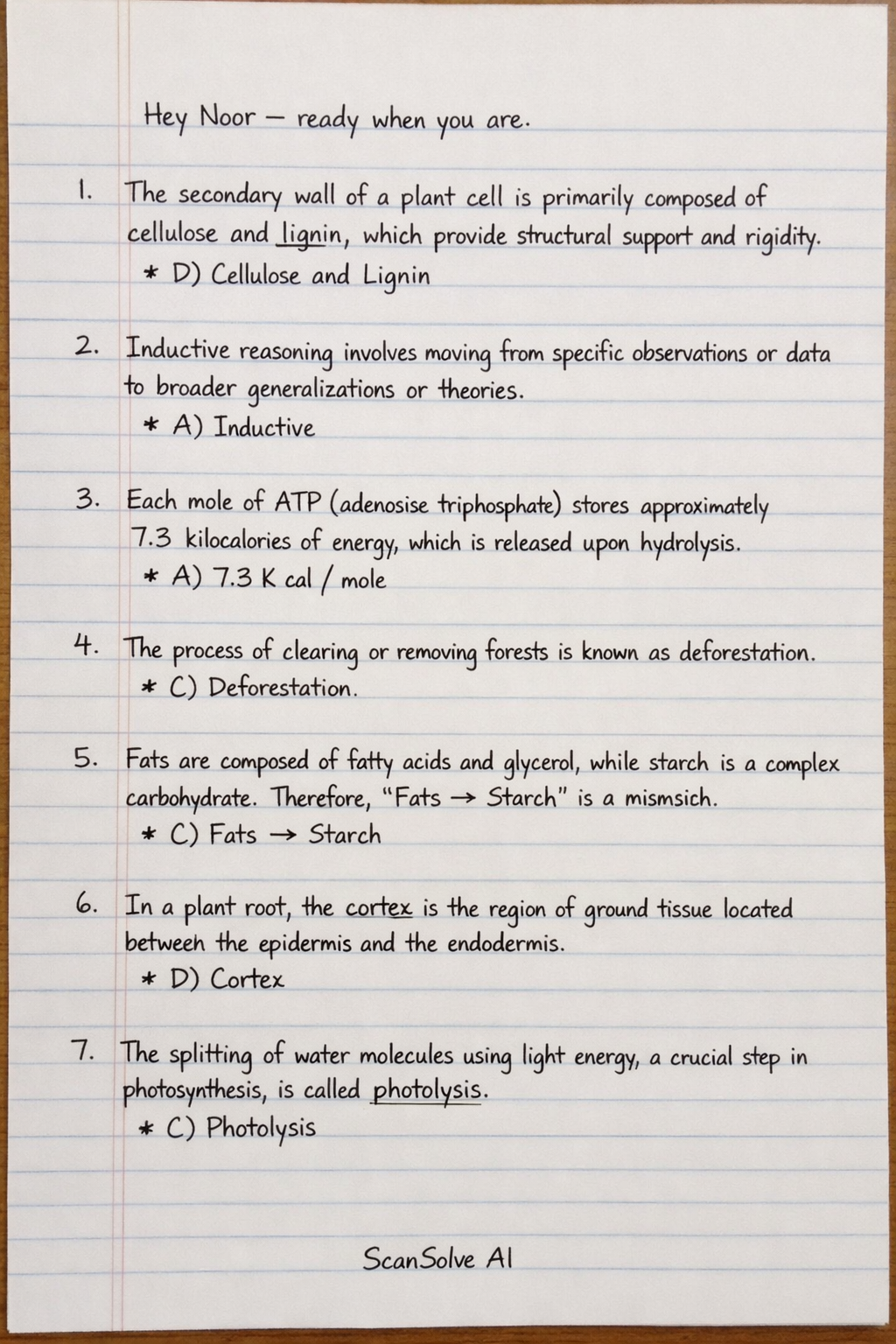
The secondary wall of a plant cell is primarily composed of cellulose and lignin, which provide structural support and rigidity.
- D) Cellulose and Lignin
-
Inductive reasoning involves moving from specific observations or data to broader generalizations or theories.
- A) Inductive
-
Each mole of ATP (adenosine triphosphate) stores approximately 7.3 kilocalories of energy, which is released upon hydrolysis.
- A) 7.3 K cal / mole
-
The process of clearing or removing forests is known as deforestation.
- C) Deforestation
-
Fats are composed of fatty acids and glycerol, while starch is a complex carbohydrate. Therefore, "Fats Starch" is a mismatch.
- C) Fats Starch
-
In a plant root, the cortex is the region of ground tissue located between the epidermis and the endodermis.
- D) Cortex
-
The splitting of water molecules using light energy, a crucial step in photosynthesis, is called photolysis.
- C) Photolysis
-
Lysosomes are organelles found in animal cells that contain digestive enzymes and are responsible for intracellular digestion of waste materials and cellular debris.
- A) Lysosomes
-
During photosynthesis, plants convert light energy into chemical energy, primarily in the form of glucose, a simple sugar.
- A) Glucose
-
Platelets (thrombocytes) are small, irregular-shaped cell fragments in the blood that play a vital role in blood clotting by forming a plug at the site of injury.
- A) Platelets
-
The pharynx is a common passageway located at the back of the throat that connects both the nasal and oral cavities to the trachea (for air) and the oesophagus (for food).
- C) Pharynx
-
Paleontology is the scientific study of life that existed prior to, and sometimes including, the start of the Holocene Epoch, using fossils to understand ancient organisms and their environments.
- B) Paleontology
Still stuck on this one?
Ask a follow-up, and the answer starts from this question.
More Biology Questions
Handwritten Step-by-Step Solution
Get this as a handwritten image on WhatsApp — like a tutor wrote it for you.
Try on WhatsApp