
We read your photo as:
What are the main components of a plant cell and their functions?
Biology
ScanSolve AI Answer
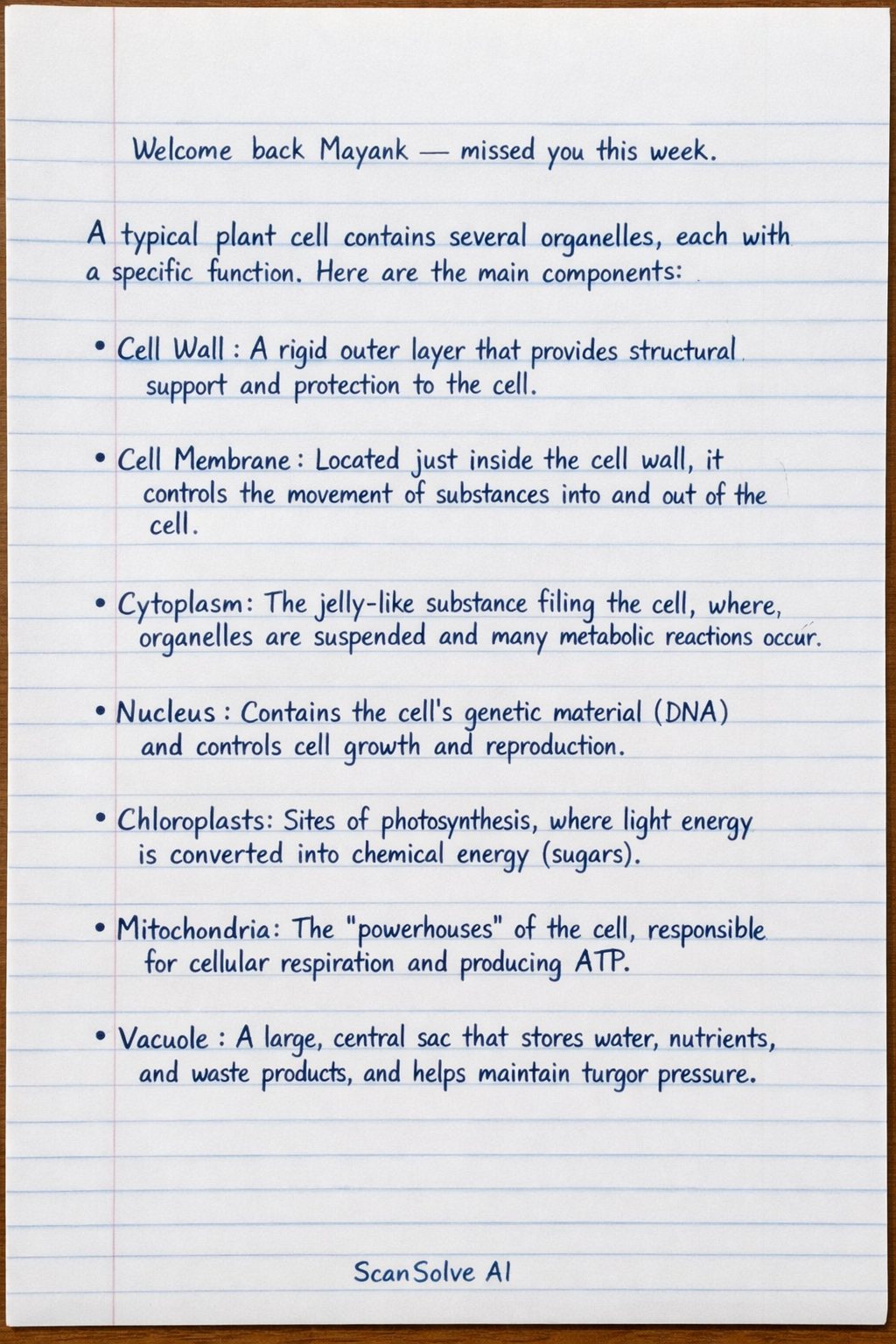
A typical plant cell contains several organelles, each with a specific function. Here are the main components:
- Cell Wall: A rigid outer layer that provides structural support and protection to the cell.
- Cell Membrane: Located just inside the cell wall, it controls the movement of substances into and out of the cell.
- Cytoplasm: The jelly-like substance filling the cell, where organelles are suspended and many metabolic reactions occur.
- Nucleus: Contains the cell's genetic material (DNA) and controls cell growth and reproduction.
- Chloroplasts: Sites of photosynthesis, where light energy is converted into chemical energy (sugars).
- Mitochondria: The "powerhouses" of the cell, responsible for cellular respiration and producing ATP.
- Vacuole: A large, central sac that stores water, nutrients, and waste products, and helps maintain turgor pressure.
- Endoplasmic Reticulum (ER): A network of membranes involved in protein and lipid synthesis. It can be rough (with ribosomes) or smooth (without ribosomes).
- Ribosomes: Small organelles responsible for protein synthesis.
- Golgi Apparatus (or Golgi Complex/Body): Modifies, sorts, and packages proteins and lipids for secretion or delivery to other organelles.
- Plasmodesmata: Small channels that connect the cytoplasm of adjacent plant cells, allowing for communication and transport.
Was this helpful?
Still stuck on this one?
Ask a follow-up, and the answer starts from this question.
Got a different question?Ask your own question
More Biology Questions
QPlant Cell Structure, Tissues, and Their Functions Plant Cell Organelles List and explain the…QThe diagram below represents a plant cell. (a) Name a carbohydrate which forms part of the structure…QWhat are the key structural differences between plant and animal cells?QStudy the example of a plant cell below and answer the questions that follow.QPlant Cell and Animal Cell, Difference, Structure of Chloroplast, Mitochondria, Nucleus, Ribosome…
Handwritten Step-by-Step Solution
Get this as a handwritten image on WhatsApp — like a tutor wrote it for you.
Try on WhatsApp