
We read your photo as:
Which of the following diseases is caused by plasmodium parasite?
ScanSolve AI Answer
Step-by-step solution
2 stepshere are the solutions to the questions:
-
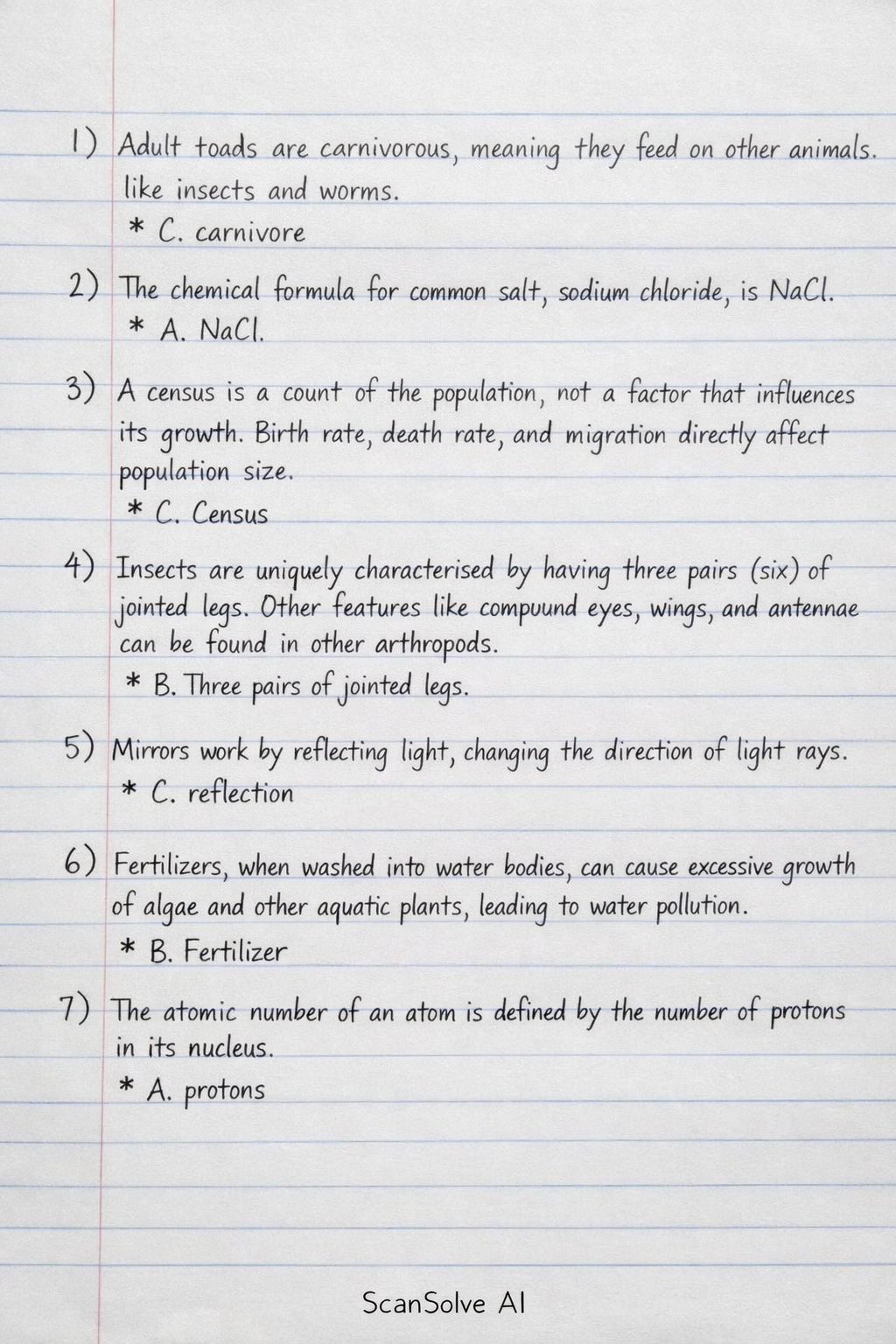
Adult toads are carnivorous, meaning they feed on other animals like insects and worms.
- C. carnivore
-
The chemical formula for common salt, sodium chloride, is NaCl.
- A. NaCl
-
A census is a count of the population, not a factor that influences its growth. Birth rate, death rate, and migration directly affect population size.
- C. Census
-
Insects are uniquely characterized by having three pairs (six) of jointed legs. Other features like compound eyes, wings, and antennae can be found in other arthropods.
- B. Three pairs of jointed legs
-
Mirrors work by reflecting light, changing the direction of light rays.
- C. reflection
-
Fertilizers, when washed into water bodies, can cause excessive growth of algae and other aquatic plants, leading to water pollution.
- B. Fertilizer
-
The atomic number of an atom is defined by the number of protons in its nucleus.
- A. protons
-
Sand has larger particles and larger pore spaces compared to clay, loam, or silt, allowing water to pass through it most quickly.
- B. Sand
-
An alloy is a homogeneous mixture of two or more metals, or a metal and a non-metal.
- C. alloy
-
Abiotic factors are non-living components of an ecosystem. Humidity is a physical environmental factor.
- C. Humidity
-
A wind vane is an instrument used to show the direction from which the wind is blowing. An anemometer measures wind speed.
- B. Wind vane
-
Malaria is a serious disease caused by the Plasmodium parasite, which is transmitted to humans through the bites of infected mosquitoes.
- B. Malaria
-
Chlorine is commonly added to water supplies to disinfect the water by killing harmful bacteria and other microorganisms, making it safe for domestic consumption.
- B. chlorine
-
Reproduction is the biological process by which new individual organisms are produced from their parents, leading to an increase in the number of living things.
- B. reproduction
-
Green plants are producers; they create their own food through photosynthesis and do not break down dead organic matter. Bacteria, fungi, and flies (as scavengers or larvae) are involved in decomposition.
- A. green plant
-
Water is often called the "universal solvent" because of its ability to dissolve a wide range of substances.
- C. water
-
Iodine solution is used as an indicator to test for the presence of starch; it turns blue-black in the presence of starch.
- D. iodine
-
To find the number of neutrons, subtract the atomic number (number of protons) from the atomic mass.
Identify the given values.
Atomic number (protons) = 18 Atomic mass = 40Calculate the number of neutrons.
Number of neutrons = Atomic mass - Atomic number
Number of neutrons = $40 - 18 = 22$
*   **B. 22**
Still stuck on this one?
Ask a follow-up, and the answer starts from this question.
More Biology Questions
Handwritten Step-by-Step Solution
Get this as a handwritten image on WhatsApp — like a tutor wrote it for you.
Try on WhatsApp