
We read your photo as:
Which of the following invertebrates DOES NOT possess antennae?
ScanSolve AI Answer
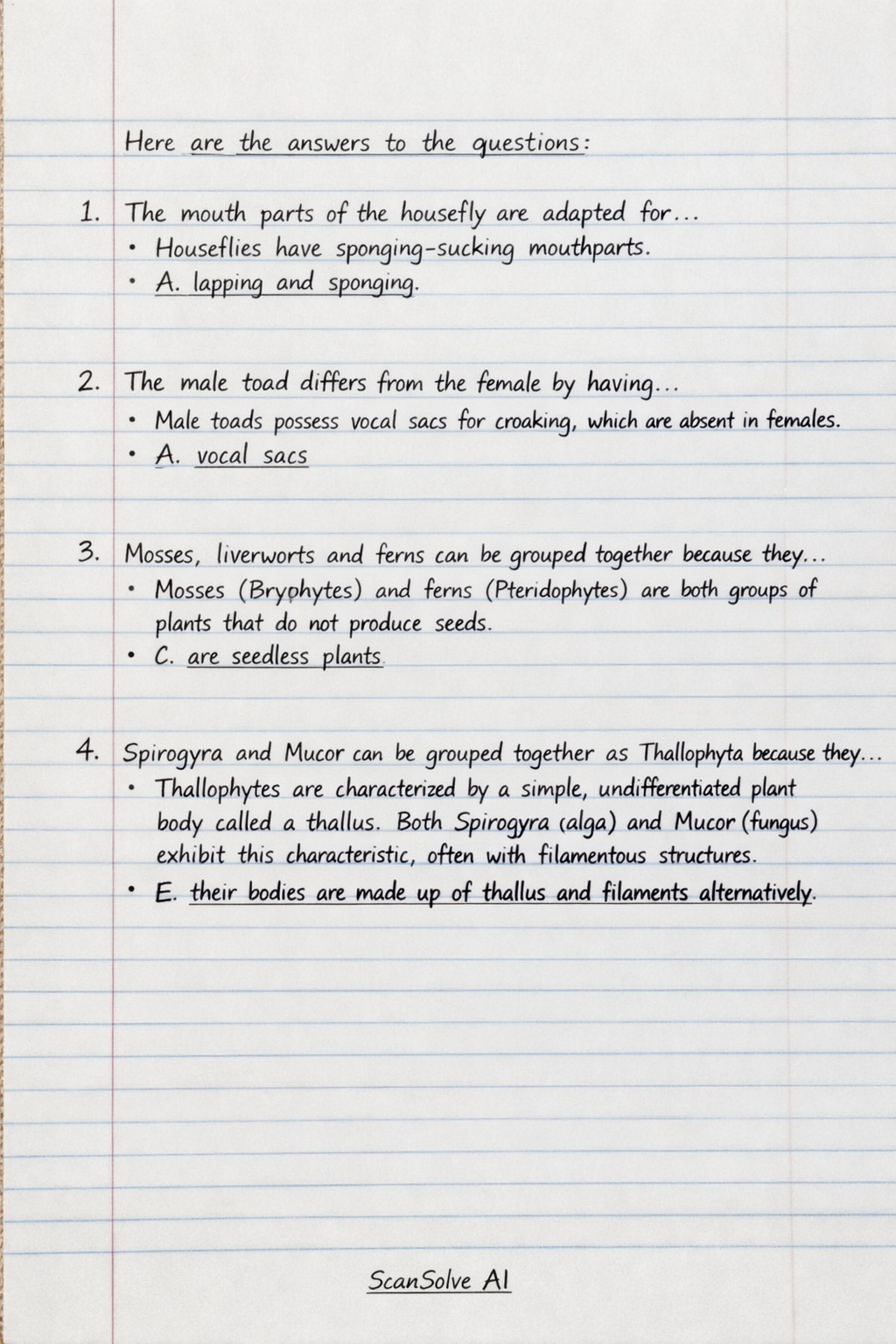
Here are the answers to the questions:
-
The mouth parts of the housefly are adapted for...
- Houseflies have sponging-sucking mouthparts.
- A. lapping and sponging
-
The male toad differs from the female by having...
- Male toads possess vocal sacs for croaking, which are absent in females.
- A. vocal sacs
-
Mosses, liverworts and ferns can be grouped together because they...
- Mosses (Bryophytes) and ferns (Pteridophytes) are both groups of plants that do not produce seeds.
- C. are seedless plants
-
Spirogyra and Mucor can be grouped together as Thallophyta because they...
- Thallophytes are characterized by a simple, undifferentiated plant body called a thallus. Both Spirogyra (alga) and Mucor (fungus) exhibit this characteristic, often with filamentous structures.
- E. their bodies are made up of thallus and filaments alternatively.
-
Which of the following invertebrates DOES NOT possess antennae?
- Centipedes, crustaceans, millipedes, and insects are arthropods that possess antennae. Spiders (arachnids) do not have antennae; they have pedipalps and chelicerae.
- E. Spider
-
Which of the following is INCORRECT? The prothallus of a fern is a flattened heart-shaped structure. It is green because its cells contain chloroplasts. It is the dominant plant. It bears numerous rhizoids. The sexual organs are attached to the ground by numerous rhizoids.
- The prothallus (gametophyte) of a fern is not the dominant plant; the sporophyte (the leafy fern plant) is the dominant generation.
- C. It is the dominant plant.
-
Which of the following cell constituents is NOT common in both plants and animals?
- Chloroplasts are organelles found in plant cells (and some protists) for photosynthesis, but not in animal cells. Mitochondria, ribosomes, Golgi apparatus, and vacuoles are found in both.
- B. Chloroplasts
-
The character-producing factors in living organisms are...
- Genes are the fundamental units of heredity that determine specific traits or characters in living organisms.
- E. genes
-
A mixture of mercurous and mercuric nitrates is added to a food substance. A white precipitate is formed which on gentle heating turns red. The food substance is...
- This describes the Millon's test, which is used to detect the presence of proteins.
- A. protein
-
The mammalian organ through which nourishment and oxygen diffuse into a developing embryo is called...
- The placenta is the organ responsible for the exchange of nutrients, oxygen, and waste products between the mother and the developing embryo/fetus.
Still stuck on this one?
Ask a follow-up, and the answer starts from this question.
More Biology Questions
Handwritten Step-by-Step Solution
Get this as a handwritten image on WhatsApp — like a tutor wrote it for you.
Try on WhatsApp