
We read your photo as:
Which of the following is NOT a risk factor for hypoxia? A) Smoking B) Menstruation C) Diving D) Blood donation
Biology
ScanSolve AI Answer
Answer
D
Blood donation
-
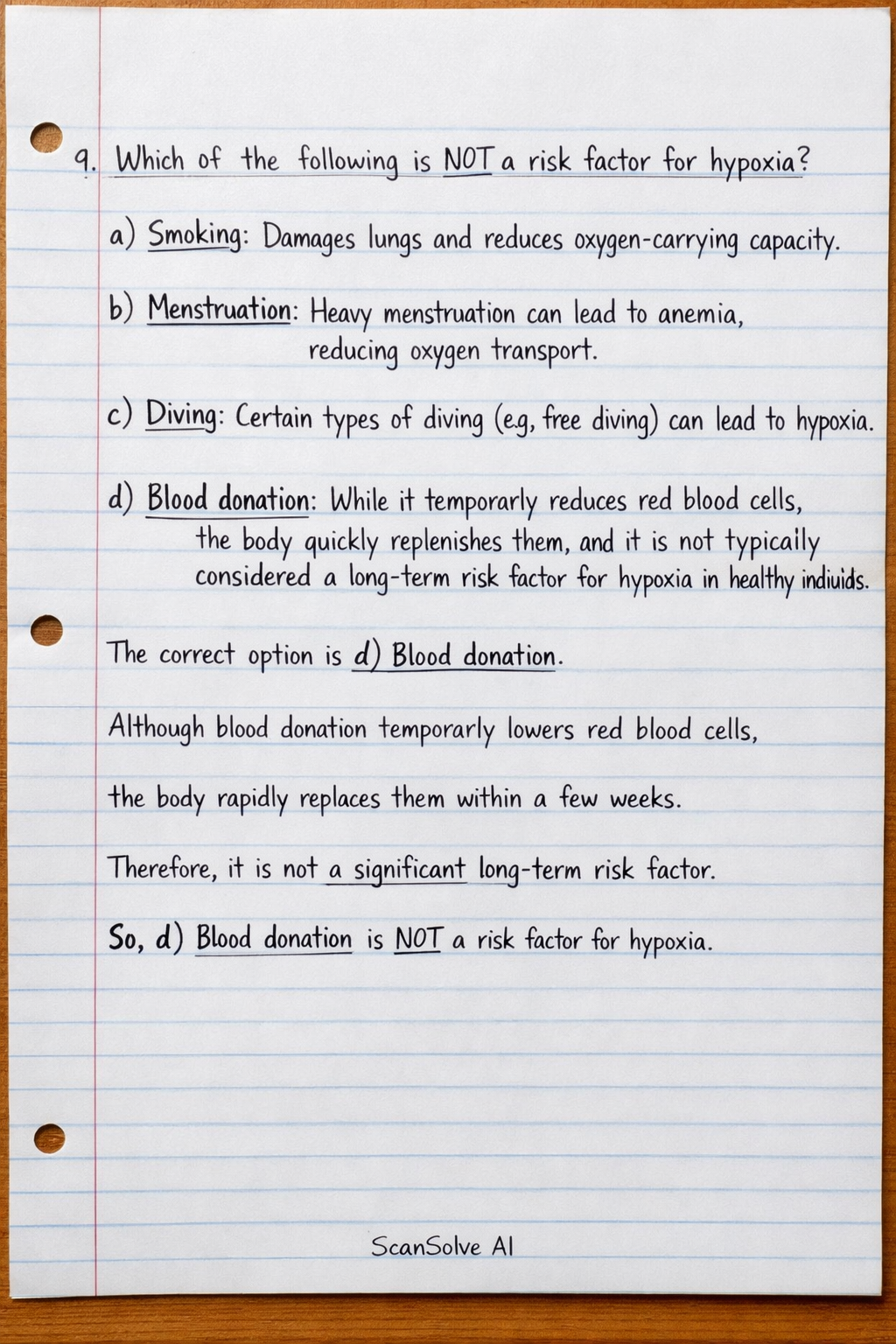
Which of the following is NOT a risk factor for hypoxia?
- a) Smoking: Damages lungs and reduces oxygen-carrying capacity.
- b) Menstruation: Heavy menstruation can lead to anemia, reducing oxygen transport.
- c) Diving: Certain types of diving (e.g., free diving) can lead to hypoxia.
- d) Blood donation: While it temporarily reduces red blood cells, the body quickly replenishes them, and it is not typically considered a long-term risk factor for hypoxia in healthy individuals.
- The correct option is d) Blood donation.
-
Anemic hypoxia can be caused by...
- Anemic hypoxia occurs when the blood's capacity to carry oxygen is reduced, often due to a decrease in functional hemoglobin.
- a) Low pressure: Causes hypoxic hypoxia.
- b) Alcohol: Can depress respiratory drive but doesn't directly cause anemic hypoxia.
- c) Carbon monoxide poisoning: Carbon monoxide binds to hemoglobin much more readily than oxygen, effectively reducing the blood's oxygen-carrying capacity, leading to anemic hypoxia.
- d) High altitudes: Causes hypoxic hypoxia.
- The correct option is c) Carbon monoxide poisoning.
-
Which characteristic is important when choosing sunglasses used by pilots?
- Pilots need to be able to read cockpit instruments, many of which are LCD screens, and detect other aircraft. Polarized lenses can interfere with LCD displays and can mask the glint off other aircraft, which is crucial for visual detection.
- a) No UV filter: Incorrect, UV protection is important.
- b) Non-polarised: Correct, to avoid interference with cockpit displays and visual detection of other aircraft.
- c) Curved sidepiece: Relates to fit, not critical optical function.
- d) Unbreakable: Desirable, but not the most important optical characteristic.
- The correct option is b) Non-polarised.
-
What time is required approximately for the eyes to adapt to brightness?
- The eyes adapt to brightness (light adaptation) much faster than they adapt to darkness. Significant adaptation occurs within seconds.
- a) 10 minutes: This is closer to dark adaptation time.
- b) 10 seconds: A reasonable approximation for the initial, noticeable adaptation to brightness.
- c) minute: Longer than typical for initial adaptation.
- d) second: Too short for full adaptation, but initial changes are very fast.
- The correct option is b) 10 seconds.
-
Which part of the visual system is responsible for colour vision?
- a) Blind spot: Area with no photoreceptors.
- b) Rods: Responsible for low-light vision, not color.
- c) Cones: Photoreceptor cells in the retina responsible for high-acuity vision and color perception. (This option is inferred as the correct answer based on the question, though the full option text is not visible).
- d) Optic nerve: Transmits visual signals, does not detect color.
- The correct option is c) Cones.
Was this helpful?
Try one yourself
A new problem that tests the same skill.
Still stuck on this one?
Ask a follow-up, and the answer starts from this question.
Got a different question?Ask your own question
More Biology Questions
QThe following is an associated factor of infertility in males Question 10Answer a. Cigarrettes…QWhich factor is NOT a modifiable risk factor for hypertension? A. AgeB. DietC. Alcohol D. Lifestyle…Q. Part A: Why did swelling occur immediately after the injury? A. Decreased blood flow B. Increased…QThe following are benefits of exercising, except— (A) Boosting the mood (B) Causing obesity (C)…QThe correct answer is A. Hyperbaric oxygen therapy.
Handwritten Step-by-Step Solution
Get this as a handwritten image on WhatsApp — like a tutor wrote it for you.
Try on WhatsApp