
We read your photo as:
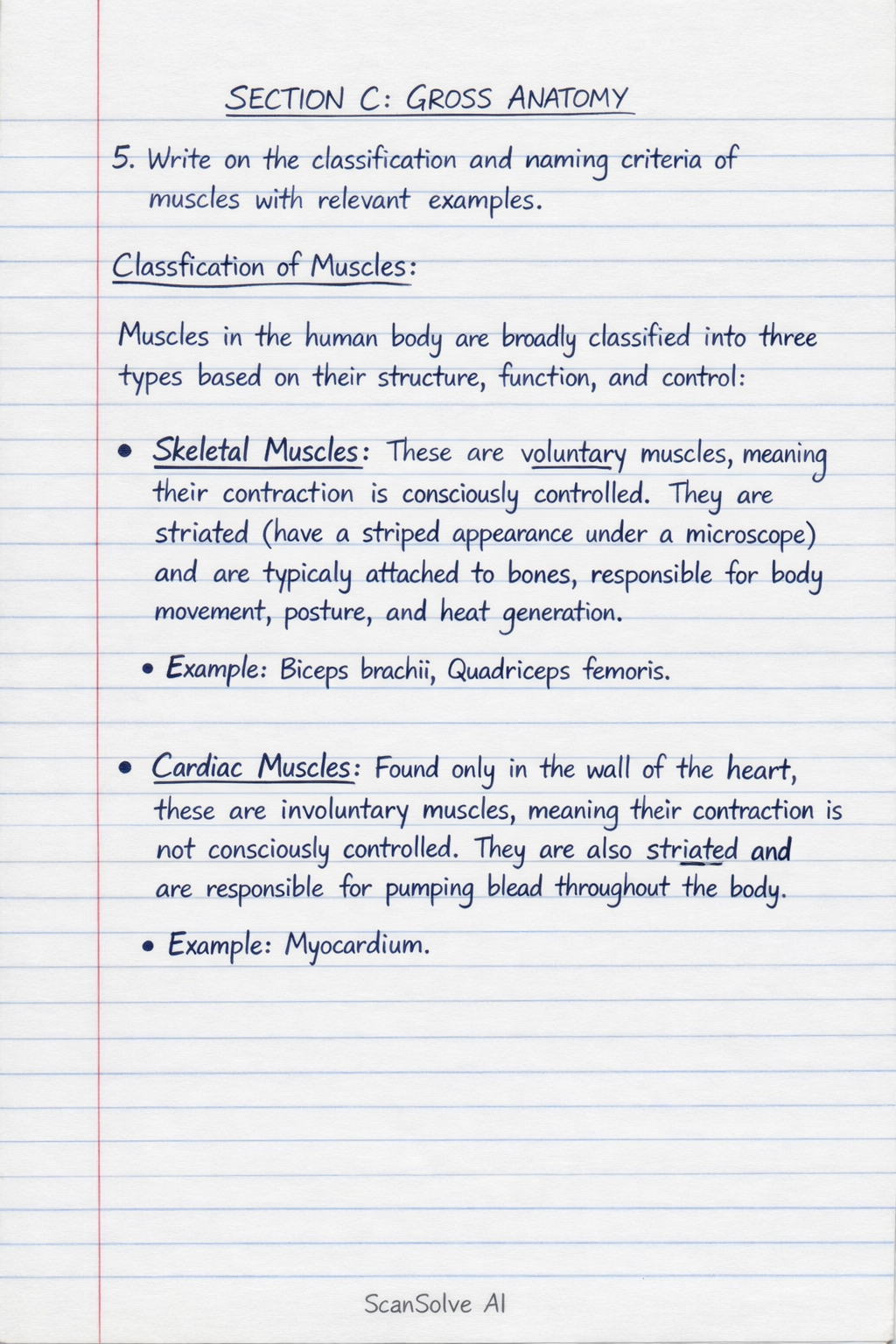
Write on the classification and naming criteria of muscles with relevant examples.
Biology
ScanSolve AI Answer
here is the answer to question 5 from the image.
SECTION C: GROSS ANATOMY
5. Write on the classification and naming criteria of muscles with relevant examples.
Classification of Muscles:
Muscles in the human body are broadly classified into three types based on their structure, function, and control:
- Skeletal Muscles: These are voluntary muscles, meaning their contraction is consciously controlled. They are striated (have a striped appearance under a microscope) and are typically attached to bones, responsible for body movement, posture, and heat generation.
- Example: Biceps brachii, Quadriceps femoris.
- Cardiac Muscles: Found only in the wall of the heart, these are involuntary muscles, meaning their contraction is not consciously controlled. They are also striated and are responsible for pumping blood throughout the body.
- Example: Myocardium.
- Smooth Muscles: These are involuntary muscles found in the walls of internal organs like the stomach, intestines, bladder, and blood vessels. They are non-striated and are responsible for slow, sustained contractions, such as moving food through the digestive tract (peristalsis) or regulating blood pressure.
- Example: Muscles in the wall of the stomach, arrector pili muscles in the skin.
Naming Criteria of Muscles:
Muscles are named using several criteria, often combining multiple features, to provide clues about their location, shape, size, or function.
- Location: Named for the bone or body region with which they are associated.
- Example: The Temporalis muscle is located over the temporal bone. The Intercostal muscles are found between the ribs.
- Shape: Named for their distinctive shape.
- Example: The Deltoid muscle (triangular, like the Greek letter delta). The Trapezius muscle (trapezoid shape). The Orbicularis oculi (circular muscle around the eye).
- Size: Named for their relative size.
- Example: Gluteus Maximus (largest gluteal muscle), Gluteus Minimus (smallest gluteal muscle). Pectoralis Major (larger chest muscle), Pectoralis Minor (smaller chest muscle).
- Direction of Muscle Fibers: Named according to the direction in which their muscle fibers run relative to the body's midline or a bone.
- Example: Rectus (fibers run straight, e.g., Rectus abdominis). Oblique (fibers run at an angle, e.g., External oblique). Transversus (fibers run across, e.g., Transversus abdominis).
- Number of Origins (Heads): Named for the number of tendons of origin (points of attachment to a stationary bone).
- Example: Biceps (two heads, e.g., Biceps brachii). Triceps (three heads, e.g., Triceps brachii). Quadriceps (four heads, e.g., Quadriceps femoris).
- Location of Attachments (Origin and Insertion): Named for their points of origin and insertion. The origin is usually named first.
- Example: The Sternocleidomastoid muscle originates from the sternum and clavicle and inserts on the mastoid process of the temporal bone.
- Action: Named for the movement they produce.
- Example: Flexor (causes flexion, e.g., Flexor carpi radialis). Extensor (causes extension, e.g., Extensor digitorum). Adductor (causes adduction, e.g., Adductor longus). Levator (elevates a structure, e.g., Levator scapulae).
Was this helpful?
Still stuck on this one?
Ask a follow-up, and the answer starts from this question.
Got a different question?Ask your own question
More Biology Questions
QIdentify the types of muscles shown in Figure 3.QFigure 3 shows four different types of muscles labelled A, B, C and D. a) Name each of the muscles…QIdentify the muscle types labeled A, B, C, and D in the provided illustrations.QAlso Write a long essay on histology of bones and histology of muscle tissuesQUnderstand the different types of muscle tissue.
Browse by topic:Anatomy
Handwritten Step-by-Step Solution
Get this as a handwritten image on WhatsApp — like a tutor wrote it for you.
Try on WhatsApp