
We read your photo as:
Outline the aim, procedure, and reporting requirements for 'Practical VI: Adaptations of Organisms'.
Biology
ScanSolve AI Answer
Answer
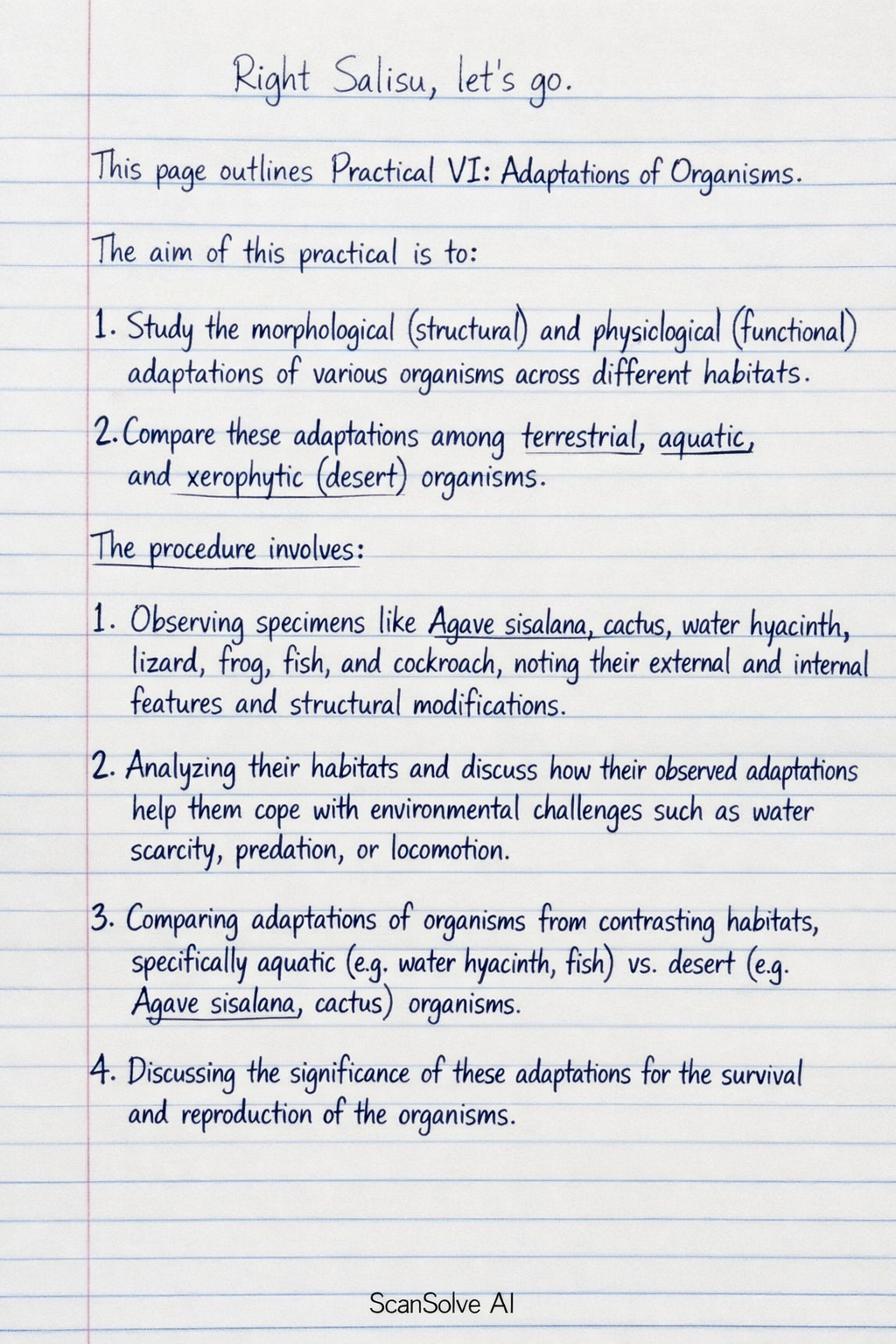
This page outlines Practical VI: Adaptations of Organisms.
The aim of this practical is to:
- Study the morphological (structural) and physiological (functional) adaptations of various organisms across different habitats.
- Compare these adaptations among terrestrial, aquatic, and xerophytic (desert) organisms.
The procedure involves:
- Observing specimens like Agave sisalana, cactus, water hyacinth, lizard, frog, fish, and cockroach, noting their external and internal features and structural modifications.
- Analyzing their habitats and discussing how their observed adaptations help them cope with environmental challenges such as water scarcity, predation, or locomotion.
- Comparing adaptations of organisms from contrasting habitats, specifically aquatic (e.g., water hyacinth, fish) versus desert (e.g., Agave sisalana, cactus) organisms.
- Discussing the significance of these adaptations for the survival and reproduction of the organisms.
The report should include detailed descriptions of each specimen's adaptations and labeled diagrams highlighting these features.
Was this helpful?
Still stuck on this one?
Ask a follow-up, and the answer starts from this question.
Got a different question?Ask your own question
More Biology Questions
QExplain the "Practical 1: Biological Kingdoms" assignment, focusing on observation and recording…QList the specimens and materials required for each question in the provided biology practical exam…QWrite two adaptations shown by the below mentioned animals, to their living environment.QBiology practical section at the advance levelQThis image displays the instructions and materials list for a Group 1 practical biology examination…
Handwritten Step-by-Step Solution
Get this as a handwritten image on WhatsApp — like a tutor wrote it for you.
Try on WhatsApp