
We read your photo as:
Explain the "Practical 1: Biological Kingdoms" assignment, focusing on observation and recording skills.
ScanSolve AI Answer
Answer
Right talented, let's break down the "Practical 1: Biological Kingdoms" section.
Here's an elaborate explanation of each part of this practical:
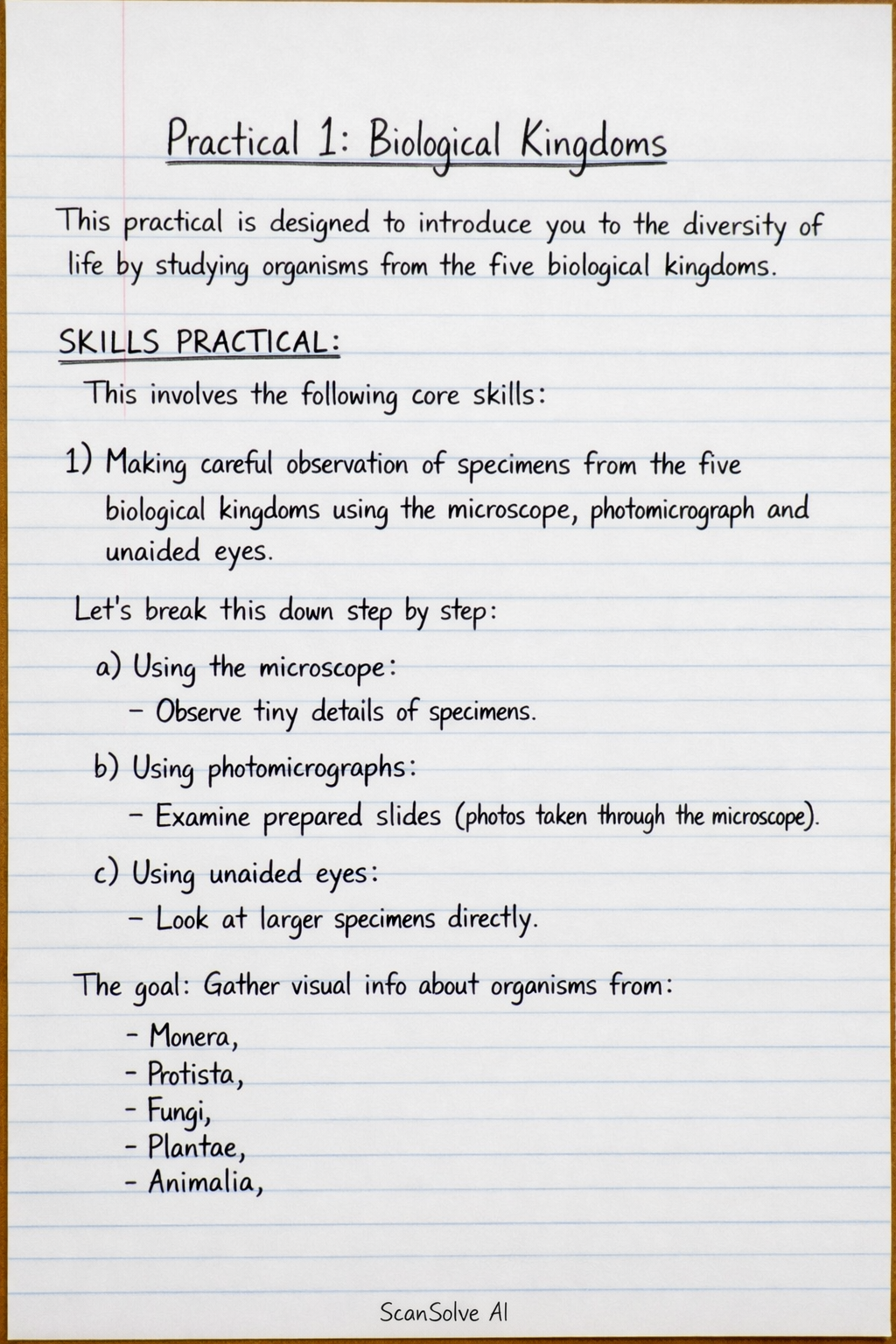
Practical 1: Biological Kingdoms
This practical is designed to introduce you to the diversity of life by studying organisms from the five biological kingdoms.
-
SKILLS PRACTICAL: This section outlines the core skills you are expected to develop and apply during the practical.
- Making careful observation of specimens from the five biological kingdoms using the microscope, photomicrograph and the unaided eyes: This means you will be actively looking at various organisms or parts of organisms. "Careful observation" implies paying close attention to details, structures, colors, and arrangements. You'll use different tools: a microscope for tiny details, photomicrographs (photos taken through a microscope) for pre-prepared views, and your unaided eyes for larger specimens. The goal is to gather visual information about the characteristics of organisms from Monera, Protista, Fungi, Plantae, and Animalia.
- Record observations in written forms and by means of appropriate drawings: After observing, you must document what you see. "Written forms" could include descriptions, notes on characteristics, or comparisons. "Appropriate drawings" refers to the detailed, accurate, and labeled scientific drawings we discussed previously, which are crucial for illustrating biological structures.
-
OBJECTIVE: These are the learning goals you should achieve by the end of the practical.
- Identify similarities and differences between members of each biological kingdom: This objective requires you to compare and contrast organisms within the same kingdom (e.g., different types of plants) and across different kingdoms (e.g., a plant versus a fungus). You'll look for shared features and distinguishing characteristics that define each group.
- Make interpretation of biological phenomena and representations: This goes beyond just observing. You need to understand why certain structures exist or how they function. For example, interpreting why a plant cell has a cell wall while an animal cell does not, or understanding the significance of a particular organelle. "Representations" refers to understanding diagrams, models, or even your own drawings as tools to explain biological concepts.
- To generally understand the concept of biological kingdom: This is the overarching goal. You should grasp what a "biological kingdom" is, why organisms are classified into these groups, and the fundamental characteristics that define each of the five kingdoms.
-
REASONING/REFLECTION: This part encourages critical thinking and self-assessment.
- Identify whether or not a concept is understood: After engaging with the practical, you should be able to reflect on your own learning. Can you explain the characteristics of each kingdom? Can you differentiate between them? This helps you pinpoint areas where you might need further clarification or study.
-
INTRODUCTION: This provides background information for the practical.
- The living kingdom is classified into five (5) kingdoms - monera, protista, fungi, plantae and animalia: This states the fundamental classification system you will be working with. It lists the five major groups of life.
- To study the various representatives of these kingdoms, prepared slides, live and preserved specimens are to be used: This reiterates the types of materials you will encounter. Prepared slides are permanent microscope slides, live specimens allow observation of movement and behavior, and preserved specimens offer a chance to examine larger structures without decay.
-
Questions: This is the task you need to complete.
- 1. Draw and label the specimen provided: This is your primary task. You will be given a specific specimen (which could be a slide, a live organism, or a preserved sample) and you must create a detailed, accurate, and fully labeled scientific drawing of it, applying all the guidelines for high-power drawings discussed previously.
Still stuck on this one?
Ask a follow-up, and the answer starts from this question.
More Biology Questions
Handwritten Step-by-Step Solution
Get this as a handwritten image on WhatsApp — like a tutor wrote it for you.
Try on WhatsApp