
We read your photo as:
Pea plants heterozygous for seed shape and seed color are crossed. Determine the phenotypic ratio of the offspring.
ScanSolve AI Answer
Answer
Step-by-step solution
2 steps3a)
-
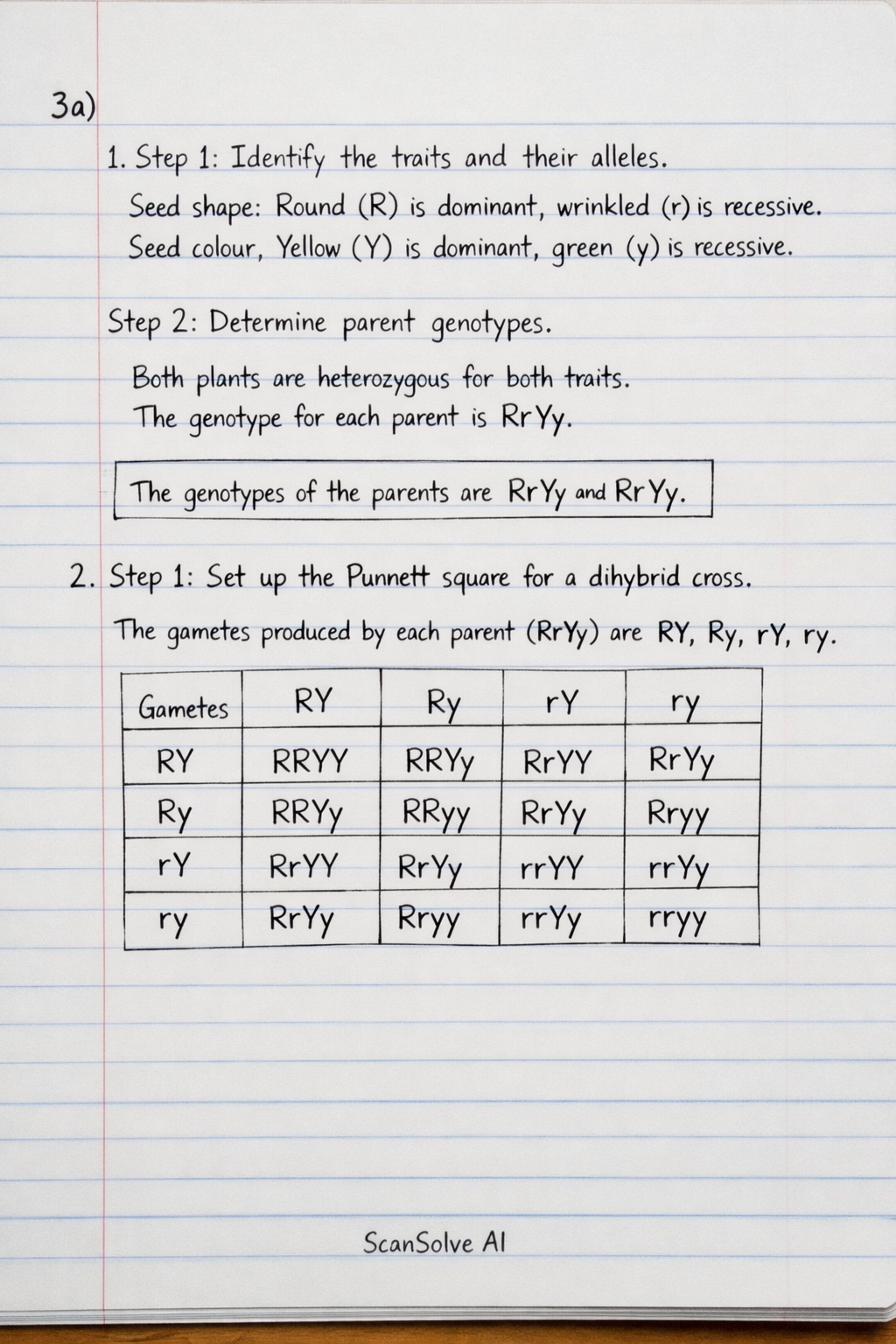
Step 1: Identify the traits and their alleles. Seed shape: Round (R) is dominant, wrinkled (r) is recessive. Seed colour: Yellow (Y) is dominant, green (y) is recessive. Step 2: Determine parent genotypes. Both plants are heterozygous for both traits. The genotype for each parent is RrYy. The genotypes of the parents are .
-
Step 1: Set up the Punnett square for a dihybrid cross. The gametes produced by each parent (RrYy) are RY, Ry, rY, ry.
Step 2: Determine the phenotypic ratio.
Count the offspring phenotypes from the Punnett square:- Round, Yellow (R_Y_): 9
- Round, green (R_yy): 3
- wrinkled, Yellow (rrY_): 3
- wrinkled, green (rryy): 1 The phenotypic ratio of the offspring is .
Part c· 2 steps
Define alleles and parent genotypes.
Haemophilia is a sex-linked recessive disorder. Let be the allele for normal blood clotting and be the allele for haemophilia.
Woman (carrier):
Man (normal blood clotting):Set up the Punnett square for the cross.
-
Step 3: Calculate the probability of a son with haemophilia. From the Punnett square, the possible male genotypes are (normal) and (haemophiliac). The probability of having a son with haemophilia () is 1 out of 4 total offspring. The probability is .
-
Step 4: Calculate the probability of a daughter who is a carrier. From the Punnett square, the possible female genotypes are (normal) and (carrier). The probability of having a daughter who is a carrier () is 1 out of 4 total offspring. The probability is .
-
Step 5: Determine if they can produce a daughter with the disease. A daughter with haemophilia would have the genotype . For this to occur, she must inherit an allele from both her mother and her father. The mother () can provide an allele. However, the father () only has an allele to pass on to his daughters. Therefore, he cannot contribute the allele necessary for a daughter to have the disease. No, this couple cannot produce a daughter with the disease because the father does not carry the recessive haemophilia allele () on his X chromosome to pass to a daughter.
-
Part d(i)
Allele:** An allele is a variant form of a gene. Different alleles result in variations in a trait, such as different eye colors or blood types.
ii. Natural selection: Natural selection is the process by which organisms better adapted to their environment tend to survive and produce more offspring. This leads to the gradual change in heritable characteristics of biological populations over successive generations.
Part d(iii)
Genotype:** The genotype is the genetic makeup of an organism. It refers to the specific set of alleles an individual possesses for a particular gene or set of genes.
Part d(iv)
Phenotype:** The phenotype is the observable physical or biochemical characteristics of an organism. It is the expression of the genotype and is influenced by environmental factors.
Part e
Here are four evidences of evolution:
- Fossil Record: The fossil record provides a historical sequence of life on Earth, showing how different species have changed over geological time. It reveals transitional forms that link ancient species to modern ones, demonstrating evolutionary pathways.
- Comparative Anatomy: Comparative anatomy involves comparing the body structures of different species. The presence of homologous structures (e.g., the similar bone structure in the forelimbs of humans, bats, and whales) suggests a common ancestry, even if these structures serve different functions.
- Molecular Biology: Molecular biology provides evidence through the similarities in DNA, RNA, and protein sequences among different organisms. The more closely related two species are, the more similar their genetic and protein sequences will be, indicating a shared evolutionary history.
- Biogeography: Biogeography is the study of the geographical distribution of species. It shows that species living in close proximity tend to be more closely related than species living in distant regions, even if the environments are similar, supporting the idea of evolution from common ancestors in specific locations.
Try one yourself
A new problem that tests the same skill.
Still stuck on this one?
Ask a follow-up, and the answer starts from this question.
More Biology Questions
Handwritten Step-by-Step Solution
Get this as a handwritten image on WhatsApp — like a tutor wrote it for you.
Try on WhatsApp