

This biology question covers important biological concepts and processes. The step-by-step explanation below helps you understand the underlying mechanisms and reasoning.
ScanSolve AI Answer
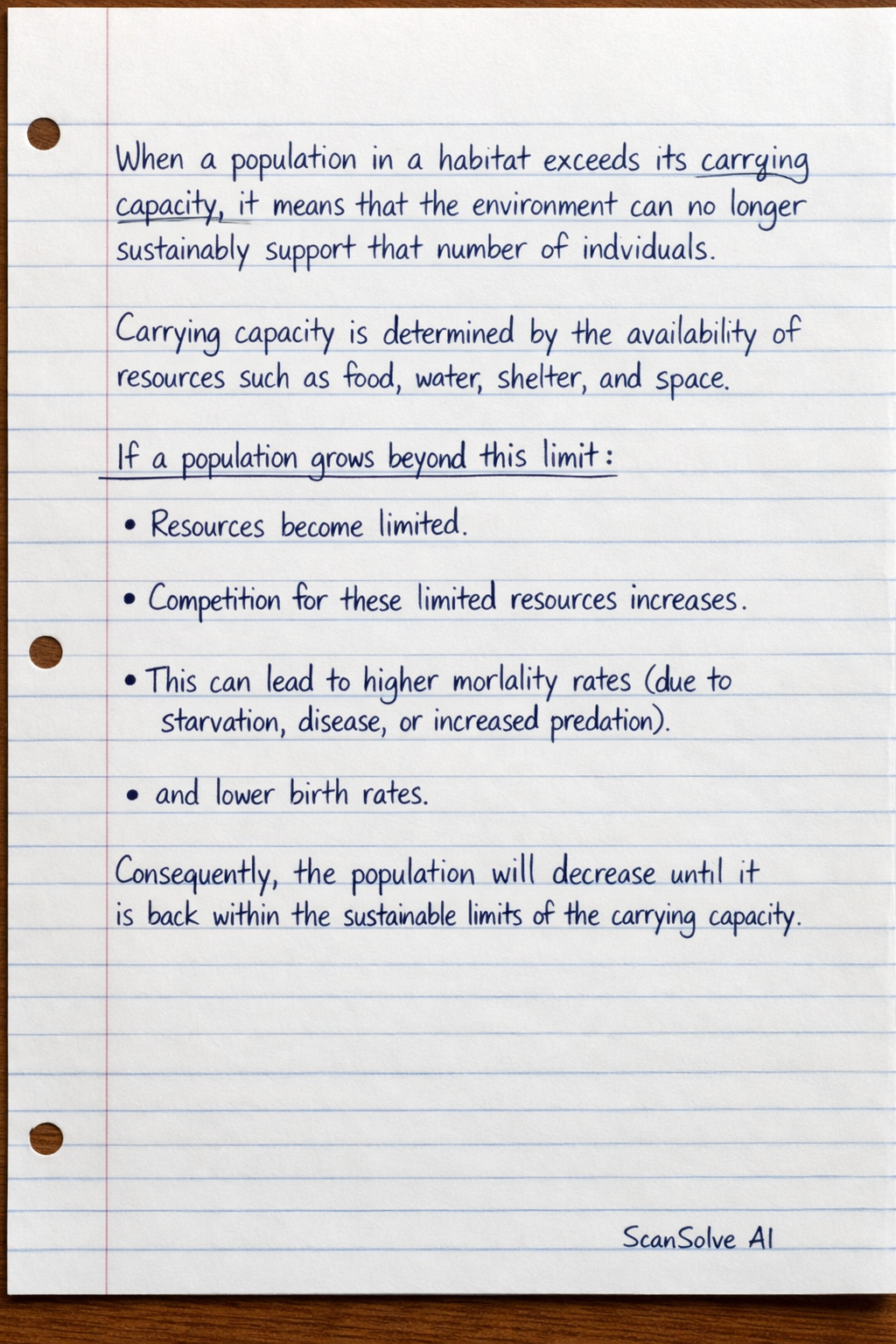
When a population in a habitat exceeds its carrying capacity, it means that the environment can no longer sustainably support that number of individuals. Carrying capacity is determined by the availability of resources such as food, water, shelter, and space. If a population grows beyond this limit: Resources become limited*. Competition for these limited resources increases. This can lead to higher mortality rates (due to starvation, disease, or increased predation) and lower birth rates. Consequently, the population will decrease* until it is back within the sustainable limits of the carrying capacity. Let's evaluate the options: A. increase due to limited resources. This is incorrect. Limited resources would cause a decrease, not an increase. B. decrease due to limited resources. This is correct. Exceeding carrying capacity leads to resource scarcity, which causes the population to decline. C. increase due to unlimited resources. This is incorrect. If a population exceeds carrying capacity, resources are by definition not unlimited; they are limited. D. decrease due to unlimited resources. This is incorrect. Unlimited resources would generally support population growth or stability, not a decrease. The final answer is B