
We read your photo as:
Explain preservation potential in palaeontology and discuss its varying potential in different environments like the littoral zone, continental environment, and limestone.
ScanSolve AI Answer
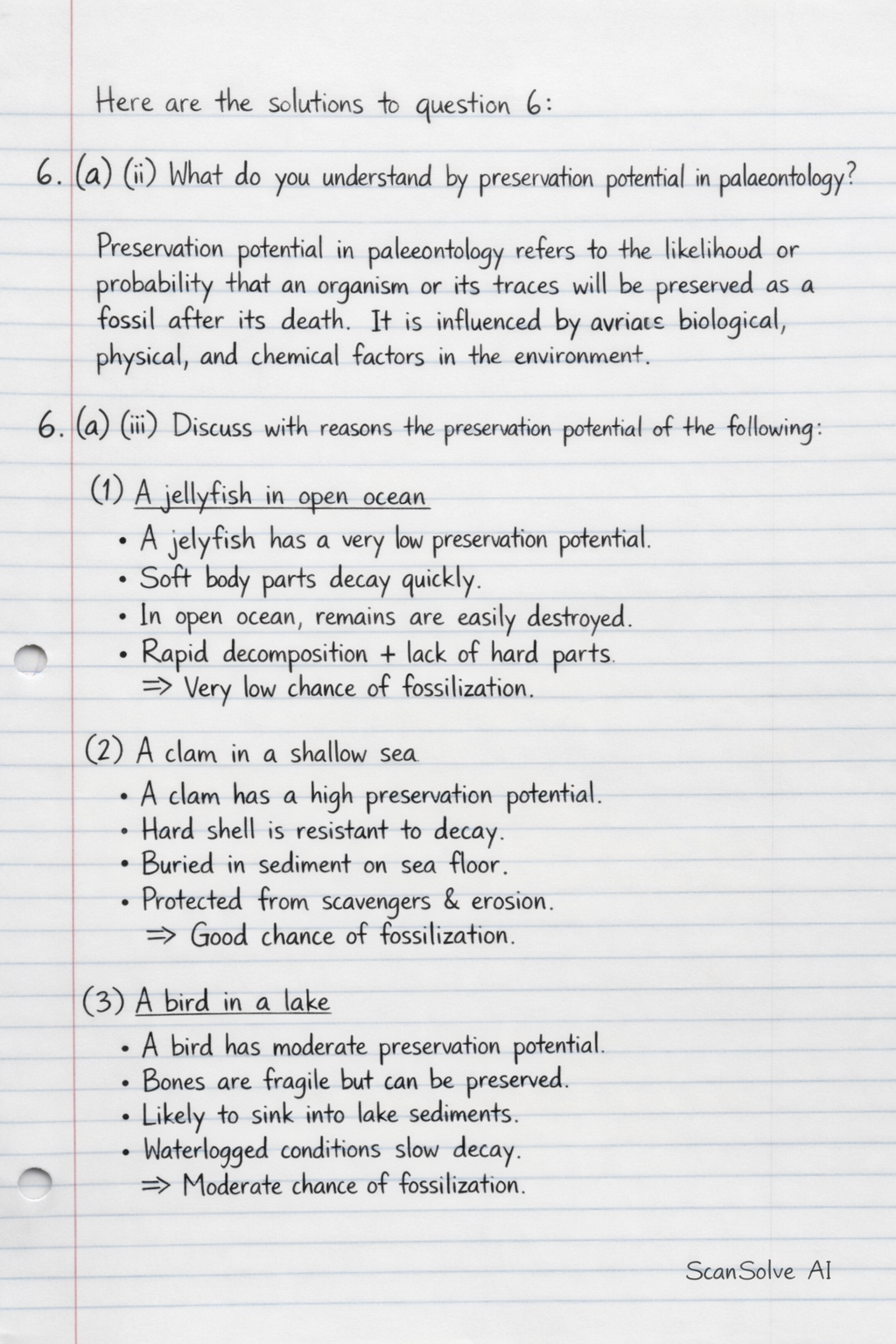
Here are the solutions to question 6:
6. (a) (i) What do you understand by preservation potential in palaeontology?
Preservation potential in palaeontology refers to the likelihood or probability that an organism or its traces will be preserved as a fossil after its death. It is influenced by various biological, physical, and chemical factors in the environment.
6. (a) (ii) Discuss with reasons the preservation potential of the following:
- Littoral zone
- Preservation Potential: Generally low.
- Reasons: The littoral zone (intertidal zone) is a high-energy environment characterized by constant wave action, tidal currents, and frequent exposure to air. This leads to rapid decomposition, scavenging by organisms, and physical abrasion or disarticulation of remains, making fossilization rare.
- Continental environment
- Preservation Potential: Generally low to moderate.
- Reasons: Continental (terrestrial) environments typically have high oxygen levels, which promote rapid decomposition by scavengers and bacteria. Erosion is also a dominant process. However, specific sub-environments like anoxic lake bottoms, swamps, or rapidly buried floodplains can offer better preservation conditions due to quick burial and reduced decomposition.
- Limestone
- Preservation Potential: High.
- Reasons: Limestone is a sedimentary rock primarily composed of calcium carbonate, often formed in marine environments. Many organisms have hard parts (shells, skeletons) made of calcium carbonate, which are readily preserved within the accumulating carbonate sediments. The stable, often low-energy marine conditions where limestone forms are conducive to burial and fossilization.
- Shale
- Preservation Potential: High.
- Reasons: Shale is a fine-grained sedimentary rock formed from mud. It typically forms in low-energy, often anoxic environments (e.g., deep marine basins, lake bottoms) where fine sediment accumulates rapidly. This rapid burial protects delicate organisms from scavengers and decomposition, and the fine-grained nature of the sediment can preserve intricate details of soft-bodied organisms or delicate hard parts.
6. (b) Define the following stratigraphic principles and state their limitations:
6. (b) (i) Principle of superposition
- Definition: In an undisturbed sequence of sedimentary rock layers, the oldest layers are at the bottom, and the youngest layers are at the top.
- Limitations: This principle does not apply to rock sequences that have been significantly deformed by folding, faulting, or overturning. It also doesn't directly apply to igneous intrusions or metamorphic rocks.
6. (b) (ii) Principle of faunal succession
- Definition: Fossil organisms succeed one another in a definite and determinable order, and therefore any time period can be recognized by its characteristic fossil content.
- Limitations: This principle relies on the presence of diagnostic fossils, which are not found in all rock types or all sedimentary layers. Some organisms have very long stratigraphic ranges, making them less useful for precise dating.
6. (b) (iii) Principle of cross-cutting relationship
- Definition: Any geological feature that cuts across another feature is younger than the feature it cuts. For example, a fault that cuts through rock layers is younger than those layers.
- Limitations: This principle only provides relative ages and requires direct observation of the cutting relationship. It can be challenging to apply in areas with complex deformation or where features are obscured.
6. (c) With examples, classify mineral deposits based on:
6. (c) (i) Time relationship with the enclosing rocks
Mineral deposits can be classified based on whether they formed at the same time as the host rock or later:
- Syngenetic Deposits: Formed contemporaneously with the enclosing host rock.
- Example: Banded Iron Formations (BIFs), which are sedimentary iron ore deposits, or placer gold deposits in ancient riverbeds.
- Epigenetic Deposits: Formed after the enclosing host rock, typically by fluids migrating through pre-existing rocks.
- Example: Gold-quartz veins that cut across older metamorphic rocks, or porphyry copper deposits where mineralization is associated with later igneous intrusions.
6. (c) (ii) Environment of formation
Mineral deposits are classified by the geological setting in which they formed:
- Magmatic Deposits: Formed directly from cooling magma.
- Example: Chromite deposits in layered igneous intrusions, or diamonds in kimberlite pipes.
- Hydrothermal Deposits: Formed by hot, aqueous fluids circulating through the Earth's crust.
- Example: Most vein-type deposits of gold, silver, copper, lead, and zinc.
- Sedimentary Deposits: Formed by precipitation from water or accumulation of detrital material.
- Example: Evaporite deposits (e.g., gypsum, halite), Banded Iron Formations, or placer deposits of gold and tin.
- Residual/Weathering Deposits: Formed by the concentration of minerals due to weathering processes.
- Example: Bauxite (aluminum ore) formed from intense weathering of aluminum-rich rocks, or lateritic nickel deposits.
6. (c) (iii) Processes of formation
Mineral deposits are classified by the specific geological processes that concentrated the valuable minerals:
- Magmatic Segregation/Crystallization: Minerals crystallize and separate from a cooling magma.
- Example: Concentration of chromite or platinum group elements in mafic and ultramafic intrusions.
- Hydrothermal Precipitation: Minerals precipitate from hot, mineral-rich fluids as they cool or react with host rocks.
- Example: Formation of sulfide minerals (e.g., chalcopyrite, galena, sphalerite) in veins or disseminated through host rocks.
- Sedimentary Accumulation/Precipitation: Minerals are concentrated by physical sorting (detrital) or chemical precipitation from water.
- Example: Placer deposits (physical accumulation of heavy minerals like gold) or evaporite deposits (chemical precipitation of salts).
- Supergene Enrichment/Residual Concentration: Weathering processes dissolve and redeposit minerals, or remove unwanted material, concentrating the valuable minerals near the surface.
- Example: Secondary copper enrichment zones above primary sulfide deposits, or bauxite formation.
Still stuck on this one?
Ask a follow-up, and the answer starts from this question.
More Biology Questions
Handwritten Step-by-Step Solution
Get this as a handwritten image on WhatsApp — like a tutor wrote it for you.
Try on WhatsApp