
We read your photo as:
Describe the procedure and precautions for an experiment investigating the effect of hydrogen peroxide concentration on catalase activity.
Biology
ScanSolve AI Answer
Here is the detailed procedure and precautions for the experiment:
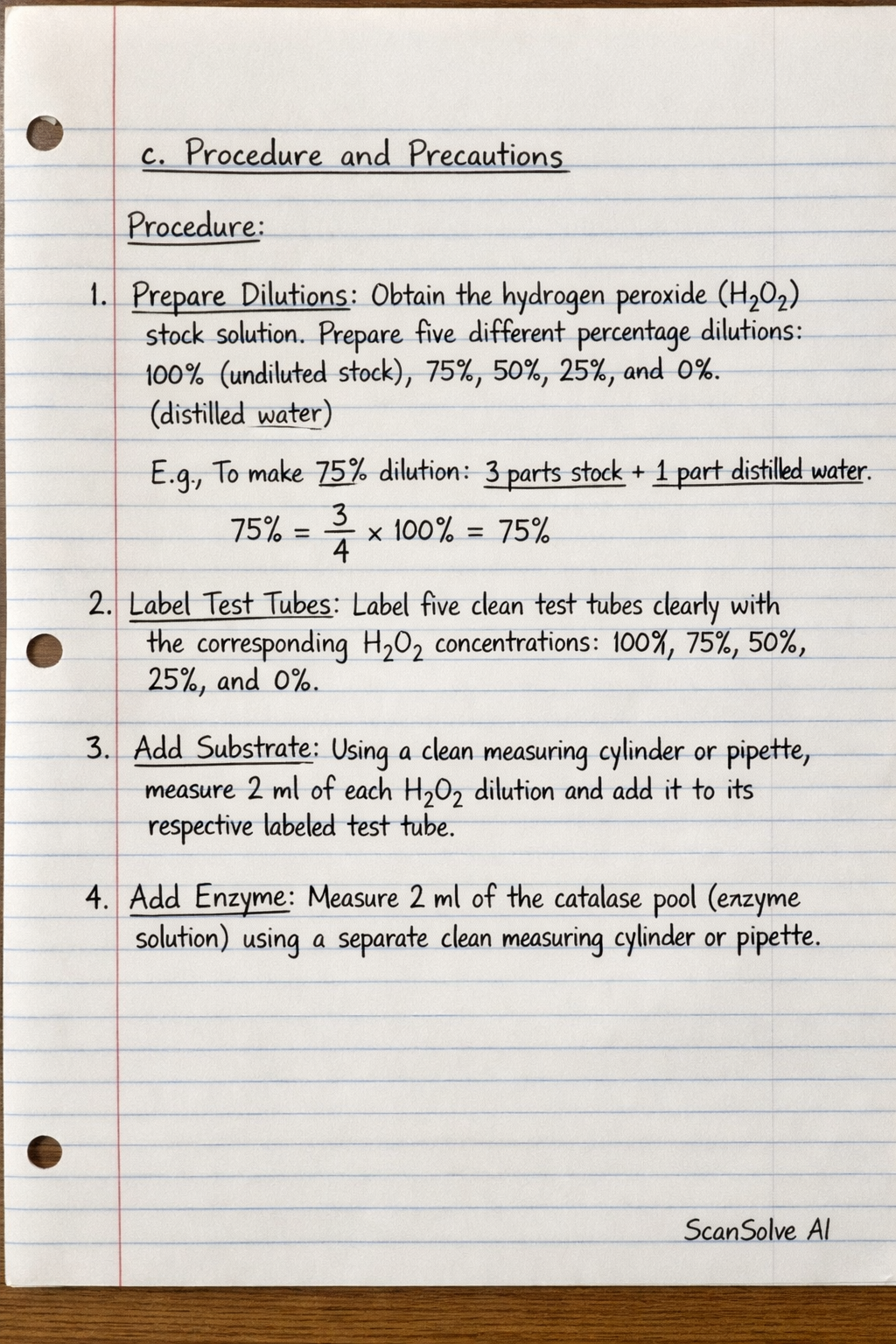
c. Procedure and Precautions
Procedure:
- Prepare Dilutions: Obtain the hydrogen peroxide () stock solution. Prepare five different percentage dilutions: 100% (undiluted stock), 75%, 50%, 25%, and 0% (distilled water). For example, to make 75% dilution, mix 3 parts stock solution with 1 part distilled water.
- Label Test Tubes: Label five clean test tubes clearly with the corresponding concentrations: 100%, 75%, 50%, 25%, and 0%.
- Add Substrate: Using a clean measuring cylinder or pipette, measure of each dilution and add it to its respective labeled test tube.
- Add Enzyme: Measure of the catalase pool (enzyme solution) using a separate clean measuring cylinder or pipette.
- Initiate Reaction and Observe: Add the of catalase pool to the test tube. Immediately start a stopwatch and gently swirl the test tube once to mix. Observe the foaming produced.
- Record Results: After a fixed time (e.g., 30 seconds or 1 minute), measure and record the height of the foam produced in the test tube. This foam height indicates the degree of enzyme activity.
- Repeat for Other Concentrations: Repeat steps 5 and 6 for the 75%, 50%, 25%, and 0% dilutions, ensuring the same fixed reaction time for each.
- Replication: Conduct at least three trials for each concentration to ensure reliability of results and calculate the average foam height.
Precautions:
- Cleanliness: Ensure all glassware (test tubes, measuring cylinders, pipettes) are thoroughly clean and dry to prevent contamination that could affect enzyme activity.
- Accurate Measurements: Use precise measuring equipment (e.g., pipettes) for adding dilutions and catalase solution to ensure consistent volumes across all test tubes.
- Constant Temperature: Perform the experiment at a constant temperature, ideally room temperature, as enzyme activity is highly sensitive to temperature fluctuations.
- Consistent Timing: Start the stopwatch immediately upon adding the enzyme to the substrate and ensure the reaction time is exactly the same for all concentrations before measuring foam height.
- Consistent Mixing: Gently swirl each test tube in the same manner and for the same duration after adding the enzyme to standardize the mixing process.
- Enzyme Handling: Handle the catalase solution carefully to avoid denaturation (e.g., keep it cool, avoid vigorous shaking) and use fresh enzyme solution.
Was this helpful?
Still stuck on this one?
Ask a follow-up, and the answer starts from this question.
Got a different question?Ask your own question
More Biology Questions
QRecord and interpret results of an experiment testing catalase activity with varying hydrogen…QDescribe the role of catalase in breaking down hydrogen peroxide and what happens when it is…QDesign and perform an investigation to determine the solution with optimal pH at which hydrogen…QDescribe the results of Experiment 4, focusing on the role of catalase concentration and substrate…QDescribe the variables and record hypothetical results for an experiment investigating catalase…
Handwritten Step-by-Step Solution
Get this as a handwritten image on WhatsApp — like a tutor wrote it for you.
Try on WhatsApp