
We read your photo as:
Which process do living organisms use to remove excess carbon dioxide from their bodies?
ScanSolve AI Answer
Step-by-step solution
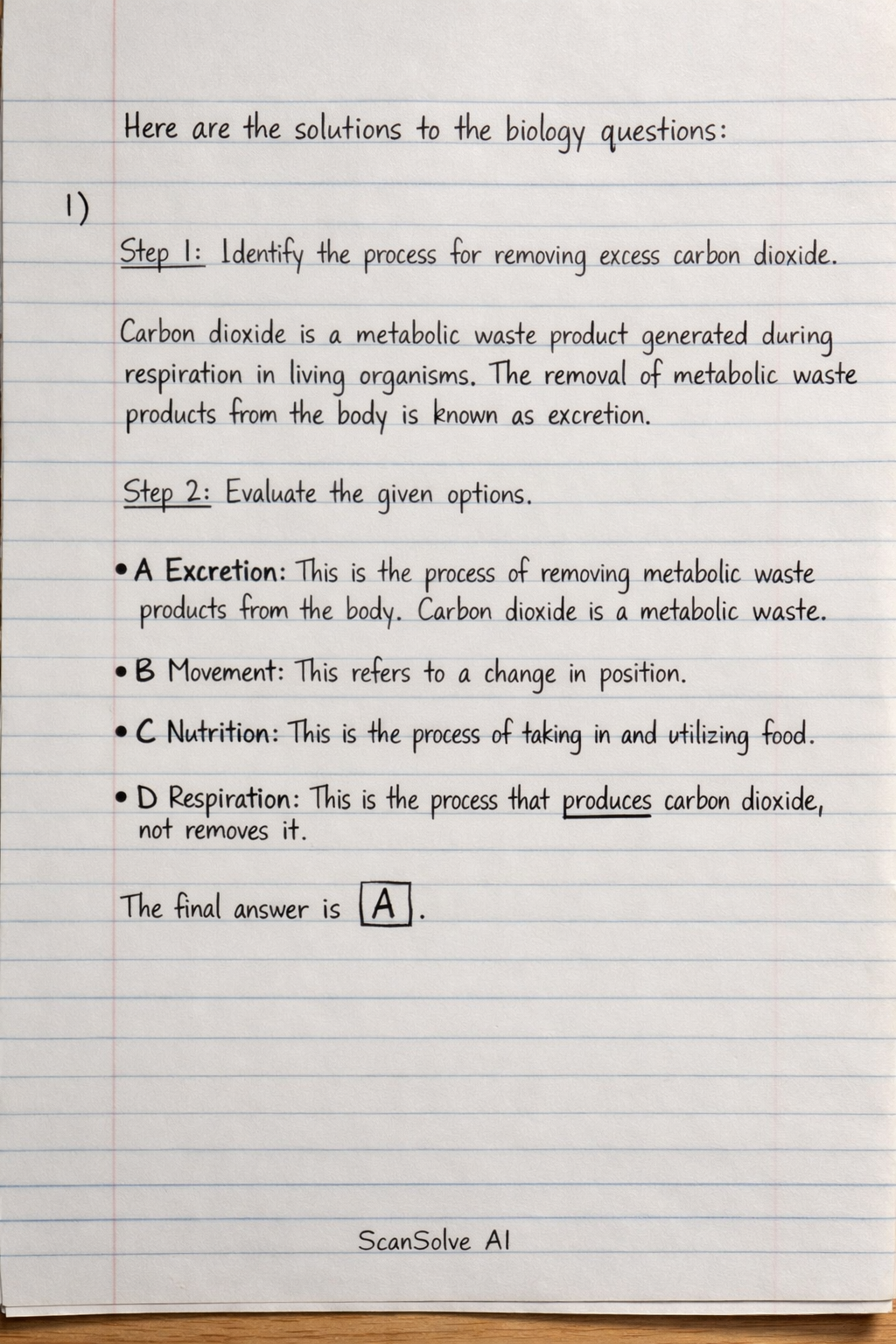
12 stepsHere are the solutions to the biology questions:
1)
Identify the process for removing excess carbon dioxide.
Carbon dioxide is a metabolic waste product generated during respiration in living organisms. The removal of metabolic waste products from the body is known as excretion.
Evaluate the given options.
- A Excretion: This is the process of removing metabolic waste products from the body. Carbon dioxide is a metabolic waste.
- B Movement: This refers to a change in position.
- C Nutrition: This is the process of taking in and utilizing food.
- D Respiration: This is the process that produces carbon dioxide, not removes it. The final answer is .
2)
Observe the features of the elephant hawk-moth in the photograph.
The moth clearly shows a segmented body, six legs (three pairs), and wings. It also has antennae.
Recall the characteristics of the given arthropod groups.
- A Arachnids: Have eight legs, two body segments, and no antennae or wings (e.g., spiders).
- B Crustaceans: Have many legs, two main body segments, and two pairs of antennae (e.g., crabs).
- C Insects: Have six legs, three body segments (head, thorax, abdomen), one pair of antennae, and usually wings (e.g., moths, butterflies).
- D Myriapods: Have many legs, segmented bodies, and one pair of antennae (e.g., centipedes).
Match the moth's features to the correct group.
The presence of six legs and wings is characteristic of insects.
The final answer is .3)
Understand the biological definition of a species.
In biology, a species is defined by the ability of its members to interbreed and produce offspring that are themselves fertile.
Evaluate the given options.
- A A group of animals that reproduce asexually: This is not the defining characteristic of a species, as many species reproduce sexually.
- B A group of organisms that can reproduce to produce fertile offspring: This is the widely accepted biological definition of a species.
- C All the plants that live in the same area at the same time: This describes a population or community, not a species.
- D A group of vertebrates that reproduce sexually: This is too specific (only vertebrates) and doesn't include the crucial "fertile offspring" aspect. The final answer is .
4)
Recall the formula for magnification.
Magnification is calculated by dividing the image length by the actual length of the object.
Substitute the given values into the formula.
Image length =
Actual length =Calculate the magnification.
The magnification is .
The final answer is .5)
Recall the distinguishing features of a plant cell.
Plant cells are characterized by the presence of a rigid cell wall outside the cell membrane and a large, permanent central vacuole. They also typically contain chloroplasts (though not all plant cells do, e.g., root cells).
Evaluate the given options based on plant cell characteristics.
- A It has a cell wall and a vacuole: These are two key distinguishing features of plant cells.
- B It has a nucleus and cytoplasm: Both plant and animal cells possess a nucleus and cytoplasm, so this does not differentiate a plant cell.
- C It has a nucleus but no chloroplasts: While a plant cell has a nucleus, the absence of chloroplasts doesn't uniquely identify it (e.g., animal cells also lack chloroplasts, and some plant cells like root cells lack them). However, the presence of a cell wall and vacuole are more definitive.
- D It has chloroplasts but no vacuole: This is incorrect, as plant cells typically have a large vacuole. The most definitive features that identify a cell as a plant cell are the presence of a cell wall and a large vacuole. The final answer is .
Still stuck on this one?
Ask a follow-up, and the answer starts from this question.
More Biology Questions
Handwritten Step-by-Step Solution
Get this as a handwritten image on WhatsApp — like a tutor wrote it for you.
Try on WhatsApp