
We read your photo as:
Which processes are carried out by all living organisms? A) Egestion, Excretion, Reproduction B) Excretion, Reproduction, Respiration C) Reproduction, Respiration, Egestion D) Egestion, Respiration, E
ScanSolve AI Answer
Answer
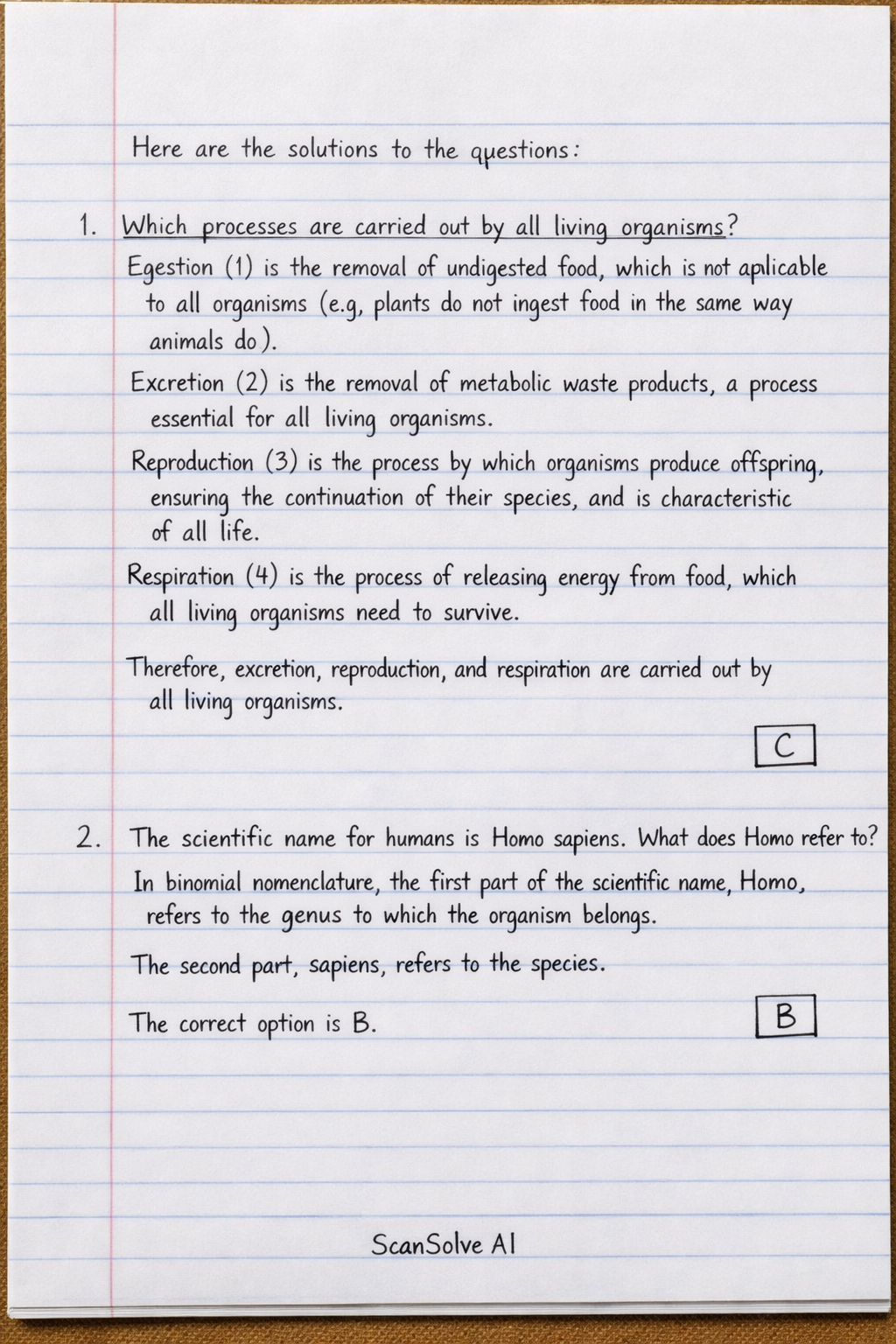
Here are the solutions to the questions:
1. Which processes are carried out by all living organisms?
- Egestion (1) is the removal of undigested food, which is not applicable to all organisms (e.g., plants do not ingest food in the same way animals do).
- Excretion (2) is the removal of metabolic waste products, a process essential for all living organisms.
- Reproduction (3) is the process by which organisms produce offspring, ensuring the continuation of their species, and is characteristic of all life.
- Respiration (4) is the process of releasing energy from food, which all living organisms need to survive.
Therefore, excretion, reproduction, and respiration are carried out by all living organisms.
The correct option is C.
2. The scientific name for humans is Homo sapiens. What does Homo refer to?
In binomial nomenclature, the first part of the scientific name, Homo, refers to the genus to which the organism belongs. The second part, sapiens, refers to the species.
The correct option is B.
3. Which row is correct for arthropod classification?
Let's evaluate each row:
- A arachnids: Arachnids (e.g., spiders) do not have antennae, have 2 body parts (cephalothorax and abdomen), and 8 legs. Row A states "antennae present: no", "number of body parts: 2", "number of legs: 6". The number of legs is incorrect.
- B crustaceans: Crustaceans (e.g., crabs) have antennae, typically 2 or 3 body parts, and a variable number of legs (often 10 or more). Row B states "antennae present: yes", "number of body parts: 3", "number of legs: 8". This is generally incorrect for crustaceans.
- C insects: Insects (e.g., flies) have antennae, 3 body parts (head, thorax, abdomen), and 6 legs (three pairs attached to the thorax). Row C states "antennae present: yes", "number of body parts: 3", "number of legs: 6". This row is correct.
- D myriapods: Myriapods (e.g., centipedes) have antennae, 2 body parts (head and trunk) or many segments, and many pairs of legs (more than 6). Row D states "antennae present: no", "number of body parts: 2", "number of legs: 4". This is incorrect.
The correct option is C.
4. In a mesophyll cell, where are chloroplasts found?
Chloroplasts are the organelles responsible for photosynthesis in plant cells. They are suspended within the cytoplasm of the cell.
- A: The space between the cell wall and cell membrane is not where chloroplasts are found.
- B: Chloroplasts are located in the cytoplasm.
- C: The nucleus contains genetic material, not chloroplasts.
- D: The vacuole stores water and other substances, but not chloroplasts.
The correct option is B.
Try one yourself
A new problem that tests the same skill.
Still stuck on this one?
Ask a follow-up, and the answer starts from this question.
More Biology Questions
Handwritten Step-by-Step Solution
Get this as a handwritten image on WhatsApp — like a tutor wrote it for you.
Try on WhatsApp