

This biology question covers important biological concepts and processes. The step-by-step explanation below helps you understand the underlying mechanisms and reasoning.
ScanSolve AI Answer
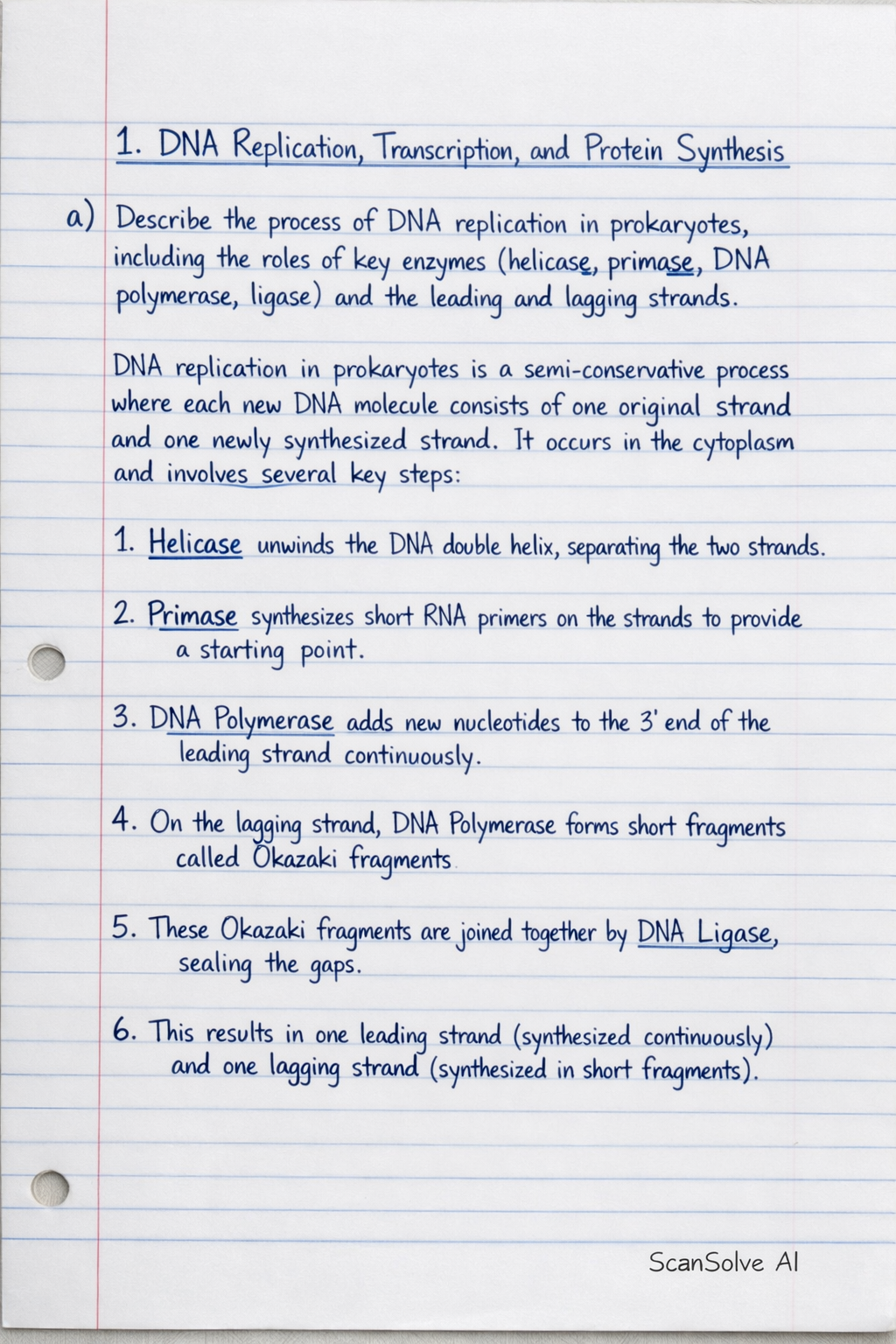
1. DNA Replication, Transcription, and Protein Synthesis a) Describe the process of DNA replication in prokaryotes, including the roles of key enzymes (helicase, primase, DNA polymerase, ligase) and the leading and lagging strands. DNA replication in prokaryotes is a semi-conservative process where each new DNA molecule consists of one original strand and one newly synthesized strand. It occurs in the cytoplasm and involves several key steps: 1. Initiation: Replication begins at a specific origin of replication (oriC). DnaA proteins bind to oriC, causing the DNA to unwind slightly. Helicase (DnaB) then binds and unwinds the DNA double helix, separating the two strands and forming replication forks. Single-strand binding proteins stabilize the separated strands. 2. Elongation: Primase* synthesizes short RNA primers on both template strands, providing a free 3'-hydroxyl group for DNA polymerase to start synthesis. DNA polymerase III* then adds deoxyribonucleotides to the 3' end of the primer, synthesizing new DNA. Leading Strand: Synthesized continuously in the 5' 3' direction, following the replication fork, requiring only one primer. Lagging Strand: Synthesized discontinuously in short fragments called Okazaki fragments* in the 5' 3' direction, moving away from the replication fork. Each Okazaki fragment requires a new primer. DNA polymerase I* removes the RNA primers and replaces them with DNA nucleotides. DNA ligase* then joins the Okazaki fragments on the lagging strand by forming phosphodiester bonds, sealing the nicks. 3. Termination: Replication forks meet at a termination site, and the two newly synthesized circular DNA molecules are separated. b) Describe the role of RNA polymerase II, and how is transcription regulated? RNA polymerase II is a multi-subunit enzyme in eukaryotes responsible for synthesizing messenger RNA (mRNA) precursors and some small RNAs. It transcribes all protein-coding genes, producing heterogeneous nuclear RNA (hnRNA) which is then processed into mature mRNA. Transcription regulation in eukaryotes is complex and involves several mechanisms: Promoters: Specific DNA sequences upstream of a gene where RNA polymerase II and general transcription factors bind to initiate transcription. Enhancers and Silencers: Distant DNA sequences that bind specific transcription factors* (activators or repressors) to either increase (enhancers) or decrease (silencers) the rate of transcription. These elements can be located far from the gene and still influence its expression through DNA looping. Chromatin Remodeling: The accessibility of DNA to transcription machinery is regulated by changes in chromatin structure. Histone acetylation generally loosens chromatin, making DNA more accessible, while histone deacetylation* compacts it, repressing transcription. DNA Methylation: Methylation of cytosine bases in CpG islands near gene promoters typically leads to gene silencing by attracting proteins that condense chromatin. Post-transcriptional Regulation: After transcription, mRNA stability, splicing, and transport can also be regulated to control gene expression. c) Discuss the 3 basic steps in protein synthesis. Protein synthesis, or translation, occurs in three basic steps: 1. Initiation: The small ribosomal subunit binds to the mRNA molecule near the start codon (AUG). An initiator tRNA carrying methionine (or formylmethionine in prokaryotes) binds to the start codon. The large ribosomal subunit then joins, forming the complete initiation complex, with the initiator tRNA positioned in the P-site. 2. Elongation: This step involves the sequential addition of amino acids to the growing polypeptide chain. A new aminoacyl-tRNA, complementary to the codon in the A-site, binds to the ribosome. A peptide bond* is formed between the amino acid in the A-site and the polypeptide chain in the P-site, catalyzed by peptidyl transferase activity of the large ribosomal subunit. The ribosome then translocates, moving the mRNA by one codon. The tRNA with the growing polypeptide chain moves from the A-site to the P-site, and the now uncharged tRNA moves from the P-site to the E-site (exit site) and is released. 3. Termination: Elongation continues until a stop codon (UAA, UAG, or UGA) enters the A-site. There are no tRNAs for stop codons. Instead, release factors bind to the stop codon, causing the hydrolysis of the bond between the polypeptide and the tRNA in the P-site. This leads to the release of the completed polypeptide chain and the dissociation of the ribosomal subunits and mRNA. 2. Diabetes Mellitus a) Define Diabetes mellitus, write on two major types and compare diabetes mellitus with diabetes insipidus. Diabetes mellitus is a chronic metabolic disorder characterized by hyperglycemia (high blood glucose levels) resulting from defects in insulin secretion, insulin action, or both. Two Major Types of Diabetes Mellitus: Type 1 Diabetes Mellitus (T1DM): An autoimmune disease characterized by the destruction of pancreatic beta cells, leading to absolute insulin deficiency. It typically has an abrupt onset, often in childhood or adolescence, and requires lifelong insulin therapy. Type 2 Diabetes Mellitus (T2DM): Characterized by insulin resistance (cells do not respond effectively to insulin) and/or a progressive decline in insulin secretion by the pancreatic beta cells. It usually develops in adulthood, is often associated with obesity and lifestyle factors, and can initially be managed with diet, exercise, and oral medications, though insulin may eventually be required. Comparison of Diabetes Mellitus with Diabetes Insipidus: Diabetes Mellitus: Involves problems with insulin and glucose metabolism*, leading to high blood glucose. Symptoms include polyuria (frequent urination), polydipsia (increased thirst), polyphagia (increased hunger), and weight loss. Diabetes Insipidus: A rare disorder characterized by polyuria and polydipsia, but it is caused by a deficiency of antidiuretic hormone (ADH) (central DI) or the kidneys' inability to respond to ADH (nephrogenic DI). It involves water balance* rather than glucose metabolism, and blood glucose levels are normal. b) Define the following terms and relate them to diabetes mellitus. (i) Glycogenolysis (ii) Glycolysis (iii) Gluconeogenesis (i) Glycogenolysis: The biochemical process by which glycogen* (stored glucose) is broken down into glucose-1-phosphate and then to glucose, primarily in the liver and muscles. Relation to Diabetes Mellitus: In diabetes, particularly T2DM, uncontrolled glycogenolysis in the liver contributes to hyperglycemia. The liver continues to release glucose from glycogen stores even when blood glucose is already high, due to impaired insulin signaling or glucagon excess. (ii) Glycolysis: The metabolic pathway that breaks down glucose* into pyruvate, producing a small amount of ATP and NADH. It is the first step in cellular respiration. Relation to Diabetes Mellitus: In diabetes, impaired glucose uptake by insulin-sensitive tissues (due to insulin resistance or deficiency) leads to reduced rates of glycolysis in these cells, contributing to high blood glucose levels. Cells cannot efficiently utilize glucose for energy. (iii) Gluconeogenesis: The metabolic pathway that synthesizes glucose* from non-carbohydrate precursors, such as lactate, amino acids, and glycerol, primarily in the liver and kidneys. Relation to Diabetes Mellitus: In diabetes, especially T2DM, gluconeogenesis is often inappropriately elevated. Insulin resistance in the liver fails to suppress glucose production, and increased glucagon levels stimulate gluconeogenesis, significantly contributing to fasting and post-prandial hyperglycemia. 3. Apoptosis, Necrosis, Free Radicals, and Atherosclerosis a) Compare and contrast apoptosis and necrosis with respect to morphology, mechanism and physiological significance. Explain the role of caspases in apoptosis. How is their activation regulated? Comparison and Contrast of Apoptosis and Necrosis: | Feature | Apoptosis (Programmed Cell Death) | Necrosis (Accidental Cell Death) | | :---------------------- | :-------------------------------------------------------------- | :---------------------------------------------------------------- | | Morphology | Cell shrinkage, chromatin condensation, nuclear fragmentation, blebbing, formation of apoptotic bodies. Intact cell membrane. | Cell swelling, rupture of plasma membrane, organelle swelling, lysis. | | Mechanism | Active, energy-dependent process. Regulated by specific signaling pathways. | Passive, uncontrolled process. Caused by acute injury (ischemia, toxins). | | Physiological Significance | Physiological (e.g., embryonic development, tissue homeostasis, removal of damaged cells). | Pathological (e.g., inflammation, tissue damage). | | Inflammation | No inflammation. Apoptotic bodies are phagocytosed. | Elicits strong inflammatory response. | | DNA Degradation | Ordered, internucleosomal DNA fragmentation. | Random DNA degradation. | Role of Caspases in Apoptosis: Caspases (cysteine-aspartic proteases) are a family of proteases that play a central role in apoptosis. They are synthesized as inactive pro-enzymes (procaspases) and are activated by proteolytic cleavage. Once activated, caspases cleave specific target proteins, leading to the morphological and biochemical changes characteristic of apoptosis. Initiator Caspases: (e.g., Caspase-8, Caspase-9) are activated first and initiate the apoptotic cascade. Effector Caspases: (e.g., Caspase-3, Caspase-6, Caspase-7) are activated by initiator caspases and carry out the proteolytic cleavage of cellular substrates, leading to cell dismantling. Regulation of Caspase Activation: Caspase activation is tightly regulated by two main pathways: 1. Extrinsic Pathway (Death Receptor Pathway): Initiated by the binding of death ligands (e.g., FasL, TNF-) to cell surface death receptors (e.g., Fas, TNFR1). This binding recruits adaptor proteins (e.g., FADD) and procaspase-8, forming the Death-Inducing Signaling Complex (DISC). Procaspase-8 is then activated by autoproteolysis, leading to the activation of effector caspases. 2. Intrinsic Pathway (Mitochondrial Pathway): Triggered by intracellular stress (e.g., DNA damage, growth factor withdrawal). This leads to the release of pro-apoptotic proteins (e.g., cytochrome c) from the mitochondria into the cytoplasm. Cytochrome c binds to Apaf-1, forming the apoptosome, which recruits and activates procaspase-9. Activated caspase-9 then cleaves and activates effector caspases. Both pathways converge on the activation of effector caspases, leading to the execution of apoptosis. Anti-apoptotic proteins (e.g., Bcl-2, Bcl-XL) and pro-apoptotic proteins (e.g., Bax, Bak) of the Bcl-2 family regulate the intrinsic pathway. b) A 50 year old man with a history of excessive alcohol consumption, chronic smoking, atherosclerosis and a diet low in fruits and vegetables is diagnosed with colorectal cancer. Histopathological analysis shows DNA damage and increased oxidative stress markers in the tumor tissue. (i) Explain how free radicals contribute to carcinogenesis. (ii) Discuss the role of antioxidants in cancer prevention and their limitation in cancer therapy. (i) How free radicals contribute to carcinogenesis: Free radicals are highly reactive molecules with unpaired electrons, such as reactive oxygen species (ROS) and reactive nitrogen species (RNS). They are generated endogenously during normal metabolism (e.