
We read your photo as:
Explain the processes of excretion and grafting, including the organs involved, benefits, and importance of scientific methods.
ScanSolve AI Answer
Step-by-step solution
15 steps1. (a) (i)
Identify three substances excreted from the human body.
- Urine
- Sweat
- Carbon dioxide
- Faeces (though technically egested, often included in excretion contexts)
- Urea
- Excess salts
- Water vapor
Answer:
The three substances excreted from the human body are:- Urea
- Carbon dioxide
- Water
1. (a) (ii)
Identify two organs that perform excretory functions.
Answer:
Two organs in humans which perform excretory functions are:- Kidneys
- Lungs
- Skin (sweat glands)
- Liver (produces urea)
1. (b) (i)
Define grafting in crop production.
Answer:
Grafting is a horticultural technique where tissues of plants are joined so as to continue their growth together. The upper part of the combined plant (the scion) grows on the root system of the lower part (the rootstock).1. (b) (ii)
State three benefits of grafting.
Answer:
Three benefits of grafting are:- To combine desirable characteristics of two plants (e.g., disease resistance from rootstock and high yield from scion).
- To repair damaged trees.
- To propagate plants that do not root easily from cuttings.
- To change varieties of fruit trees.
- To speed up fruiting or flowering.
1. (c) (i)
State two ways scientific methods are important.
Answer:
Two ways in which scientific methods are important are:- They provide a systematic approach to investigate phenomena, ensuring reliability and validity of results.
- They allow for the development of new technologies and solutions to real-world problems.
1. (c) (ii)
Give reasons for each laboratory rule.
Answer:
Reasons for the laboratory rules:- (α) Do not wear rubber slippers to the laboratory: Rubber slippers offer inadequate protection against chemical spills or falling objects, and they can be slippery, leading to accidents.
- (β) Close all taps before leaving the laboratory: To prevent water wastage and potential flooding.
- (γ) Spilled liquids must be cleaned immediately: To prevent slips, falls, and contamination, especially if the liquid is corrosive or toxic.
1. (d) (i)
Explain earthing in household wiring.
Answer:
Earthing in household wiring is the process of connecting the metal casing of an electrical appliance to the earth via a low-resistance wire. This provides a safe path for current to flow directly to the earth in case of a fault, preventing electric shock.1. (d) (ii)
Name two sources of electric power generation.
Answer:
Two sources of electric power generation are:- Thermal power plants (e.g., coal, natural gas)
- Hydroelectric power plants
- Nuclear power plants
- Solar power plants
- Wind power plants
2. (a)
Give four reasons to discourage the use of chemical fertilizers.
Answer:
Four reasons why farmers should be discouraged from using chemical fertilizers are:- They can lead to water pollution (eutrophication) when runoff enters water bodies.
- Excessive use can degrade soil structure and reduce soil fertility over time.
- They can harm beneficial soil microorganisms.
- They are often expensive, increasing production costs for farmers.
- They can contribute to greenhouse gas emissions (e.g., nitrous oxide from nitrogen fertilizers).
2. (b) (i)
Define temporary hard water.
Answer:
Temporary hard water is water that contains dissolved hydrogen carbonates of calcium and magnesium, which can be removed by boiling.2. (b) (ii)
Write the chemical equation for softening temporary hard water by heating.
Answer:
When temporary hard water containing calcium hydrogen carbonate is heated, it decomposes to form insoluble calcium carbonate, carbon dioxide, and water, thus removing the hardness.Similarly for magnesium hydrogen carbonate:
Note: MgCO is slightly soluble, but often precipitates as Mg(OH) upon further heating.
2. (c) (i)
Define a lever.
Answer:
A lever is a simple machine consisting of a rigid bar or beam that pivots around a fixed point called a fulcrum, used to multiply force or change the direction of force.2. (c) (ii)
Explain mechanical advantage and velocity ratio.
Answer:
- (α) Mechanical advantage: It is the ratio of the output force (load) to the input force (effort) in a machine. It indicates how much a machine multiplies the applied force.
- (β) Velocity ratio: It is the ratio of the distance moved by the effort to the distance moved by the load in a machine. It is a theoretical value that depends only on the geometry of the machine.
2. (d) (i)
Define food processing.
Answer:
Food processing is the transformation of raw ingredients into food, or of food into other forms, through physical or chemical means. It involves various techniques to prepare food for consumption, storage, or further use.2. (d) (ii)
State two advantages and one disadvantage of food processing.
Answer:
- (α) Two advantages of food processing:
- Increases shelf life and prevents spoilage, reducing food waste.
- Makes food more convenient to prepare and consume.
- Adds variety to the diet.
- Makes food safe for consumption by destroying harmful microorganisms.
- (β) One disadvantage of food processing:
- Can lead to a loss of nutrients (vitamins, minerals) during processing.
- Processed foods often contain high levels of salt, sugar, or unhealthy fats.
- May involve the use of artificial additives, preservatives, or colorings.
- (α) Two advantages of food processing:
Still stuck on this one?
Ask a follow-up, and the answer starts from this question.
More Biology Questions
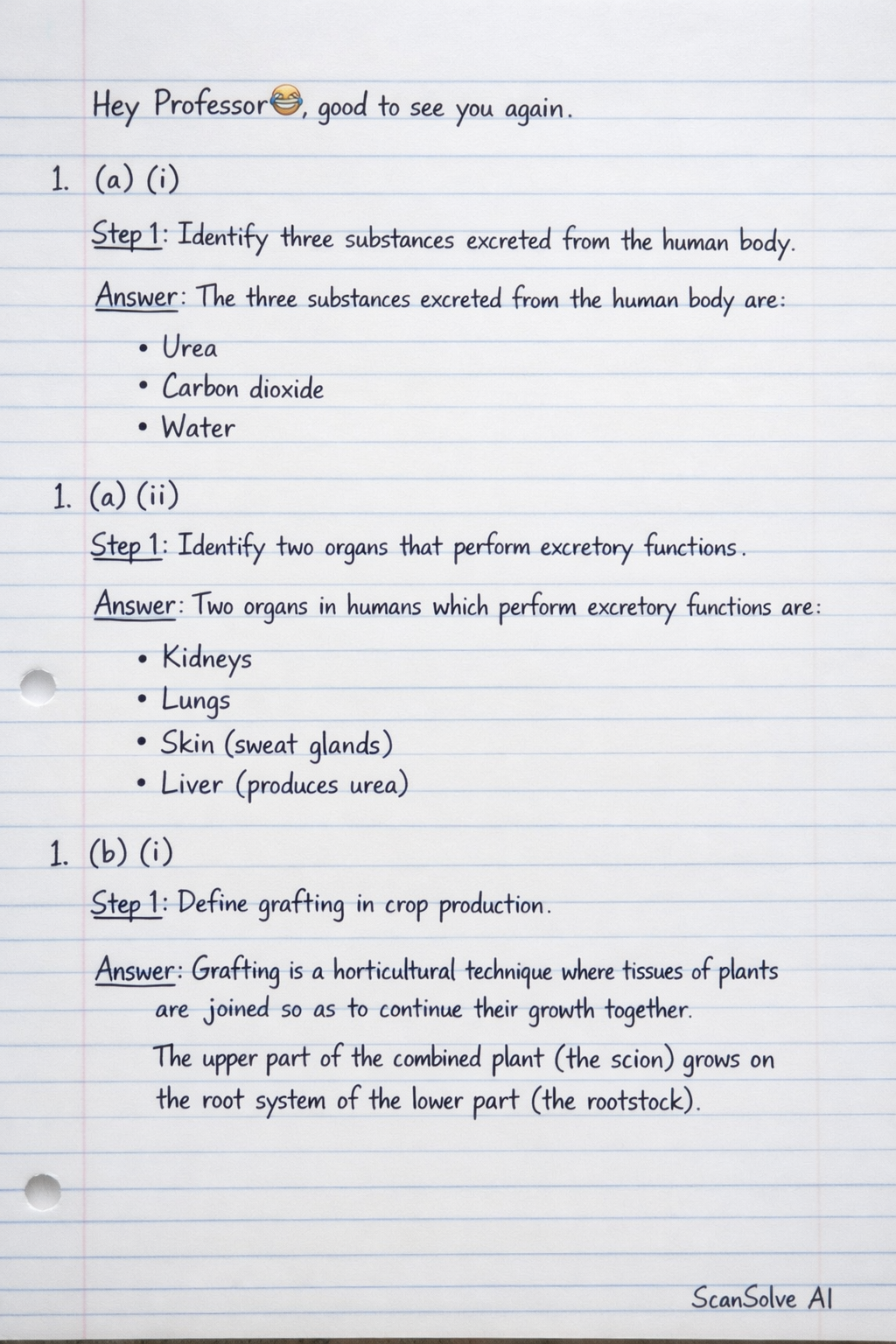
Handwritten Step-by-Step Solution
Get this as a handwritten image on WhatsApp — like a tutor wrote it for you.
Try on WhatsApp