
We read your photo as:
Describe the production processes for cheese, yoghurt, and the antibiotic penicillin, highlighting the key biological or chemical agents involved.
ScanSolve AI Answer
here are the descriptions for 9. c):
-
9. c) (i) Cheese production: This process involves using lactic acid bacteria to ferment lactose in milk, producing lactic acid. Rennet (an enzyme) is then added to coagulate the milk proteins (casein), forming curds. The curds are separated from the whey, pressed, salted, and aged to develop flavor and texture.
-
9. c) (ii) Yoghurt production: Yoghurt is produced by fermenting milk with specific lactic acid bacteria, primarily Lactobacillus bulgaricus and Streptococcus thermophilus. These bacteria convert lactose into lactic acid, which causes the milk proteins to coagulate and thicken, giving yoghurt its characteristic texture and tangy flavor.
-
9. c) (iii) Production of the antibiotic penicillin: Penicillin is produced through the fermentation of the Penicillium chrysogenum fungus in large bioreactors. The fungus is grown in a nutrient-rich medium under controlled conditions, where it synthesizes and secretes penicillin. After fermentation, the penicillin is extracted and purified from the culture broth.
Still stuck on this one?
Ask a follow-up, and the answer starts from this question.
More Biology Questions
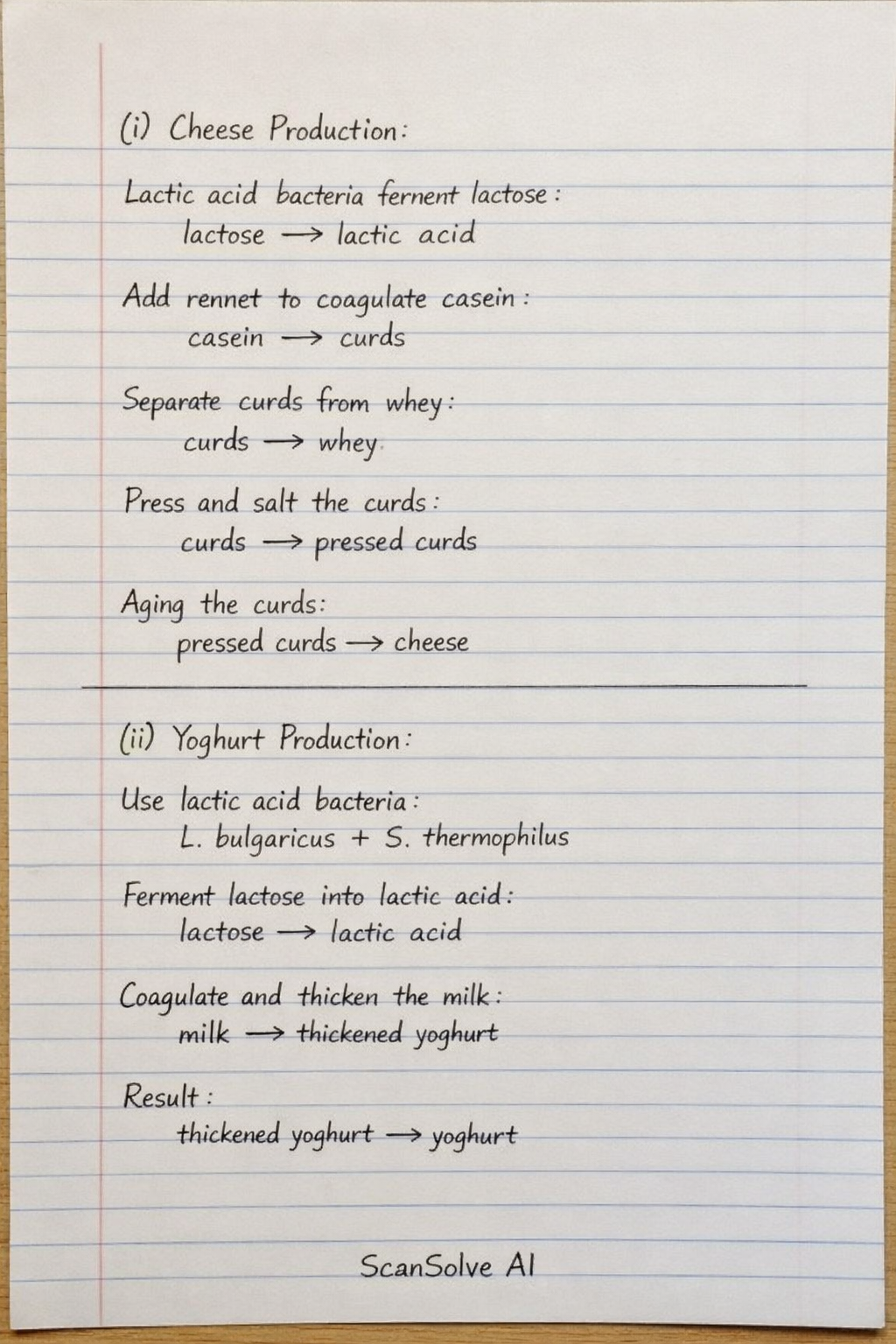
Handwritten Step-by-Step Solution
Get this as a handwritten image on WhatsApp — like a tutor wrote it for you.
Try on WhatsApp