
We read your photo as:
Propose a hypothesis and experimental procedure to test the effect of microbial growth on milk quality using a redox indicator.
Biology
ScanSolve AI Answer
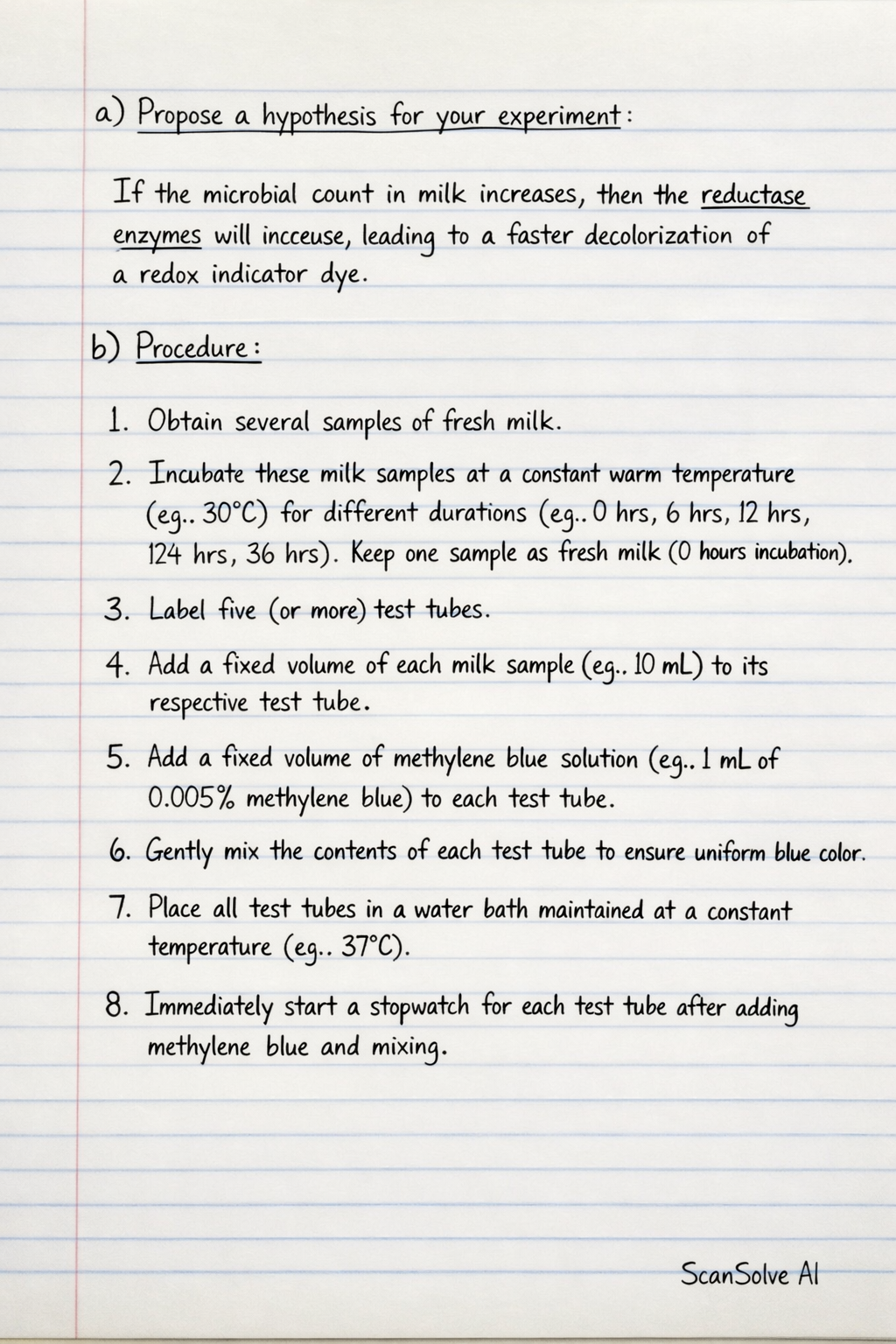
a) Propose a hypothesis for your experiment:
If the microbial count in milk increases, then the reductase enzymes will increase, leading to a faster decolorization of a redox indicator dye.
b) Procedure:
- Obtain several samples of fresh milk.
- Incubate these milk samples at a constant warm temperature (e.g., ) for different durations (e.g., 0 hours, 6 hours, 12 hours, 24 hours, 36 hours) to create varying microbial counts. Keep one sample as fresh milk (0 hours incubation).
- Label five (or more) test tubes.
- Add a fixed volume of each milk sample (e.g., ) to its respective test tube.
- Add a fixed volume of methylene blue solution (e.g., of 0.005% methylene blue) to each test tube.
- Gently mix the contents of each test tube to ensure uniform blue color.
- Place all test tubes in a water bath maintained at a constant temperature (e.g., ).
- Immediately start a stopwatch for each test tube after adding methylene blue and mixing.
- Record the time taken for the methylene blue in each test tube to completely decolorize (turn colorless).
- Repeat the experiment at least three times for each milk sample to ensure reliability and calculate the average decolorization time.
Was this helpful?
Still stuck on this one?
Ask a follow-up, and the answer starts from this question.
Got a different question?Ask your own question
More Biology Questions
QDesign an experiment to investigate the relationship between microbial count and reductase activity…QSuggest a hypothesis and describe the procedure for an experiment investigating the effect of…QInference: Stale milk contains a higher concentration of microorganisms, which produce reductase…QExplain the expected results of the methylene blue reductase test at 100% dilution and what…QDesign an experiment to confirm that the decolorization of methylene blue in skim milk is catalyzed…
Handwritten Step-by-Step Solution
Get this as a handwritten image on WhatsApp — like a tutor wrote it for you.
Try on WhatsApp