
We read your photo as:
Propose a hypothesis for an experiment involving enzyme activity, identify variables (independent, dependent, controlled), and describe the procedure and precautions.
ScanSolve AI Answer
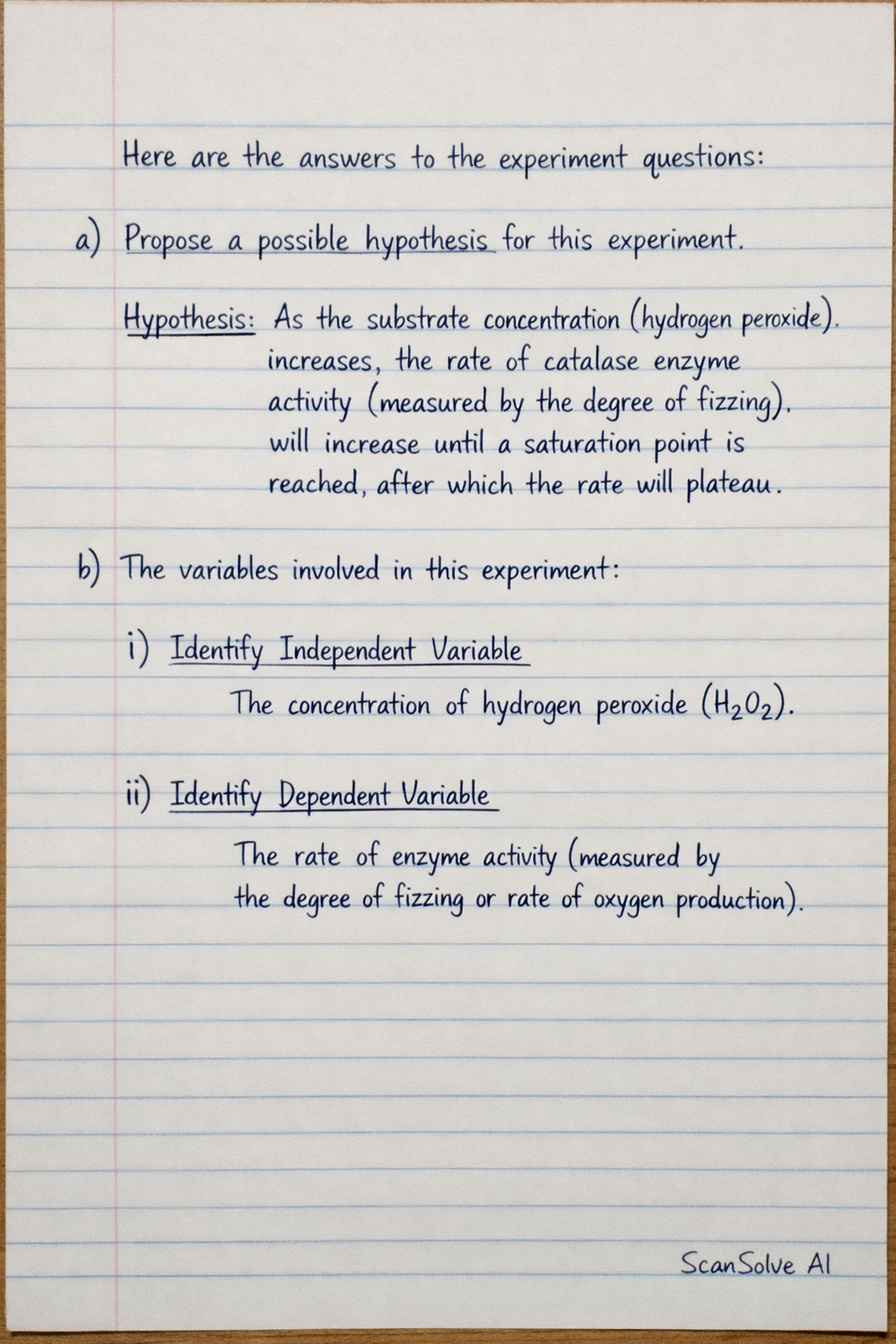
Here are the answers to the experiment questions:
a) Propose a possible hypothesis for this experiment.
Hypothesis: As the substrate concentration (hydrogen peroxide) increases, the rate of catalase enzyme activity (measured by the degree of fizzing) will increase until a saturation point is reached, after which the rate will plateau.
b) The variables involved in this experiment
-
i) Identify Independent Variable (the variable or factor being altered in this experiment) The concentration of hydrogen peroxide (HO).
-
ii) Identify Dependent Variable (the variable or factor being tested or measured) The rate of enzyme activity (measured by the degree of fizzing or rate of oxygen production).
-
iii) Identify two Controlled variables (variable or factor being kept constant during experiment)
- The volume and concentration of the catalase yeast solution added to each test tube.
- The temperature at which the experiment is conducted.
- The pH of the reaction mixture.
- The volume of hydrogen peroxide added to each test tube (2 ml). (Choose any two from the above)
c) Describe the procedure in details and precaution to test your hypothesis.
Procedure:
- Prepare Substrate Dilutions: Using the provided hydrogen peroxide stock solution, prepare five different percentage dilutions: 100%, 75%, 50%, 25%, and 0%. Use distilled water for dilution.
- Set Up Test Tubes: Label five clean test tubes A, B, C, D, and E.
- Add Substrate: To each test tube, add 2 ml of the respective hydrogen peroxide dilution:
- Test tube A: 2 ml of 100% HO
- Test tube B: 2 ml of 75% HO
- Test tube C: 2 ml of 50% HO
- Test tube D: 2 ml of 25% HO
- Test tube E: 2 ml of 0% HO (control)
- Add Enzyme: To each test tube, add 2 ml of the prepared catalase yeast solution.
- Observe and Record: Immediately after adding the enzyme, observe and record the "degree of fizzing" (rate of oxygen gas production) in each test tube. This can be done qualitatively (e.g., on a scale of 0-5) or quantitatively (e.g., by measuring the volume of gas produced over a fixed time using a gas syringe).
- Repeat: Repeat the experiment for each concentration at least three times to ensure reliability and calculate average results.
Precautions:
- Constant Temperature: Conduct the experiment in a water bath at a constant temperature (e.g., 25°C or 37°C) to prevent temperature fluctuations from affecting enzyme activity.
- Constant pH: Ensure the pH of all solutions is maintained at an optimal level for catalase (e.g., pH 7) using buffer solutions if necessary.
- Consistent Enzyme Amount: Use the exact same volume (2 ml) and concentration of catalase yeast solution in each test tube.
- Immediate Observation: Begin recording observations immediately after adding the enzyme, as the reaction starts quickly.
- Clean Apparatus: Use clean and dry test tubes and measuring equipment to avoid contamination.
- Safety: Wear safety goggles when handling hydrogen peroxide.
- Accurate Measurements: Use precise measuring tools (e.g., pipettes) for accurate volumes of solutions.
Still stuck on this one?
Ask a follow-up, and the answer starts from this question.
More Biology Questions
Handwritten Step-by-Step Solution
Get this as a handwritten image on WhatsApp — like a tutor wrote it for you.
Try on WhatsApp