
We read your photo as:
Provide a diagram of a moss plant, labeling the sporophyte and gametophyte generations, and list three characteristics of Bryophyta. Also, describe three characteristics used to classify arthropods an
ScanSolve AI Answer
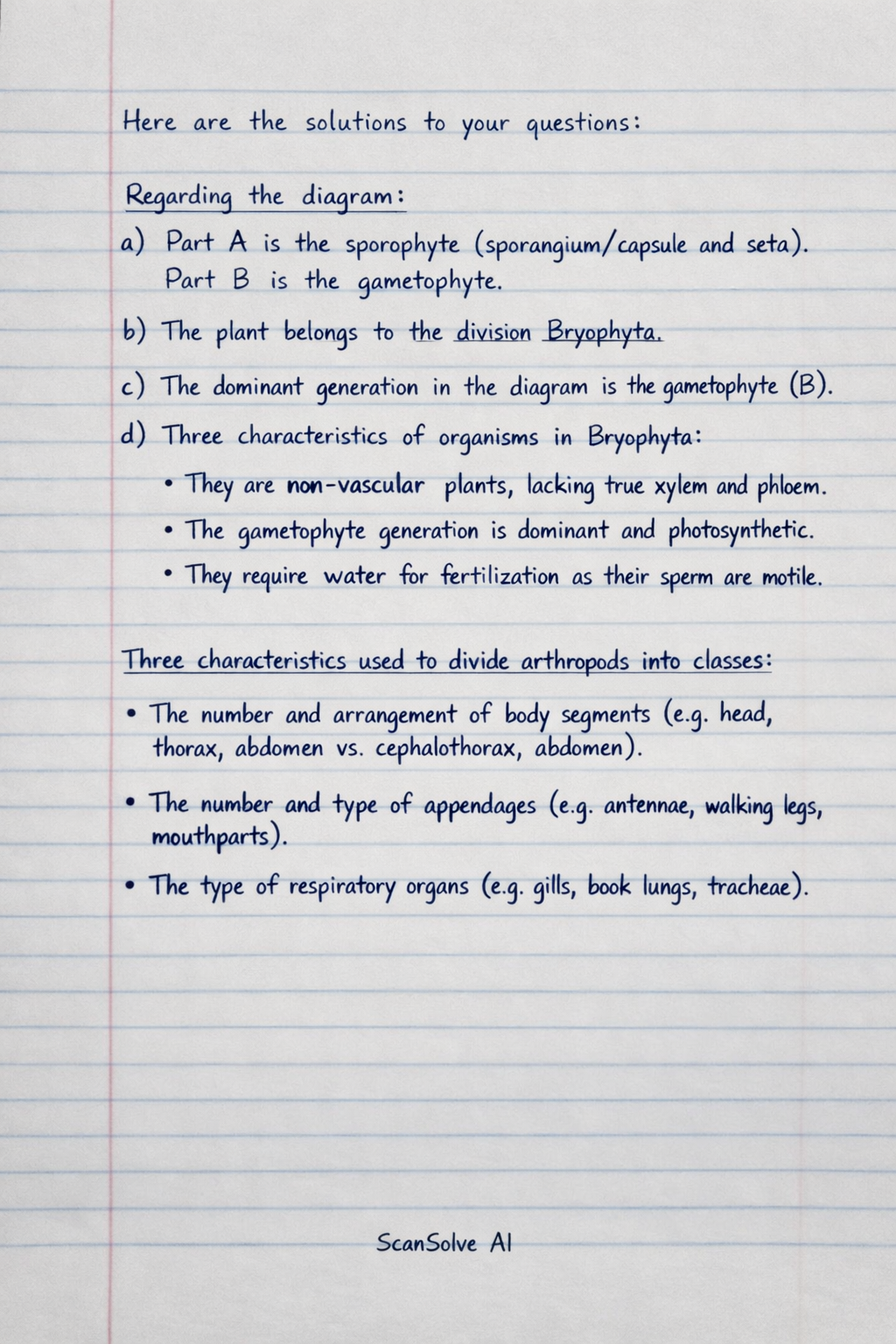
Here are the solutions to your questions:
-
Regarding the diagram:
- a) Part A is the sporophyte (sporangium/capsule and seta). Part B is the gametophyte.
- b) The plant belongs to the division Bryophyta.
- c) The dominant generation in the diagram is the gametophyte (B).
- d) Three characteristics of organisms in Bryophyta:
- They are non-vascular plants, lacking true xylem and phloem.
- The gametophyte generation is dominant and photosynthetic.
- They require water for fertilization as their sperm are motile.
-
Three characteristics used to divide arthropods into classes:
- The number and arrangement of body segments (e.g., head, thorax, abdomen vs. cephalothorax, abdomen).
- The number and type of appendages (e.g., antennae, walking legs, mouthparts).
- The type of respiratory organs (e.g., gills, book lungs, tracheae).
-
a) Two differences between algae and fungi:
- Algae are autotrophic (photosynthetic) and have cell walls made of cellulose, while fungi are heterotrophic (absorptive) and have cell walls made of chitin.
- Algae contain chlorophyll and produce their own food, whereas fungi lack chlorophyll and obtain nutrients by decomposing or parasitizing other organisms. b) Economic importance of algae:
- Algae are a significant food source for humans and aquatic animals (e.g., seaweed).
- They are used to produce commercial products like agar and carrageenan, which are used as gelling agents.
-
a) Alteration of generations is a life cycle found in plants and some algae, characterized by the regular alternation between two distinct multicellular forms: a haploid gametophyte (which produces gametes) and a diploid sporophyte (which produces spores). b) Two divisions in the plant kingdom that show alternation of generation:
- Bryophyta (e.g., mosses)
- Pteridophyta (e.g., ferns)
-
a) Three major characteristics common to millipedes, grasshoppers, and crayfish (all belonging to Phylum Arthropoda):
- They possess a rigid exoskeleton made of chitin.
- Their bodies are segmented.
- They have jointed appendages.
b) The specific name of Irish potato is Solanum tuberosum.
i) Two errors made when writing the name "solanum Tuberrasum":
- The genus name ("solanum") should begin with a capital letter (Solanum).
- The species epithet ("Tuberrasum") should begin with a lowercase letter (tuberosum).
- The entire scientific name should be italicized (or underlined if handwritten).
- The species epithet is misspelled; it should be tuberosum, not Tuberrasum.
Still stuck on this one?
Ask a follow-up, and the answer starts from this question.
More Biology Questions
Handwritten Step-by-Step Solution
Get this as a handwritten image on WhatsApp — like a tutor wrote it for you.
Try on WhatsApp