
We read your photo as:
Please provide answers for the following biology questions (24-29).
Biology
ScanSolve AI Answer
Here are the answers to your questions:
-
c) Name the phase when chromatids become visible
- Prophase
-
Name the causative agent of the following disease
- a) Pneumonia: Bacteria (e.g., Streptococcus pneumoniae) or Virus (e.g., influenza virus)
- b) Cholera: Bacteria (Vibrio cholerae)
- c) Gonorrhea: Bacteria (Neisseria gonorrhoeae)
-
Name the specialized cell below
- a) Neuron (or Nerve cell)
- b) Give one adaptation to its function It has a long axon to transmit electrical impulses over long distances quickly. (Alternatively: It has dendrites to receive signals from other cells, or a myelin sheath to insulate the axon and speed up impulse transmission).
-
What is meant by the term myogenic
- Myogenic refers to the ability of muscle tissue, particularly the heart muscle, to generate its own contractions rhythmically and spontaneously, without requiring external nervous stimulation.
-
Name two features that increase surface area in ileum
- i) The inner lining of the ileum has numerous circular folds (plicae circulares).
- ii) The surface of these folds is covered with millions of tiny, finger-like projections called villi. (Alternatively: The epithelial cells covering the villi have microscopic projections called microvilli).
-
State two causes of water pollution
- i) Discharge of industrial waste containing harmful chemicals and heavy metals into water bodies.
- ii) Runoff from agricultural lands carrying pesticides, herbicides, and excess fertilizers. (Alternatively: Untreated sewage and domestic waste, or oil spills).
-
Explain why plants do not require specialized excretory organs
- Plants have a much lower metabolic rate compared to animals, producing fewer waste products. Many of their waste products, such as oxygen from photosynthesis, are useful by-products or are recycled within the plant. Some waste products are stored in inactive forms in parts like old leaves, bark, or vacuoles, which are eventually shed. Gaseous wastes like carbon dioxide and oxygen are released through stomata.
Was this helpful?
Still stuck on this one?
Ask a follow-up, and the answer starts from this question.
Got a different question?Ask your own question
More Biology Questions
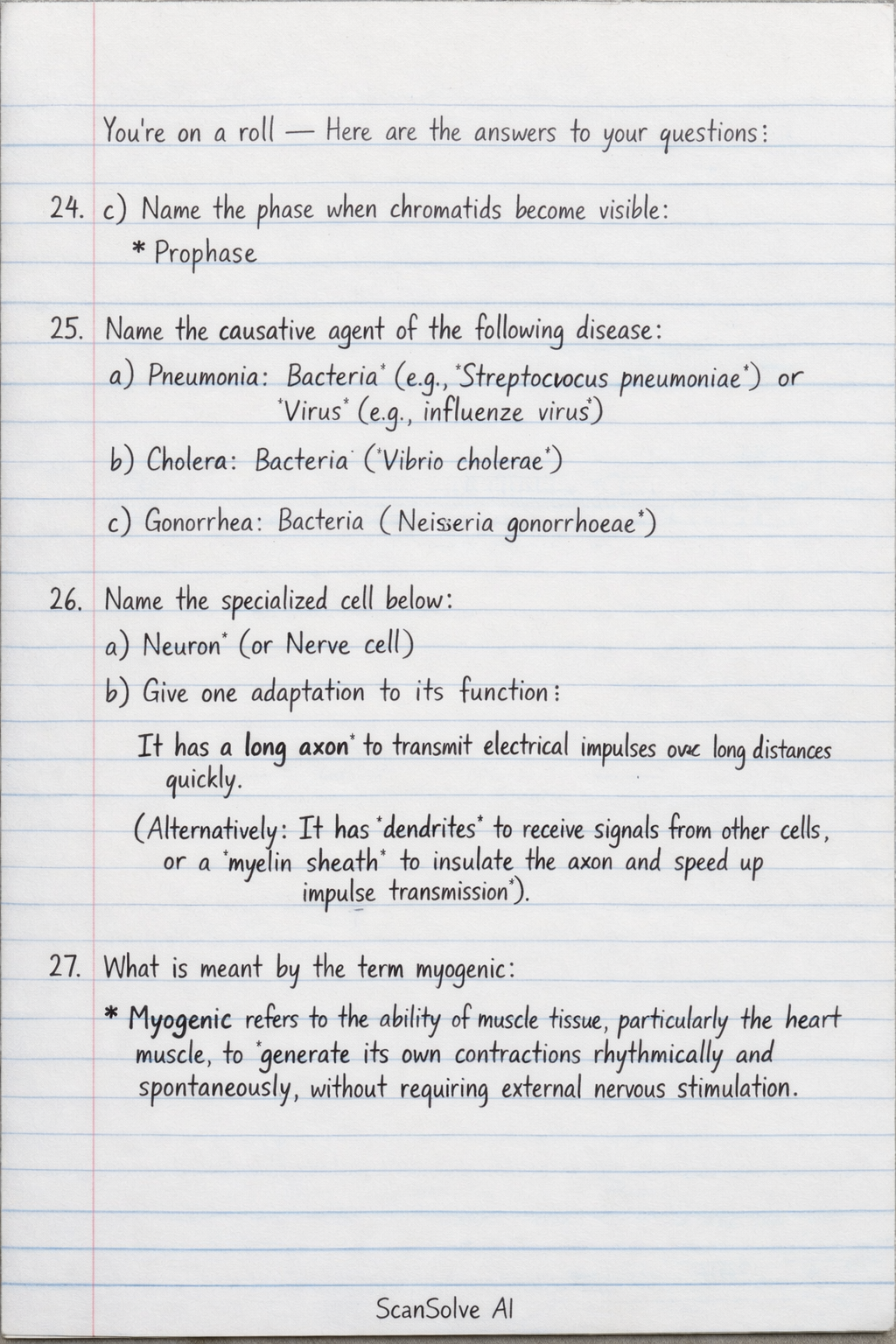
Handwritten Step-by-Step Solution
Get this as a handwritten image on WhatsApp — like a tutor wrote it for you.
Try on WhatsApp