
We read your photo as:
Provide answers to question 2 about parasites, including identification, control methods, economic importance, affected farm animals, and specific examples.
Biology
ScanSolve AI Answer
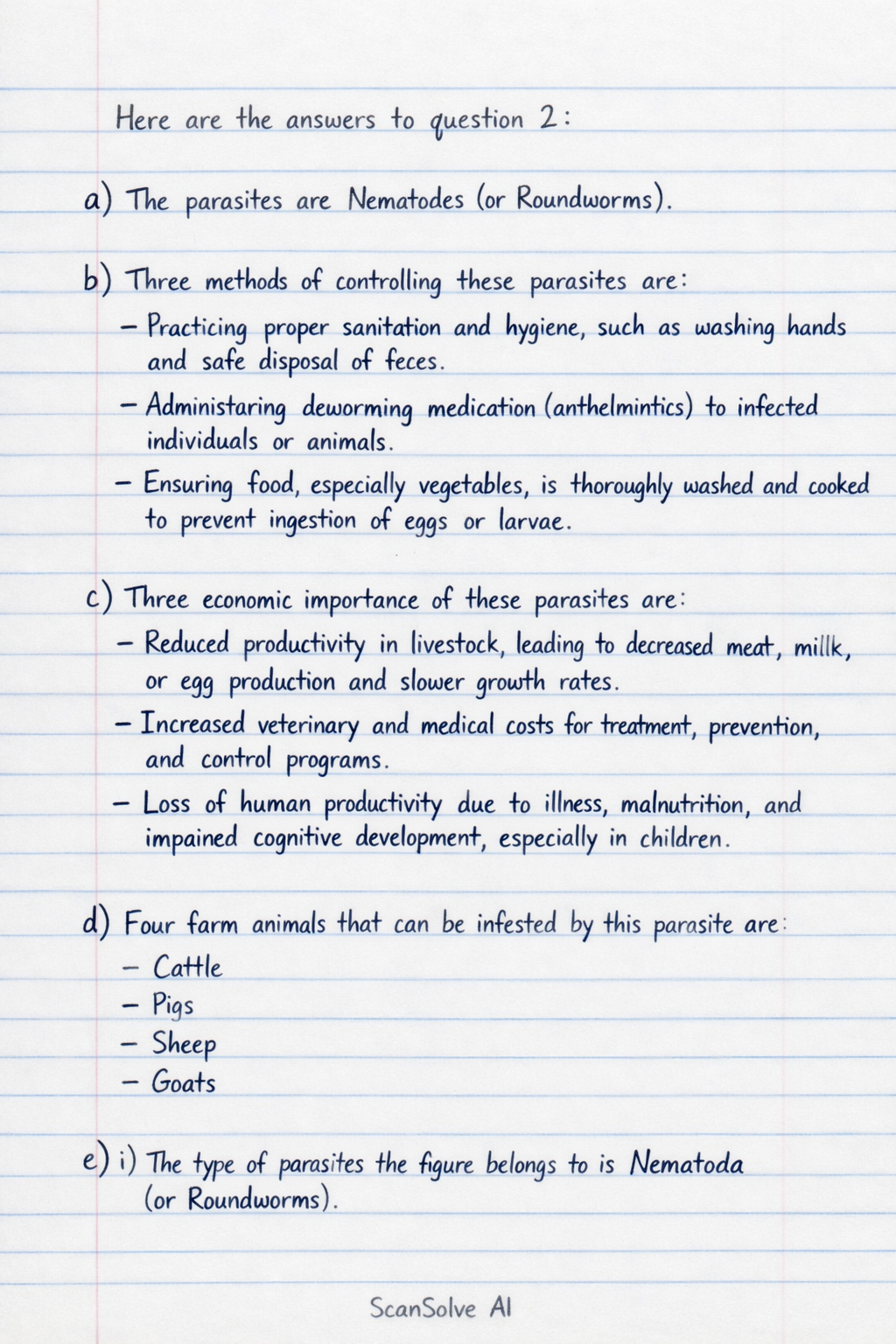
Here are the answers to question 2:
a) The parasites are Nematodes (or Roundworms).
b) Three methods of controlling these parasites are:
- Practicing proper sanitation and hygiene, such as washing hands and safe disposal of feces.
- Administering deworming medication (anthelmintics) to infected individuals or animals.
- Ensuring food, especially vegetables, is thoroughly washed and cooked to prevent ingestion of eggs or larvae.
c) Three economic importance of these parasites are:
- Reduced productivity in livestock, leading to decreased meat, milk, or egg production and slower growth rates.
- Increased veterinary and medical costs for treatment, prevention, and control programs.
- Loss of human productivity due to illness, malnutrition, and impaired cognitive development, especially in children.
d) Four farm animals that can be infested by this parasite are:
- Cattle
- Pigs
- Sheep
- Goats
e) i) The type of parasites the figure belongs to is Nematoda (or Roundworms).
ii) Three parasites that belong to the type in e(i) above are:
- Ascaris lumbricoides (human roundworm)
- Hookworms (e.g., Ancylostoma duodenale)
- Pinworms (Enterobius vermicularis)
Was this helpful?
Still stuck on this one?
Ask a follow-up, and the answer starts from this question.
Got a different question?Ask your own question
More Biology Questions
QIdentify parasites, their type, examples, affected farm animals, economic importance, and control…QIdentify the parasites in the figure, name four farm animals they infest, state their type and three…QIdentify the parasites shown in Figure 2, list three control methods, three economic impacts, four…QA homework question about identifying parasites, listing infested animals, classifying parasites by…QThe figure 3 below illustrates parasite of farm animals. Study them carefully and use it to answer…
Handwritten Step-by-Step Solution
Get this as a handwritten image on WhatsApp — like a tutor wrote it for you.
Try on WhatsApp