
We read your photo as:
QUESTION 4: ANIMAL REPRODUCTION. Start this question on a NEW page.
Biology
ScanSolve AI Answer
Step-by-step solution
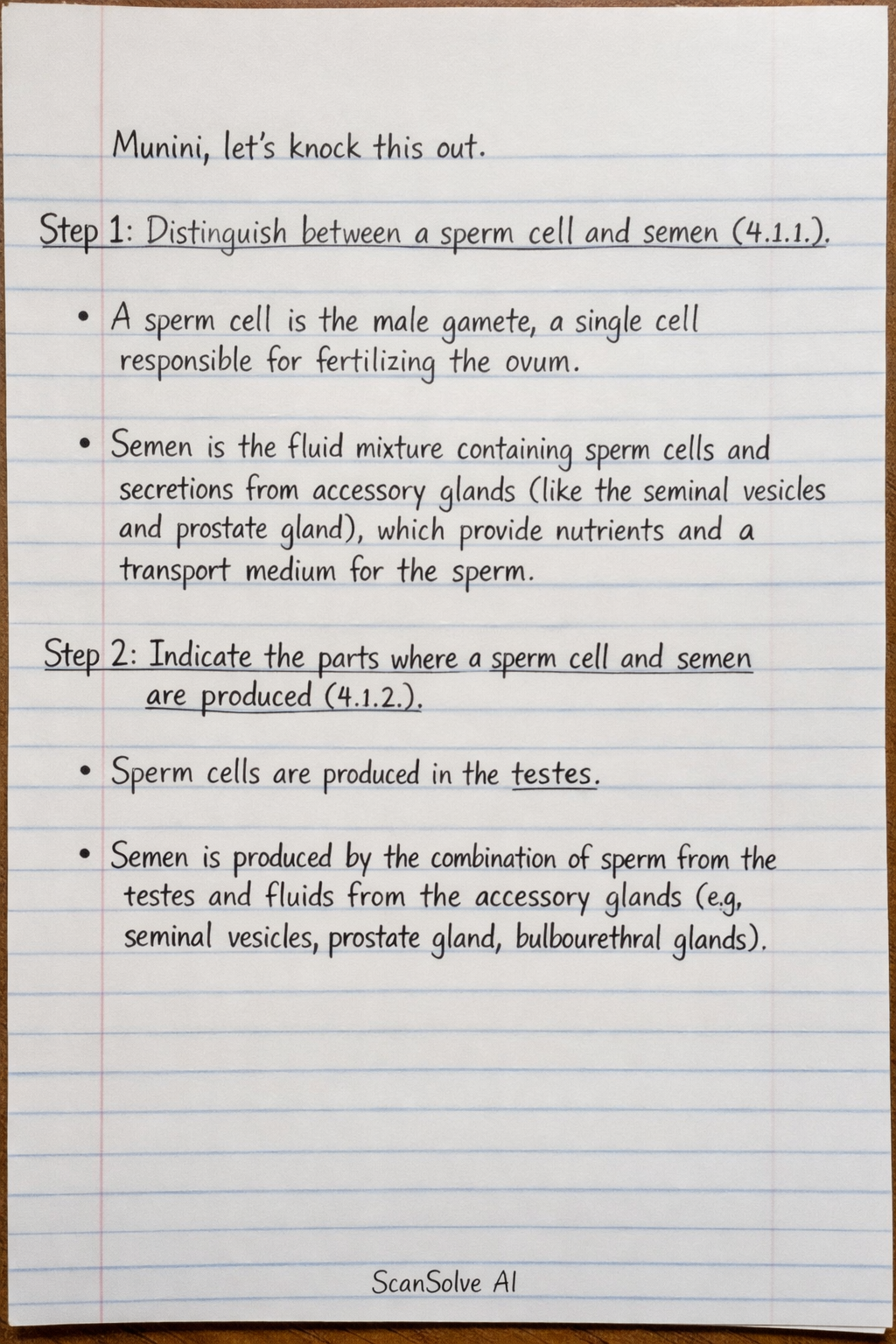
4 stepsDistinguish between a sperm cell and semen (4.1.1).
- A sperm cell is the male gamete, a single cell responsible for fertilizing the ovum.
- Semen is the fluid mixture containing sperm cells and secretions from accessory glands (like the seminal vesicles and prostate gland), which provide nutrients and a transport medium for the sperm.
Indicate the parts where a sperm cell and semen are produced (4.1.2).
- Sperm cells are produced in the testes.
- Semen is produced by the combination of sperm from the testes and fluids from the accessory glands (e.g., seminal vesicles, prostate gland, bulbourethral glands).
Identify the hormone labeled A and parts B, E, and F (4.2.1).
- A: Follicle-stimulating hormone (FSH) (produced in the pituitary gland in the brain, which stimulates follicle development in the ovary).
- B: Ovary (the primary female reproductive organ where ova are produced and hormones are secreted).
- E: Uterus (the organ where the embryo develops).
- F: Corpus luteum (a temporary endocrine structure in the ovary that produces progesterone after ovulation).
Name the hormone responsible for producing the signs of oestrus (4.2.2).
The hormone responsible for producing the signs of oestrus is oestrogen.
Was this helpful?
Still stuck on this one?
Ask a follow-up, and the answer starts from this question.
Got a different question?Ask your own question
More Biology Questions
QPractical questions about reproductive systems in farm animalsQReproduction in human se kuse mcq questionQPlease answer the following questions about reproduction and contraception.QThis question is a collection of short-answer and multiple-choice biology questions about…QExplain everything in Reproduction
Handwritten Step-by-Step Solution
Get this as a handwritten image on WhatsApp — like a tutor wrote it for you.
Try on WhatsApp