
We read your photo as:
Questions 7, 8, and 9 relate to ecology and trophic levels. What specific questions are being asked about these topics?
ScanSolve AI Answer
Answer
B dan C
Step-by-step solution
11 steps7.
Identify the role of each component.
- A = pohon yang sudah mati (dead tree) is dead organic matter.
- B = jamur (mushroom) is a decomposer, which breaks down dead organic matter.
- C = cacing tanah (earthworm) is a detritivore, consuming dead organic matter.
Determine which organisms are detritivores.
Both mushrooms (B) and earthworms (C) obtain nutrients by consuming or breaking down dead organic material, thus acting as detritivores.
The correct option is c. B dan C.8.
Understand the concept of trophic levels.
Trophic levels describe the position an organism occupies in a food chain, indicating how it obtains energy.
Relate trophic levels to ecosystem interactions and stability.
The primary role of trophic levels is to illustrate the flow of energy and transfer of nutrients from one organism to another within an ecosystem. This flow is fundamental to the interactions and stability of the ecosystem.
The correct option is b. Tingkatan trofik memainkan peran kunci dalam aliran energi dan transfer nutrisi.9.
Define "free from predators."
An organism that is free from predators is typically at the highest trophic level in its food chain, meaning it is not preyed upon by other organisms within that ecosystem.
Evaluate the given trophic levels.
- Produsen (producers) are eaten by primary consumers.
- Konsumen pertama (primary consumers) are eaten by secondary consumers.
- Konsumen kedua (secondary consumers) are eaten by tertiary consumers.
- Herbivora (herbivores) are primary consumers and are eaten by carnivores.
- Predator puncak (apex predator) is at the top of the food chain and generally has no natural predators. The correct option is e. predator puncak.
10.
Analyze each characteristic in the context of freshwater ecosystems.
- (1) Variasi suhu di daerah sekitar rendah (Low temperature variation in the surrounding area): Water has a high specific heat capacity, leading to more stable temperatures compared to land. This is generally true for freshwater bodies.
- (2) Tidak dipengaruhi oleh iklim dan cuaca (Not affected by climate and weather): This is incorrect; freshwater ecosystems are significantly influenced by climate and weather.
- (3) Konsentrasi makanan sangat luas (Very wide food concentration): This is too vague and varies greatly.
- (4) Penetrasi cahaya matahari kurang (Low penetration of sunlight): This is often true for deeper or turbid freshwater bodies.
- (5) Arus air selalu mengalami perputaran (Water currents always circulate): This is true for many freshwater bodies like rivers and lakes (due to currents or thermal turnover).
- (6) Salinitas rendah bahkan lebih rendah dari protoplasma (Low salinity, even lower than protoplasm): This is the defining characteristic of freshwater, distinguishing it from saltwater.
Select the most accurate combination of characteristics for freshwater.
Characteristics (1), (4), and (6) are strong indicators of freshwater ecosystems.
The correct option is b. (1) - (4) - (6).11.
Understand what constitutes climate.
Climate refers to the long-term weather patterns of a region, determined by various atmospheric conditions and energy inputs.
Identify the abiotic components that directly form climate.
The key abiotic factors that directly contribute to the formation of climate are temperature, precipitation (rainfall), wind, and solar radiation (sunlight). Air humidity is also a direct component.
The correct option is e. kelembapan udara, suhu, curah hujan, dan cahaya matahari.12.
Classify organisms in Group X based on how they obtain food.
- Padi (rice), lumut (moss), and fitoplankton (phytoplankton) are all organisms that produce their own food, primarily through photosynthesis. They are autotrophs.
Try one yourself
A new problem that tests the same skill.
Still stuck on this one?
Ask a follow-up, and the answer starts from this question.
More Biology Questions
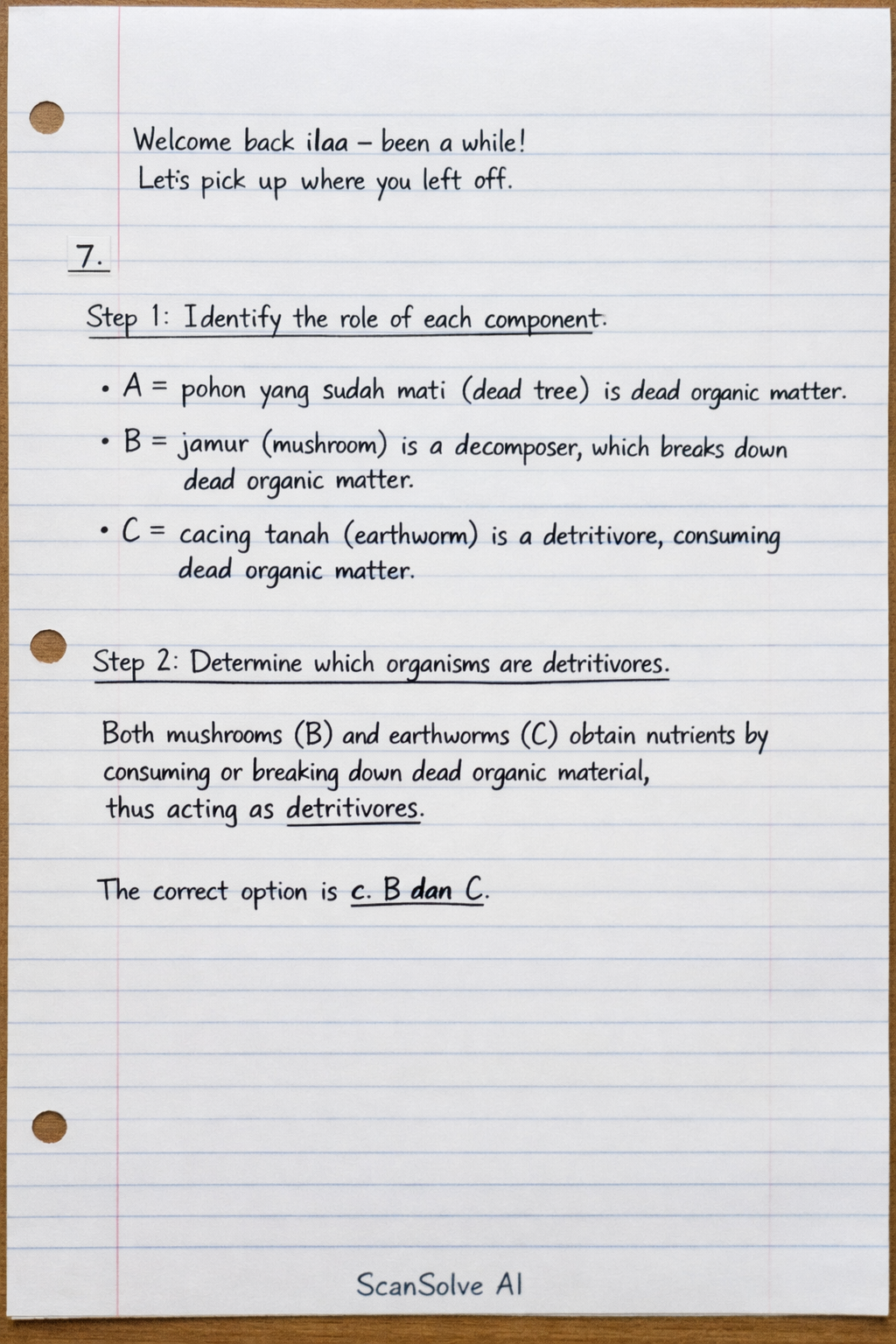
Handwritten Step-by-Step Solution
Get this as a handwritten image on WhatsApp — like a tutor wrote it for you.
Try on WhatsApp