
We read your photo as:
Explain the results of an iodine test on a non-germinating maize grain, detailing the color changes in the endosperm and embryo.
ScanSolve AI Answer
Here are the observations and explanation for Experiment 3:
a. Observations:
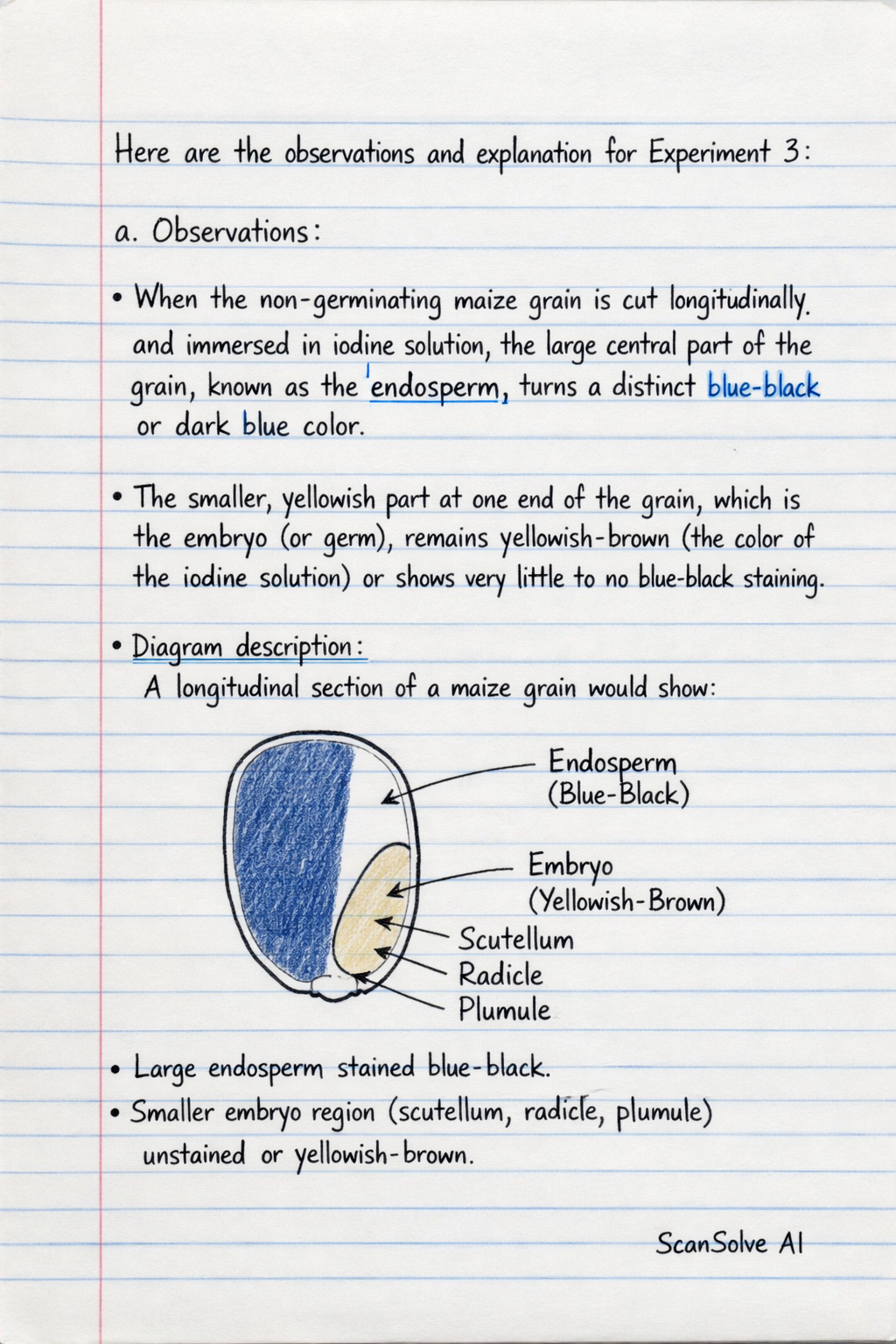
- When the non-germinating maize grain is cut longitudinally and immersed in iodine solution, the large central part of the grain, known as the endosperm, turns a distinct blue-black or dark blue color.
- The smaller, yellowish part at one end of the grain, which is the embryo (or germ), remains yellowish-brown (the color of the iodine solution) or shows very little to no blue-black staining.
- Diagram description: A longitudinal section of a maize grain would show the large endosperm region stained blue-black, and the smaller embryo region (consisting of the scutellum, radicle, and plumule) unstained or stained yellowish-brown.
b. Explanation:
Iodine solution is a chemical indicator used to test for the presence of starch. Starch reacts with iodine to produce a characteristic blue-black color. In a non-germinating maize grain, the endosperm is the primary storage tissue for starch, which serves as a food reserve. Therefore, when iodine solution is applied, the endosperm stains blue-black, indicating a high concentration of starch. The embryo (germ) of the maize grain, on the other hand, primarily contains lipids (fats) and proteins, with very little or no starch. Consequently, the embryo does not react with the iodine solution and does not turn blue-black, retaining the original color of the iodine solution. This experiment demonstrates that starch is predominantly stored in the endosperm of the maize grain.
Still stuck on this one?
Ask a follow-up, and the answer starts from this question.
More Biology Questions
Handwritten Step-by-Step Solution
Get this as a handwritten image on WhatsApp — like a tutor wrote it for you.
Try on WhatsApp