
We read your photo as:
Describe the roles of decomposers and explain how removing a secondary consumer would impact a food web.
ScanSolve AI Answer
Answer
Step-by-step solution
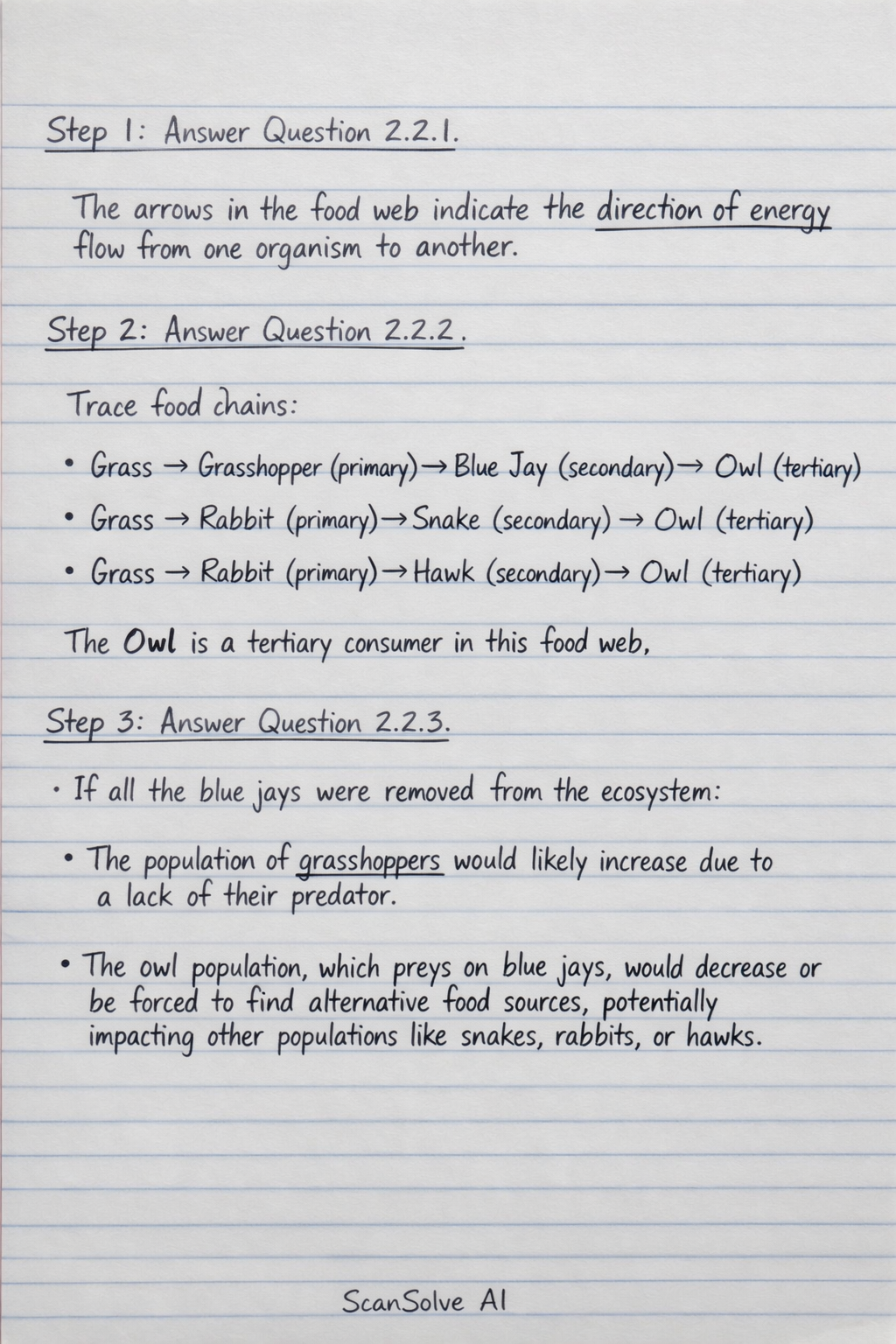
5 stepsAnswer Question 2.2.1.
The arrows in the food web indicate the direction of energy flow from one organism to another.
Answer Question 2.2.2.
To identify the tertiary consumer, we trace food chains:
- Grass Grasshopper (primary) Blue jay (secondary) Owl (tertiary)
- Grass Rabbit (primary) Snake (secondary) Owl (tertiary)
- Grass Rabbit (primary) Hawk (secondary) Owl (tertiary) The Owl is a tertiary consumer in this food web.
Answer Question 2.2.3.
If all the blue jays were removed from the ecosystem:
- The population of grasshoppers would likely increase due to a lack of their predator.
- The owl population, which preys on blue jays, would decrease or be forced to find alternative food sources, potentially impacting other populations like snakes, rabbits, or hawks.
Answer Question 2.2.4.
Decomposers (like bacteria and fungi) break down dead organic matter (dead plants, animals, and waste products). This process returns essential nutrients to the soil, making them available for producers and completing the nutrient cycle in the ecosystem.
Answer Question 2.2.5.
To calculate the percentage of energy passed from the grasshopper to the blue jay:
The energy at the grasshopper level is .
The energy at the blue jay level is .The formula for percentage energy transfer is:
Substitute the given values:
Perform the calculation:
The percentage of energy passed on from the grasshopper to the blue jay is
\boxed{\text{8.57%}}.
Try one yourself
A new problem that tests the same skill.
Still stuck on this one?
Ask a follow-up, and the answer starts from this question.
More Biology Questions
Handwritten Step-by-Step Solution
Get this as a handwritten image on WhatsApp — like a tutor wrote it for you.
Try on WhatsApp