
We read your photo as:
Describe the roles of producers and consumers in a pond ecosystem, and explain energy transfer through trophic levels, using examples from a pond water sample.
ScanSolve AI Answer
Step-by-step solution
4 stepsBased on the provided practical instructions for "FOOD CHAINS AND TROPHIC LEVELS" using a pond water sample:
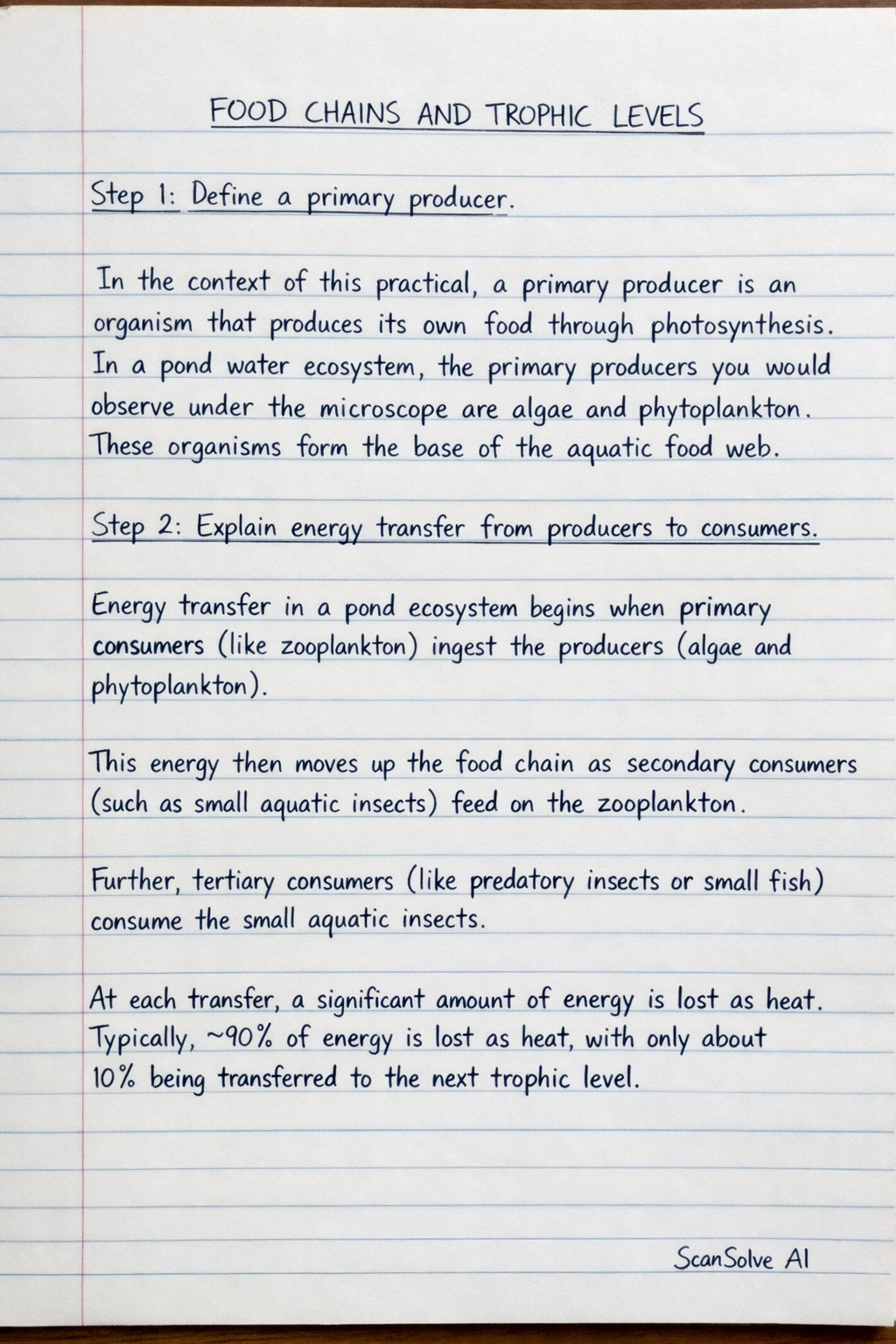
Define a primary producer.
In the context of this practical, a primary producer is an organism that produces its own food through photosynthesis. In a pond water ecosystem, the primary producers you would observe under the microscope are algae and phytoplankton. These organisms form the base of the aquatic food web.
Explain energy transfer from producers to consumers.
Energy transfer in a pond ecosystem begins when primary consumers (like zooplankton) ingest the producers (algae and phytoplankton). This energy then moves up the food chain as secondary consumers (such as small aquatic insects) feed on the zooplankton. Further, tertiary consumers (like predatory insects or small fish) consume the small aquatic insects. At each transfer, a significant amount of energy is lost as heat, typically around 90%, with only about 10% being transferred to the next trophic level.
Discuss unique interactions.
The practical focuses on identifying organisms at different trophic levels, which implies observing feeding interactions.
- Herbivory: This interaction occurs when primary consumers feed on producers. An example from the pond water sample would be observing zooplankton consuming algae or phytoplankton.
- Predation: This is an interaction where one organism (the predator) hunts and kills another (the prey) for food. In the pond sample, you might observe small aquatic insects preying on zooplankton, or predatory insects and small fish preying on the small aquatic insects. These interactions demonstrate the flow of energy and the predator-prey relationships within the pond ecosystem.
Conclusion.
The conclusion for this practical would summarize your observations from the pond water sample. You would list the specific organisms identified at each trophic level: producers (e.g., specific types of algae or phytoplankton), primary consumers (e.g., specific types of zooplankton), secondary consumers (e.g., specific small aquatic insects), and tertiary consumers (e.g., specific predatory insects or small fish). Finally, you would illustrate the constructed food web, using arrows to show the direction of energy flow between these identified organisms, thereby demonstrating the concepts of food chains, food webs, and trophic levels in the pond ecosystem.
Still stuck on this one?
Ask a follow-up, and the answer starts from this question.
More Biology Questions
Handwritten Step-by-Step Solution
Get this as a handwritten image on WhatsApp — like a tutor wrote it for you.
Try on WhatsApp