
We read your photo as:
Describe rotator cuff disorders, including their causes, mechanisms of pain, and diagnostic tests like Dawbarn's sign.
ScanSolve AI Answer
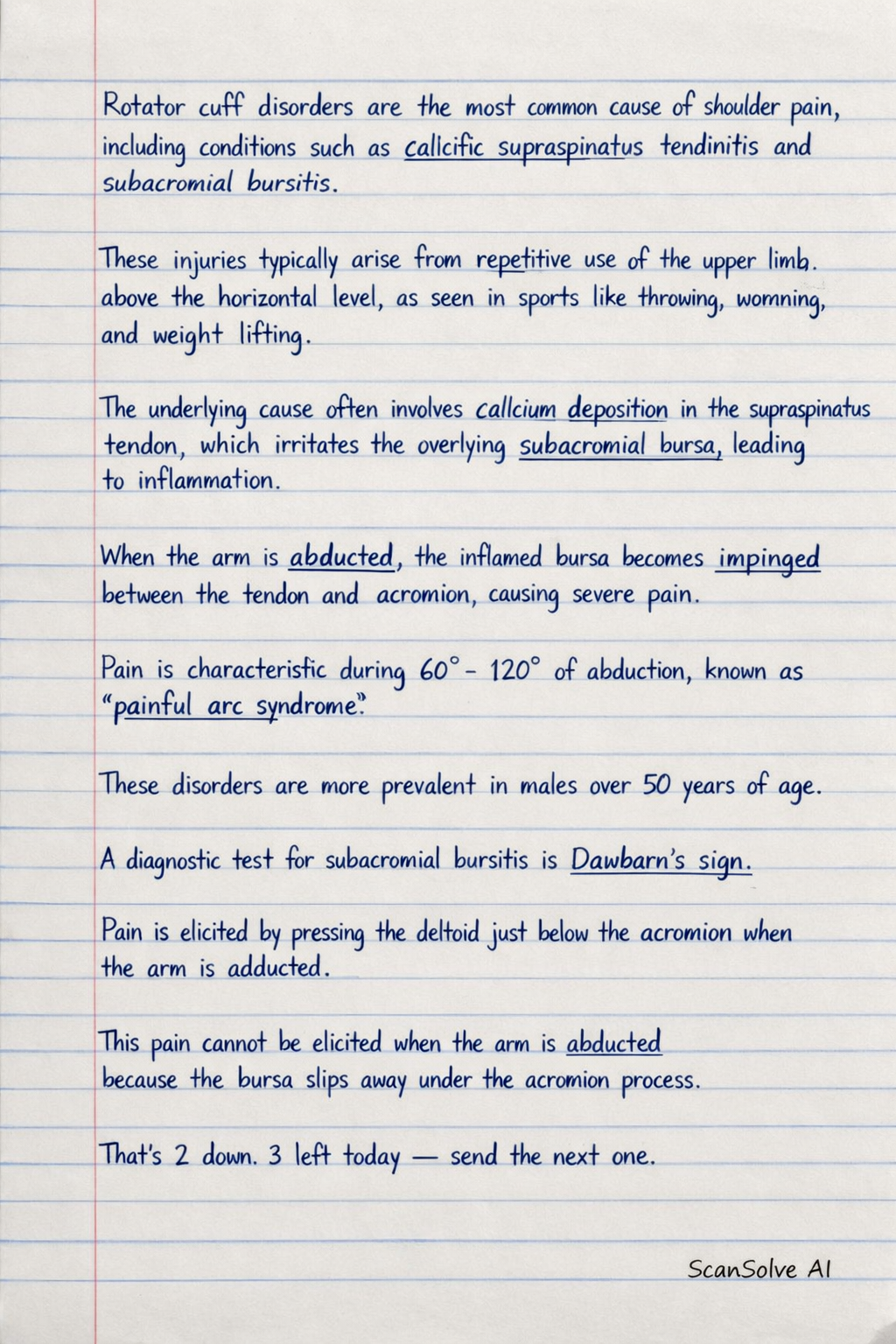
Rotator cuff disorders are the most common cause of shoulder pain, including conditions such as calcific supraspinatus tendinitis and subacromial bursitis. These injuries typically arise from repetitive use of the upper limb above the horizontal level, as seen in sports like throwing, swimming, and weight lifting.
The underlying cause often involves calcium deposition in the supraspinatus tendon, which irritates the overlying subacromial bursa, leading to inflammation. When the arm is abducted, the inflamed bursa becomes impinged between the tendon and acromion, causing severe pain. This pain is characteristic during 60°-120° of abduction, known as painful arc syndrome. These disorders are more prevalent in males over 50 years of age.
A diagnostic test for subacromial bursitis is Dawbarn's sign. Pain is elicited by pressing the deltoid just below the acromion when the arm is adducted. This pain cannot be elicited when the arm is abducted because the bursa slips away under the acromion process.
Still stuck on this one?
Ask a follow-up, and the answer starts from this question.
More Biology Questions
Handwritten Step-by-Step Solution
Get this as a handwritten image on WhatsApp — like a tutor wrote it for you.
Try on WhatsApp