
We read your photo as:
SECTION A Answer ALL 3 questions Define the following terms. Excretion. (ii) Homeostasis. Describe the role of the kidney in osmoregulation. Explain how the human body regulates the amount of sugar level in blood.
ScanSolve AI Answer
This answer stops before the end.
It was cut off when it was first written. Ask ScanSolve this question again for the full working.
Step-by-step solution
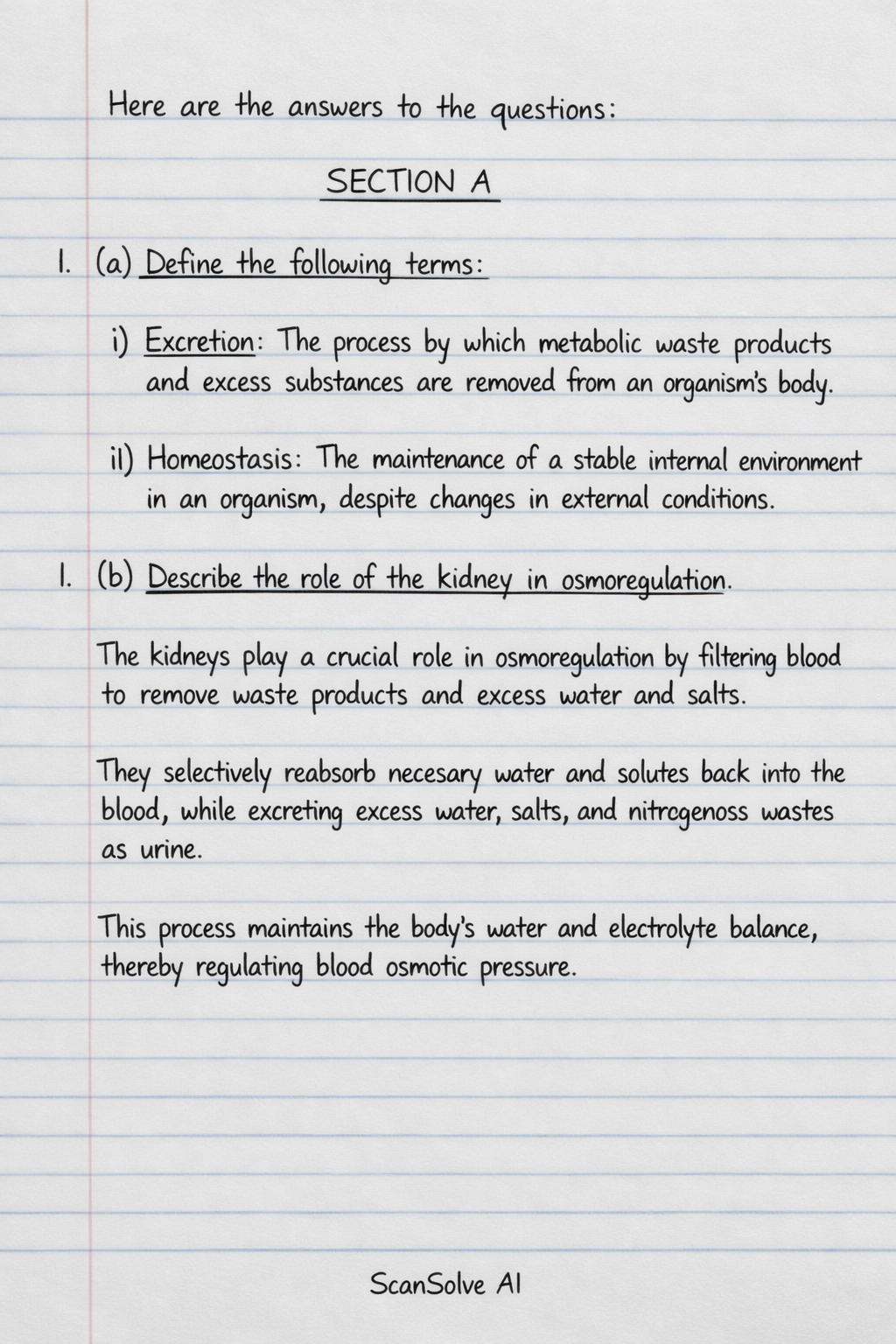
20 stepsHere are the answers to the questions:
SECTION A
1. (a) Define the following terms:
Part i
Excretion: The process by which metabolic waste products and excess substances are removed from an organism's body.
Part ii· 20 steps
Homeostasis: The maintenance of a stable internal environment in an organism, despite changes in external conditions.
1. (b) Describe the role of the kidney in osmoregulation.
The kidneys play a crucial role in osmoregulation by filtering blood to remove waste products and excess water and salts. They selectively reabsorb necessary water and solutes back into the blood, while excreting excess water, salts, and nitrogenous wastes as urine. This process maintains the body's water and electrolyte balance, thereby regulating blood osmotic pressure.
1. (c) Explain how the human body regulates the amount of sugar level in blood.
Blood sugar (glucose) levels are regulated by the hormones insulin and glucagon, produced by the pancreas.
When blood glucose levels rise (e.g., after a meal), the pancreas releases insulin.
Insulin promotes the uptake of glucose by body cells and stimulates the liver and muscles to convert excess glucose into glycogen for storage, thus lowering blood glucose.
When blood glucose levels fall, the pancreas releases glucagon.
Glucagon stimulates the liver to break down stored glycogen back into glucose and release it into the bloodstream, thereby raising blood glucose levels.
2. (a) Describe the structure of:
- i) A mould fungus: A mould fungus consists of a network of thread-like structures called hyphae, which collectively form a mycelium. Some hyphae grow upwards to form sporangiophores that bear sporangia, containing asexual spores. Other hyphae, called rhizoids, anchor the mould and absorb nutrients.
- ii) An Amoeba: An Amoeba is a single-celled protozoan with an irregular, constantly changing shape. It possesses a flexible cell membrane, cytoplasm (divided into outer ectoplasm and inner endoplasm), a nucleus, a contractile vacuole (for osmoregulation), and food vacuoles. It moves and feeds using temporary cytoplasmic extensions called pseudopods.
2. (b) How does a mould fungus carry out asexual reproduction?
Mould fungi primarily reproduce asexually through the production of spores.Specialized hyphae (e.g., sporangiophores) produce sporangia or conidia.
Within these structures, numerous asexual spores are formed through mitosis.
These spores are then dispersed, often by wind or water.
Upon landing in a suitable environment with adequate moisture and nutrients, the spores germinate and grow into new hyphae, forming a new mould colony.
2. (c) Account for the various ways by which Fungi are beneficial to man.
Fungi are beneficial to humans in several ways:- Decomposition: They act as decomposers, breaking down dead organic matter and recycling essential nutrients back into the ecosystem.
- Food source: Many mushrooms are edible, and yeast (a type of fungus) is used in baking bread and fermenting alcoholic beverages.
- Medicine: Fungi are a source of important antibiotics, such as penicillin, derived from the Penicillium mould.
- Biocontrol: Some fungi are used as biological agents to control pests and weeds in agriculture.
- Symbiotic relationships: Mycorrhizal fungi form symbiotic relationships with plant roots, enhancing the plant's ability to absorb water and nutrients.
3. (a) State the biological importance of:
- i) Nitrogen to plants: Nitrogen is an essential macronutrient for plants, crucial for the synthesis of vital organic molecules such as proteins, nucleic acids (DNA and RNA), chlorophyll, and ATP. It is fundamental for plant growth, development, and metabolic processes.
- ii) Nitrogen fixation in nature: Nitrogen fixation is the process by which atmospheric nitrogen gas (), which is unusable by most organisms, is converted into ammonia () or ammonium (). This conversion is primarily carried out by nitrogen-fixing bacteria (e.g., Rhizobium in legume root nodules). It makes nitrogen available in a usable form for plants, thereby supporting the entire food web.
3. (b) Describe the role of the following processes in the circulation of carbon in nature:
- i) Photosynthesis: Photosynthesis is the process by which green plants, algae, and some bacteria absorb atmospheric carbon dioxide () using light energy. They convert it into organic compounds (sugars) and oxygen. This process removes carbon from the atmosphere and incorporates it into biomass, forming the base of most food chains.
- ii) Respiration: Respiration is the process by which all living organisms (plants, animals, and microorganisms) break down organic compounds (e.g., glucose) to release energy for their metabolic activities. During this process, carbon dioxide () is produced as a byproduct and released back into the atmosphere or water, completing the carbon cycle.
3. (c) How does deforestation affect the carbon cycle?
Deforestation significantly impacts the carbon cycle by reducing the number of trees, which are major carbon sinks.Trees absorb large amounts of atmospheric carbon dioxide through photosynthesis.
When forests are cleared, this carbon absorption capacity is lost.
Furthermore, the carbon stored in the trees is released back into the atmosphere, either rapidly through burning or slowly through decomposition.
This leads to an increase in atmospheric carbon dioxide levels, contributing to the greenhouse effect and climate change.
SECTION B
4. (a) State the differences between aerobic and anaerobic respiration.
- Oxygen requirement: Aerobic respiration requires oxygen, while anaerobic respiration does not.
- ATP yield: Aerobic respiration produces a large amount of ATP (approximately 38 molecules per glucose molecule), whereas anaerobic respiration produces a small amount of ATP (2 molecules per glucose molecule).
- Location: Aerobic respiration primarily occurs in the mitochondria, while anaerobic respiration occurs in the cytoplasm.
- End products: The end products of aerobic respiration are carbon dioxide and water. The end products of anaerobic respiration are lactic acid (in animals) or ethanol and carbon dioxide (in plants and yeast).
4. (b) Describe an experiment to show that carbon dioxide is produced by a potted plant during respiration.
Set up two airtight bell jars.
Place a healthy potted plant in Bell Jar A and an empty pot (or a dead plant) in Bell Jar B (control).
In each bell jar, place a small beaker containing limewater (calcium hydroxide solution).
Cover both bell jars with a black cloth or place them in a dark room to prevent photosynthesis.
Leave the setup for several hours or overnight.
Observation*
The limewater in Bell Jar A will turn cloudy or milky, indicating the presence of carbon dioxide. The limewater in Bell Jar B will remain clear.
Conclusion*
The potted plant in the dark respired, producing carbon dioxide, which reacted with the limewater.
4. (c) What is the disadvantage of putting a potted plant inside a living room at night?
At night, plants cease photosynthesis due to the absence of light but continue to respire. During respiration, plants take in oxygen and release carbon dioxide. In an enclosed living room, this process can slightly reduce the oxygen concentration and increase the carbon dioxide concentration. While generally not harmful in a well-ventilated room, it could be a minor concern for individuals with severe respiratory conditions.5. (a) Draw a large labelled diagram of the mammalian skin.
(As an AI, I cannot draw diagrams, but I can describe the key structures to be labelled in a diagram of mammalian skin.)
A labelled diagram of mammalian skin should include three main layers:- Epidermis: The outermost protective layer.
- Dermis: The middle layer, containing connective tissue, blood vessels, nerve endings, hair follicles, sebaceous glands, and sweat glands.
- Subcutaneous layer (Hypodermis): The innermost layer, composed mainly of adipose tissue (fat) for insulation and energy storage. Key structures to label: Hair shaft, hair follicle, sebaceous gland, sweat gland, erector pili muscle, nerve endings (e.g., sensory receptors), blood vessels (arteriole, venule), adipose tissue.
5. (b) What are the differences between the epidermis of the mammalian skin and that of a leaf?
- Structure: Mammalian skin epidermis is typically multilayered (stratified squamous epithelium) and contains keratin, providing protection. Leaf epidermis is usually a single layer of cells and is transparent to allow light penetration.
- Specialized cells: Mammalian skin epidermis contains melanocytes (for pigment) and lacks stomata. Leaf epidermis contains stomata (pores for gas exchange and transpiration) flanked by guard cells, and is often covered by a waxy cuticle.
- Function: Mammalian skin epidermis primarily provides physical protection, prevents water loss, and acts as a barrier against pathogens. Leaf epidermis primarily regulates gas exchange, controls water loss, and protects underlying tissues.
5. (c) How is temperature regulation carried out in the mammalian skin during over heating?
When the mammalian body overheats, the skin plays a vital role in cooling:Sweat glands* are stimulated to produce sweat, which is released onto the skin surface.
The evaporation of sweat carries away latent heat, cooling the body.
Blood vessels* in the dermis undergo vasodilation, meaning they widen.
This increases blood flow to the skin surface, allowing more heat to
Still stuck on this one?
Ask a follow-up, and the answer starts from this question.
More Biology Questions
Handwritten Step-by-Step Solution
Get this as a handwritten image on WhatsApp — like a tutor wrote it for you.
Try on WhatsApp