
We read your photo as:
Define shock, classify shock, and describe how you would manage a patient with hypovolemic shock from trauma.
ScanSolve AI Answer
Here are the answers to your questions:
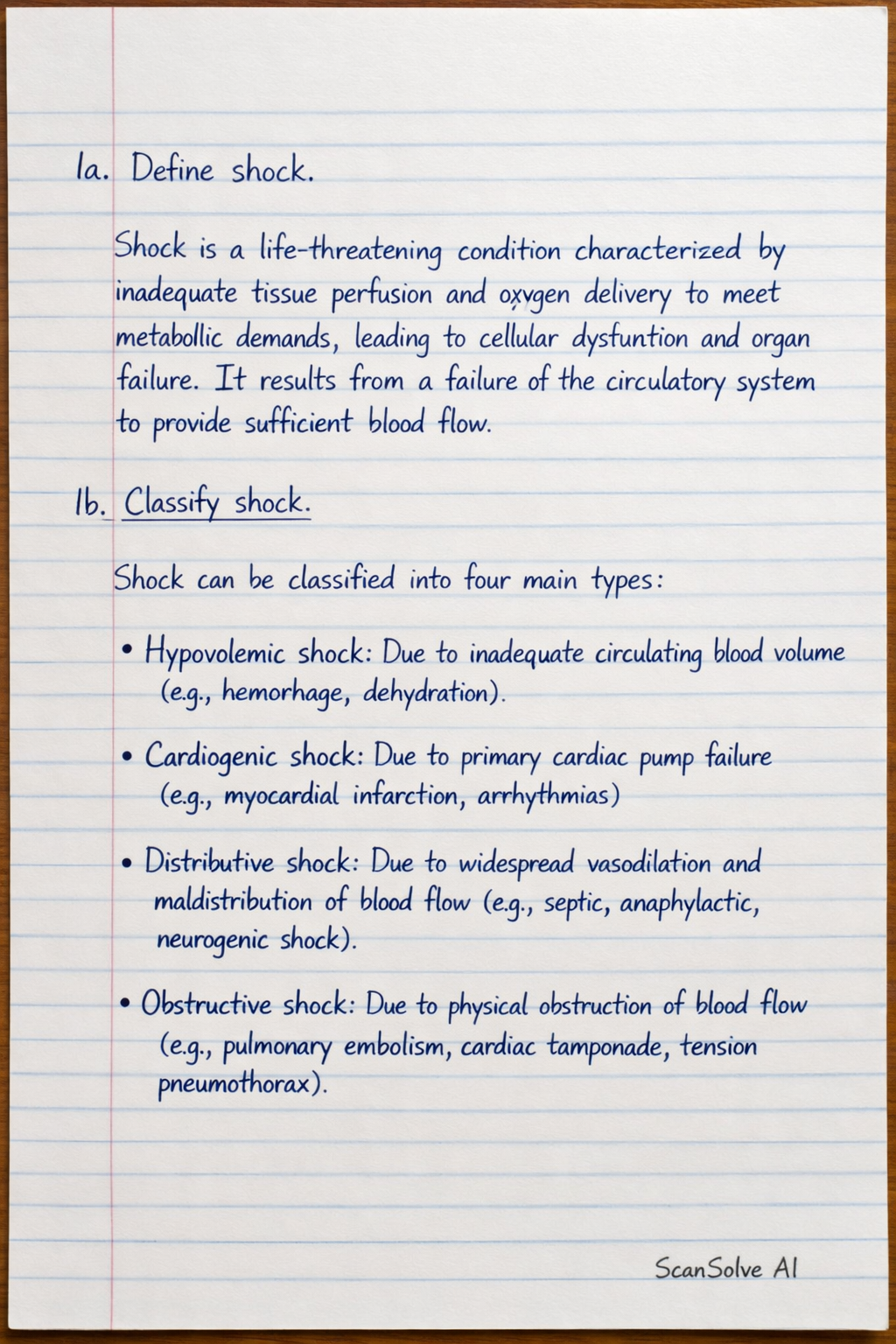
1a. Define shock.
Shock is a life-threatening condition characterized by inadequate tissue perfusion and oxygen delivery to meet metabolic demands, leading to cellular dysfunction and organ failure. It results from a failure of the circulatory system to provide sufficient blood flow.
1b. Classify shock.
Shock can be classified into four main types:
- Hypovolemic shock: Due to inadequate circulating blood volume (e.g., hemorrhage, dehydration).
- Cardiogenic shock: Due to primary cardiac pump failure (e.g., myocardial infarction, arrhythmias).
- Distributive shock: Due to widespread vasodilation and maldistribution of blood flow (e.g., septic, anaphylactic, neurogenic shock).
- Obstructive shock: Due to physical obstruction of blood flow (e.g., pulmonary embolism, cardiac tamponade, tension pneumothorax).
1c. Describe how you would manage him.
The patient presents with signs of hypovolemic shock due to trauma (motor vehicular accident, distended abdomen, non-clotting blood on tap, fast thready pulse, disorientation).
- Initial Resuscitation (ATLS principles):
- Airway: Ensure patent airway, protect cervical spine.
- Breathing: Assess breathing, administer high-flow oxygen.
- Circulation: Establish two large-bore intravenous (IV) lines. Rapidly infuse crystalloids (e.g., normal saline or Ringer's lactate) 1-2 liters. If no response, initiate blood transfusion (O-negative or type-specific if available). Control external bleeding.
- Disability: Assess neurological status (GCS).
- Exposure: Fully expose patient, prevent hypothermia.
- Identify and Control Source of Bleeding: The distended abdomen and non-clotting blood suggest intra-abdominal hemorrhage. Prepare for urgent surgical intervention (laparotomy) to control bleeding.
- Monitoring: Continuous monitoring of vital signs (heart rate, blood pressure, respiratory rate, oxygen saturation), urine output (Foley catheter), and level of consciousness.
- Investigations: Send blood for complete blood count, cross-matching, coagulation profile, electrolytes, and arterial blood gas.
- Analgesia: Provide appropriate pain relief.
2a. How you will bring her to the hospital.
- Scene Safety: Ensure the accident scene is safe for rescuers.
- Initial Assessment: Perform a rapid primary survey (ABCDE) at the scene.
- Immobilization: Given severe pain and swelling in the right thigh, suspect a fracture. Immobilize the injured limb using a splint (e.g., traction splint if femur fracture suspected, or rigid splint). Ensure spinal immobilization with a cervical collar and backboard if there's any suspicion of spinal injury due to the mechanism of injury.
- Pain Management: Administer appropriate analgesia if possible.
- Transport: Rapid and safe transport to the nearest appropriate trauma center, ideally by ambulance with trained personnel. Continuously monitor vital signs during transport.
2b. How you will manage her.
Upon arrival at the hospital, management follows Advanced Trauma Life Support (ATLS) principles:
- Primary Survey (ABCDE):
- Airway: Ensure patent airway, protect cervical spine.
- Breathing: Assess breathing, administer high-flow oxygen.
- Circulation: Establish two large-bore IV lines, take blood samples for investigations (CBC, cross-match, electrolytes, coagulation), assess for signs of shock, and initiate fluid resuscitation if needed.
- Disability: Assess neurological status (GCS, pupil reaction).
- Exposure: Fully expose the patient, prevent hypothermia.
- Resuscitation: Address any life-threatening injuries identified in the primary survey.
- Secondary Survey: A head-to-toe examination to identify all injuries, including the right thigh. Re-evaluate vital signs.
- Investigations: X-rays of the right thigh (AP and lateral views) to confirm and characterize the fracture. Other imaging (e.g., pelvis X-ray, chest X-ray, FAST scan) as indicated by the mechanism of injury or clinical findings.
- Definitive Management:
- Fracture Management: Depending on the type of fracture, this may involve closed reduction and casting/splinting, or surgical intervention (e.g., open reduction and internal fixation).
- Pain Control: Administer strong analgesics.
- Tetanus Prophylaxis: Administer if indicated.
- Antibiotics: If an open fracture is present.
3a. What are the differential diagnoses?
For sudden onset left hemi-scrotal pain and swelling in a 23-year-old man, the key differential diagnoses are:
- Testicular torsion: Acute onset, severe pain, often with nausea/vomiting, high-riding testis, absent cremasteric reflex. This is a surgical emergency.
- Epididymitis/Orchitis: Gradual onset, pain often less severe, fever, dysuria, positive Prehn's sign (pain relief with elevation of testis), normal cremasteric reflex. Often associated with UTIs or STIs.
- Torsion of testicular appendage (hydatid of Morgagni): Less severe pain, "blue dot sign" on examination.
- Incarcerated hernia: Scrotal swelling that may extend into the groin, often irreducible, associated with abdominal pain.
- Trauma: History of injury.
- Tumor: Usually painless, but can present with acute pain due to hemorrhage or infarction.
3b. Describe how will you manage him?
Given the acute onset and age, testicular torsion must be ruled out immediately.
- History and Physical Examination:
- Detailed history of pain onset, associated symptoms (nausea, vomiting, fever, dysuria).
- Physical examination: Inspect and palpate the scrotum, assess for tenderness, swelling, position of testis, cremasteric reflex, and "blue dot sign." Examine the abdomen and inguinal regions.
- Investigations:
- Urinalysis: To rule out urinary tract infection (suggestive of epididymitis).
- Doppler Ultrasound of the Scrotum: This is the most crucial investigation. It can differentiate between testicular torsion (decreased or absent blood flow) and epididymitis (increased blood flow).
- Management based on diagnosis:
- If testicular torsion is suspected or confirmed: This is a surgical emergency. Immediate surgical exploration (scrotal exploration) is required to detorse the testis and perform bilateral orchidopexy (fixation of both testes) to prevent recurrence. Time is critical to save the testis.
- If epididymitis is diagnosed: Treat with appropriate antibiotics, analgesics, scrotal support, and rest.
- If torsion of testicular appendage: Manage symptomatically with analgesics and scrotal support.
- If incarcerated hernia: Surgical repair.
4a. (i) List four (4) differences in clinical presentations of acute otitis externa and acute otitis media.
- Pain location: Otitis externa pain is often worse with manipulation of the pinna or tragus; otitis media pain is deep-seated and not affected by external ear movement.
- Discharge: Otitis externa often presents with purulent discharge from the ear canal; otitis media may have discharge only if the tympanic membrane has perforated.
- Hearing loss: Otitis externa may have mild conductive hearing loss due to swelling of the ear canal; otitis media often has more significant conductive hearing loss due to middle ear effusion.
- Tympanic membrane (TM) appearance: Otitis externa typically has a normal or mildly inflamed TM, but the ear canal is swollen and tender; otitis media shows a bulging, red, or dull TM with loss of landmarks.
- Fever/systemic symptoms: Otitis externa usually has minimal systemic symptoms; otitis media often presents with fever and more pronounced systemic illness, especially in children.
4a. (ii) Outline two (2) steps taken in the treatment of impacted ear wax.
- Cerumenolytics: Instillation of ear drops (e.g., mineral oil, hydrogen peroxide, docusate sodium) into the ear canal for several days to soften the wax.
- Irrigation/Syringing: After softening, the ear canal is gently irrigated with warm water using a syringe to flush out the wax. This should not be performed if there is a history of tympanic membrane perforation or ear surgery.
- Manual Removal: Using instruments like a curette or forceps under direct visualization, especially for hard or large impactions, or if irrigation is contraindicated.
4b. Define Burn and Mention options of Total Body Surface Area (TBSA) Estimation.
A burn is a type of injury to skin or other tissues caused by heat, cold, electricity, chemicals, radiation, or friction. It results in cellular necrosis and can range from superficial damage to full-thickness destruction.
Options for Total Body Surface Area (TBSA) Estimation:
- Rule of Nines (Wallace Rule of Nines): Divides the body into sections that are multiples of 9% (e.g., head and neck 9%, each arm 9%, anterior trunk 18%, posterior trunk 18%, each leg 18%, perineum 1%). Primarily used for adults.
- Lund-Browder Chart: A more accurate method, especially for children, as it accounts for the changing proportions of body parts with age. It uses a diagram to estimate the percentage of different body areas.
- Palm Method (Rule of Palms): The patient's palm (excluding fingers) is roughly 1% of their TBSA. This can be used to estimate scattered or irregular burns.
5a. Write a short note on neural tube defects.
Neural tube defects (NTDs) are a group of birth defects that occur when the neural tube, which forms the early brain and spinal cord, fails to close completely during the first month of embryonic development. This can result in conditions like spina bifida (affecting the spinal cord) and anencephaly (affecting the brain). Folic acid supplementation before and during early pregnancy significantly reduces the risk of NTDs.
5b. (i) List 5 possible acute surgical chest conditions in a patient in A/E with respiratory distress.
- Tension pneumothorax: Air trapped in the pleural space, collapsing the lung and shifting mediastinum.
- Hemothorax: Blood accumulation in the pleural space.
- Flail chest: Multiple rib fractures leading to a segment of the chest wall moving paradoxically.
- Cardiac tamponade: Fluid accumulation in the pericardial sac, compressing the heart.
- Tracheobronchial injury: Trauma to the trachea or bronchi, leading to air leak and respiratory compromise.
- Esophageal rupture: Can lead to mediastinitis and pleural effusion.
5b. (ii) List the indicators that show that a chest tube is ready for removal.
- Minimal drainage: Less than 100-200 mL of serous fluid over 24 hours.
- No air leak: Absence of bubbling in the water seal chamber, indicating the pleura is sealed.
- Full lung re-expansion: Confirmed by chest X-ray.
- Resolution of underlying condition: The reason for chest tube insertion (e.g., pneumothorax, hemothorax, effusion) has resolved.
- Patient clinically stable: No respiratory distress, stable vital signs.
Still stuck on this one?
Ask a follow-up, and the answer starts from this question.
More Biology Questions
Handwritten Step-by-Step Solution
Get this as a handwritten image on WhatsApp — like a tutor wrote it for you.
Try on WhatsApp