
We read your photo as:
What is short-sightedness? Explain the causes, symptoms, correction methods, and prevalence in different countries based on the provided data. Also, briefly describe osmoregulation in a dehydrated per
ScanSolve AI Answer
Answer
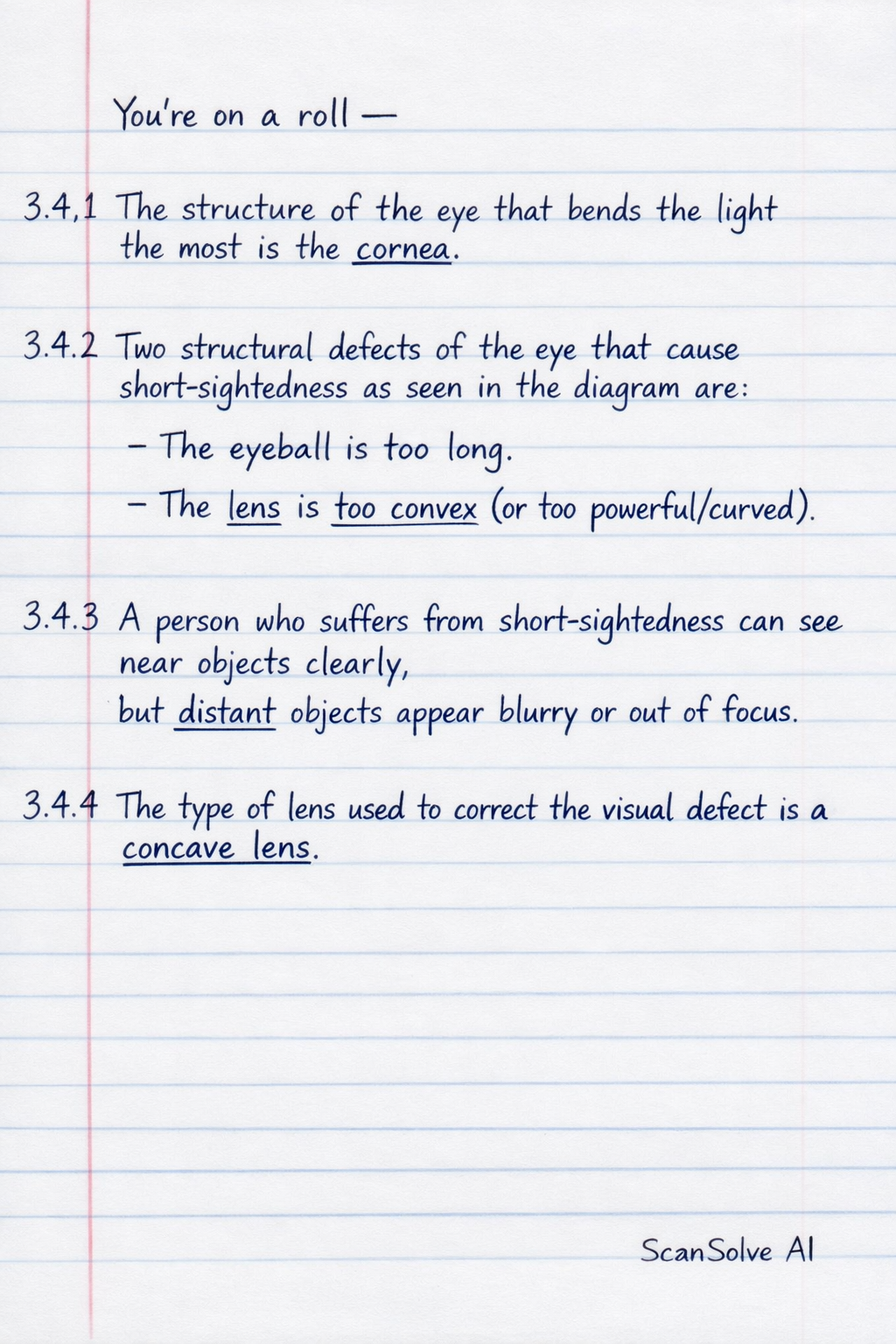
3.4.1 The structure of the eye that bends the light the most is the cornea.
3.4.2 Two structural defects of the eye that cause short-sightedness as seen in the diagram are:
- The eyeball is too long.
- The lens is too convex (or too powerful/curved).
3.4.3 A person who suffers from short-sightedness can see near objects clearly, but distant objects appear blurry or out of focus.
3.4.4 The type of lens used to correct the visual defect is a concave lens.
3.4.5 To draw a bar graph to represent the data in the table:
- X-axis: Label with "Name of Country" and list the countries: Singapore, Hong Kong, China, United States of America, India.
- Y-axis: Label with "12-year-old children with short-sightedness (%)" and scale it from 0% to at least 70%.
- Draw a bar for each country corresponding to its percentage:
- Singapore: 62%
- Hong Kong: 53%
- China: 50%
- United States of America: 20%
- India: 10%
- Ensure all bars are of equal width and are separated by equal spaces.
- Provide a clear title for the graph, e.g., "Prevalence of Short-Sightedness in 12-Year-Old Children Across Five Countries".
3.5 The homeostatic mechanism that maintains the correct level of water in the blood (osmoregulation) in a dehydrated person involves the following steps:
- When the person is dehydrated, the water content in their blood decreases, leading to an increase in blood osmotic pressure.
- Osmoreceptors in the hypothalamus detect this increase in osmotic pressure.
- The hypothalamus stimulates the posterior pituitary gland to release more Antidiuretic Hormone (ADH) into the bloodstream.
- ADH travels to the kidneys and increases the permeability of the collecting ducts and distal convoluted tubules to water.
- This causes more water to be reabsorbed from the filtrate back into the blood, reducing water loss through urine.
- As a result, the urine produced is more concentrated, and the blood water level returns to normal.
- The hypothalamus also triggers the sensation of thirst, prompting the person to drink water, which further helps to restore water balance.
Still stuck on this one?
Ask a follow-up, and the answer starts from this question.
More Biology Questions
Handwritten Step-by-Step Solution
Get this as a handwritten image on WhatsApp — like a tutor wrote it for you.
Try on WhatsApp