

This biology question covers important biological concepts and processes. The step-by-step explanation below helps you understand the underlying mechanisms and reasoning.
ScanSolve AI Answer
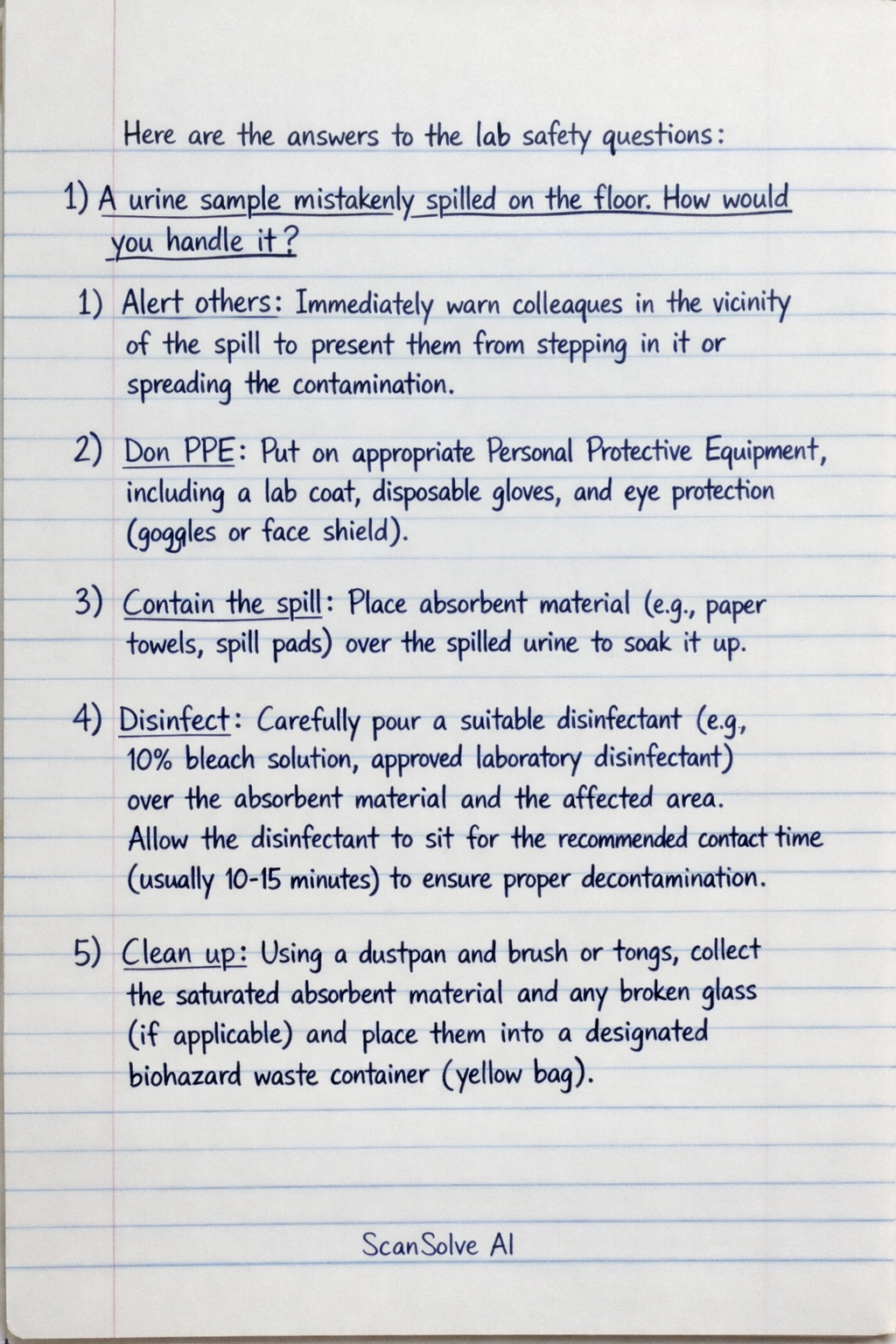
Here are the answers to the lab safety questions: A urine sample mistakenly spilled on the floor. How would you handle it? 1. Alert others: Immediately warn colleagues in the vicinity of the spill to prevent them from stepping in it or spreading the contamination. 2. Don PPE: Put on appropriate Personal Protective Equipment, including a lab coat, disposable gloves, and eye protection (goggles or face shield). 3. Contain the spill: Place absorbent material (e.g., paper towels, spill pads) over the spilled urine to soak it up. 4. Disinfect: Carefully pour a suitable disinfectant (e.g., 10% bleach solution, approved laboratory disinfectant) over the absorbent material and the affected area. Allow the disinfectant to sit for the recommended contact time (usually 10-15 minutes) to ensure proper decontamination. 5. Clean up: Using a dustpan and brush or tongs, collect the saturated absorbent material and any broken glass (if applicable) and place them into a designated biohazard waste container (yellow bag). 6. Final disinfection: Wipe the area again with fresh disinfectant and clean paper towels. 7. Dispose of waste: Seal the biohazard waste container and dispose of it according to laboratory protocols for infectious waste. 8. Remove PPE and wash hands: Carefully remove gloves and other PPE, then thoroughly wash hands with soap and water. You discovered an unlabelled solution in the fridge. What is the best practice in handling it? The best practice for handling an unlabelled solution in the fridge is to treat it as potentially hazardous and unknown. 1. Do not use it: Never use an unlabelled solution, as its identity, concentration, and potential hazards are unknown. 2. Isolate it: If possible and safe to do so (e.g., if it's in a sealed container), move it to a designated "unknowns" or "quarantine" area, or place it in a secondary containment tray within the fridge to prevent accidental use or contamination of other items. 3. Report it: Immediately report the discovery to your supervisor or the laboratory safety officer. 4. Identify or dispose: Efforts should be made to identify the solution if possible (e.g., by checking lab records or asking colleagues). If its identity cannot be determined, it must be disposed of as hazardous waste according to the laboratory's chemical waste disposal protocols. It should never be poured down the drain. You got into the lab and have been provided with PPE consisting of lab coat, goggles, hand gloves, face shield and crocs. Describe in sequence how you will don and doff them. Donning (Putting On) Sequence: 1. Crocs: Put on the crocs first, as they are footwear and should be on before entering the main work area. 2. Lab Coat: Put on the lab coat and fasten all buttons. This protects your clothing and body. 3. Goggles: Place the goggles over your eyes, ensuring a snug fit. 4. Face Shield: Position the face shield over your face, ensuring it covers your entire face from forehead to chin. 5. Hand Gloves: Put on the disposable hand gloves last, pulling the cuffs over the wrists of the lab coat to ensure full coverage and prevent skin exposure. Doffing (Taking Off) Sequence: 1. Hand Gloves: Carefully remove the gloves first, turning them inside out as you peel them off to avoid touching the contaminated outer surface. Dispose of them in the appropriate waste bin. 2. Face Shield: Remove the face shield by handling the head strap or ear pieces, avoiding touching the front surface. Place it in a designated cleaning area or waste bin. 3. Goggles: Remove the goggles by handling the ear pieces or strap, avoiding touching the front surface. Place them in a designated cleaning area. 4. Lab Coat: Unfasten the lab coat and remove it, turning it inside out as you take it off to contain any potential contamination. Place it in a designated laundry hamper or biohazard waste bin if heavily contaminated. 5. Crocs: Remove the crocs after leaving the contaminated work area, or as the final step before leaving the lab. On the lab bench is a cotton wool soaked with blood, a condemned lab request form and a broken petri dish. How would you segregate and discard them. Explain why. 1. Cotton wool soaked with blood: Segregation: Place in a yellow biohazard waste bag/container*. Reason: This is infectious waste (specifically, pathological/sharps waste* if it's a sharp object, but cotton wool is soft waste). It contains human blood, which is a potentially infectious material and must be treated as biohazardous to prevent the spread of pathogens. 2. Condemned lab request form: Segregation: Place in a black general waste bin*. Reason: This is general waste*. Assuming "condemned" means it's a discarded paper form that is not contaminated with blood or body fluids, it can be disposed of as regular office waste. If it were contaminated, it would go into a yellow biohazard bag. 3. Broken petri dish: Segregation: Place in a puncture-resistant sharps container* (often blue or white with a biohazard symbol). Reason: This is sharps waste due to the broken glass, posing a physical hazard (cuts). Additionally, if it's a used petri dish, it is also infectious waste* (biohazardous) as it likely contained microbial cultures. The sharps container protects personnel from injury and contains the biological hazard.