
SI1CTION B (20 marks) (Answer all Questions) A bladder containing an attached single invaginated scolex is called (2 marks) The expansion of blood vessels which could be due to parasitic activities is called (2 marks) An organism that may Lie free living, but could also obtain nutrition lrom a host is callcd An organism in which the parasite reaches the adult stage and reproduces serually, is oallcd An organism in which the parasite reaches the adult stage and reproduces sexually. is callcd . . The chain of segments which constitute a cestode is known as .. An example of nematodes in the large intestine is ... . .. Mange is an example of ... ..... Arachnid The parasite causing malarra in monkey is called Coccidia belongs to the family SECTION C (40 marks) (Answer any two questions) Question Three a. In which of the domains of lit'e can trypanosoma species be catcgorized'/ (2 rrarks) b. Give two (2) examples each of, i. acarine arachnid$(4 marks) Question One a. You are invited to attend to a flock of sheep graz,ing behind Schroder llall. Your prelirnirrary irtvcstrrritliotr suggests olpossible cestode infestation" i. Explain the possible means by rvhich the cestodes were transmitteclto thesc antmals (2 inail.i) ii. What kind of life cycle does these cestodes have'/ (2 marks) iii" What stage of the life cycle of these cestodes would you desoribe as infective'/ (2 ttrarks) iv. Givetwo (2) forms ortypes of larval stages inwhich an egg of these cestodes oould devclop into (4 marks) b. Discuss five (5) factors that are common to both Plo,vnodium htot+'le,si and Lei.shtrtcrniu spectes. (10 urarks) Question Two a. Match the terms in A with those in Il 8 a Ti AC . e c C s k o t s o n d si e d , e C r o t c h ci e di f oll a o s wi p p n . , g T r o e r m g a a ni t o s cl m e s s , ; c o c ci di a BO anterior ryop soma, etrb gnatho miraci a, horr":.di unicellular" o s p c y p s . , t , pl s a c s ol m e o x di , p u o m s t e s r p i o p r , i di t r o y s p o a r n u o a s " o suckct.<tral m a s p p Name one host each that can be inlected by theser parasites (6 marks). i" What is common to all of them'/ (2 marks) ii. b. Give one (1) example each of cestodes afl-octing dog and cattlc (4 ntarks)
ScanSolve AI Answer
here are the answers to the parasitology questions:
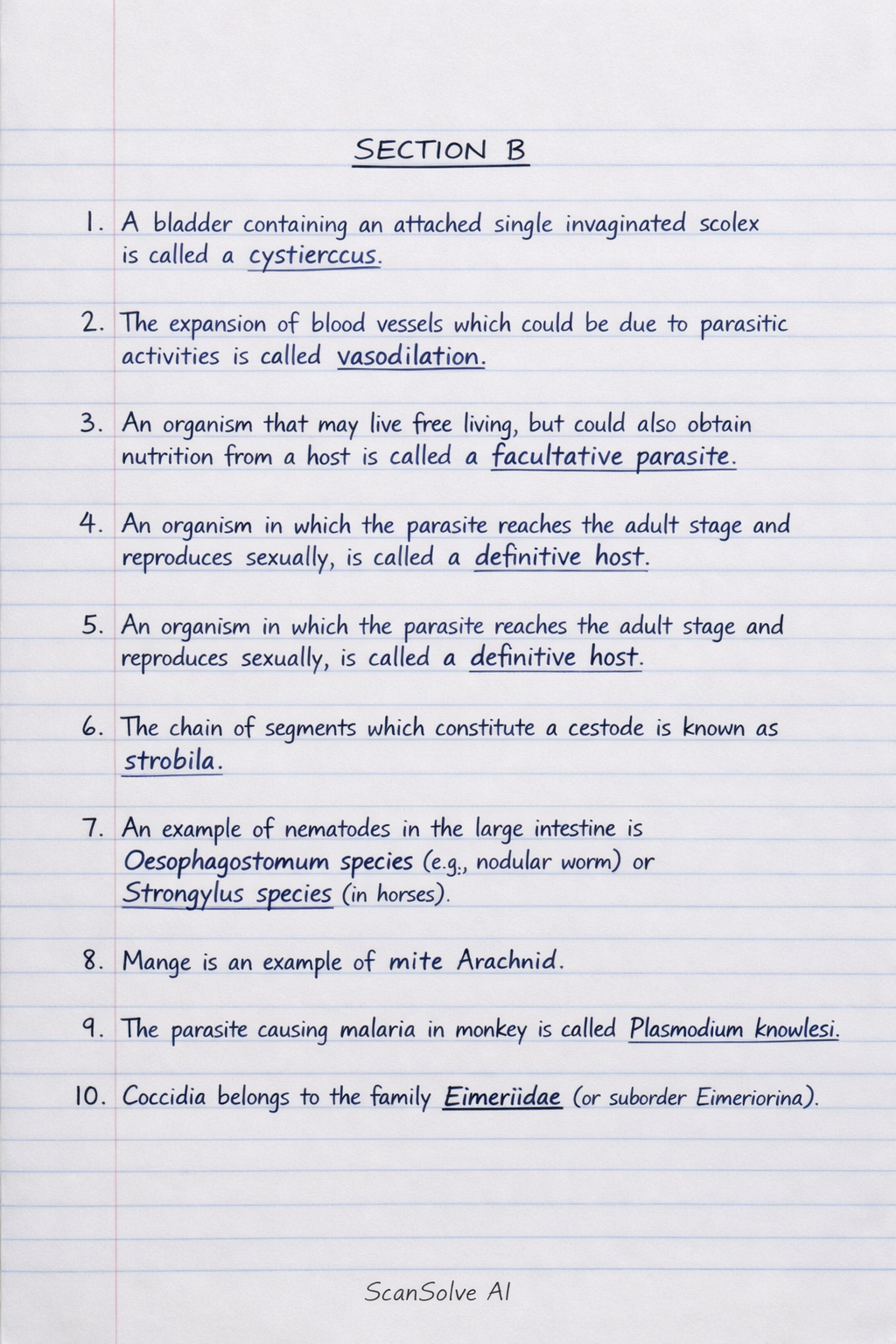
SECTION B
- A bladder containing an attached single invaginated scolex is called a cysticercus.
- The expansion of blood vessels which could be due to parasitic activities is called vasodilation.
- An organism that may live free living, but could also obtain nutrition from a host is called a facultative parasite.
- An organism in which the parasite reaches the adult stage and reproduces sexually, is called a definitive host.
- An organism in which the parasite reaches the adult stage and reproduces sexually, is called a definitive host.
- The chain of segments which constitute a cestode is known as strobila.
- An example of nematodes in the large intestine is Oesophagostomum species (e.g., nodular worm) or Strongylus species (in horses).
- Mange is an example of mite Arachnid.
- The parasite causing malaria in monkey is called Plasmodium knowlesi.
- Coccidia belongs to the family Eimeriidae (or suborder Eimeriorina).
SECTION C
Question One
a. Cestode infestation in sheep:
i. Explain the possible means by which the cestodes were transmitted to these animals.
Cestodes are typically transmitted to sheep through the ingestion of an intermediate host that harbors the infective larval stage of the parasite. For many common sheep cestodes (e.g., Moniezia species), the intermediate host is a pasture mite (oribatid mite) which ingests the cestode eggs. Sheep become infected by grazing on pastures contaminated with these infected mites.
ii. What kind of life cycle do these cestodes have?
These cestodes have an indirect life cycle, meaning they require at least one intermediate host (e.g., pasture mite) to complete their development and transmission to the definitive host (sheep).
iii. What stage of the life cycle of these cestodes would you describe as infective?
The infective stage for the sheep (definitive host) is the cysticercoid (larval stage) found within the intermediate host (pasture mite).
iv. Give two (2) forms or types of larval stages in which an egg of these cestodes could develop into.
Two forms of larval stages that an egg of cestodes could develop into are:
- Cysticercoid: A small, solid larval stage found in invertebrate intermediate hosts (e.g., Moniezia in mites).
- Cysticercus: A bladder-like larval stage containing a single invaginated scolex, typically found in vertebrate intermediate hosts (e.g., Taenia ovis in sheep muscle).
b. Discuss five (5) factors that are common to both Plasmodium knowlesi and Leishmania species.
Here are five common factors:
- Vector-borne Transmission: Both Plasmodium knowlesi and Leishmania species are transmitted to their mammalian hosts through the bite of an arthropod vector. Plasmodium knowlesi is transmitted by Anopheles mosquitoes, while Leishmania species are transmitted by sandflies.
- Intracellular Parasitism: Both parasites are obligate intracellular parasites during at least part of their life cycle in the mammalian host. Plasmodium knowlesi infects red blood cells and liver cells, while Leishmania species infect macrophages.
- Zoonotic Potential: Both can cause zoonotic diseases, meaning they can be transmitted from animals to humans. Plasmodium knowlesi is primarily a parasite of macaques but can cause malaria in humans. Leishmania species have various animal reservoirs (e.g., rodents, dogs) that can transmit the disease to humans.
- Complex Life Cycles: Both parasites exhibit complex life cycles involving multiple developmental stages and hosts (definitive and intermediate/vector).
- Geographical Distribution: Both diseases are prevalent in tropical and subtropical regions, often overlapping in areas where their respective vectors and hosts are found.
Question Two
a. Match the terms in A with those in B:
- Trypanosoma: anterior trypomastigote (a specific morphological stage)
- Coccidia: oocysts (the resistant, infective stage shed in feces)
- Trematodes: miracidia (the ciliated larval stage that infects the first intermediate host, usually a snail)
- Cestodes: proglottids (segments of the strobila containing reproductive organs)
- Nematodes: dioecious (having separate male and female individuals)
i. What is common to all of them?
All of them are parasites.
ii. Name one host each that can be infected by these parasites.
- Trypanosoma: Human (e.g., Trypanosoma brucei causing sleeping sickness)
- Coccidia: Chicken (e.g., Eimeria tenella causing coccidiosis)
- Trematodes: Snail (as a first intermediate host for many species)
- Cestodes: Dog (e.g., Taenia hydatigena)
- Nematodes: Sheep (e.g., Haemonchus contortus)
b. Give one (1) example each of cestodes affecting dog and cattle.
- Cestode affecting dog: Dipylidium caninum (flea tapeworm) or Taenia hydatigena.
- Cestode affecting cattle: Moniezia expansa (ruminant tapeworm) or Taenia saginata (larval stage, Cysticercus bovis, in cattle).
Still stuck on this one?
Ask a follow-up, and the answer starts from this question.
More Biology Questions
Handwritten Step-by-Step Solution
Get this as a handwritten image on WhatsApp — like a tutor wrote it for you.
Try on WhatsApp