
We read your photo as:
Explain the significance of lung volumes and capacities, how heart conditions affect them, and why vital capacity varies with posture.
ScanSolve AI Answer
-
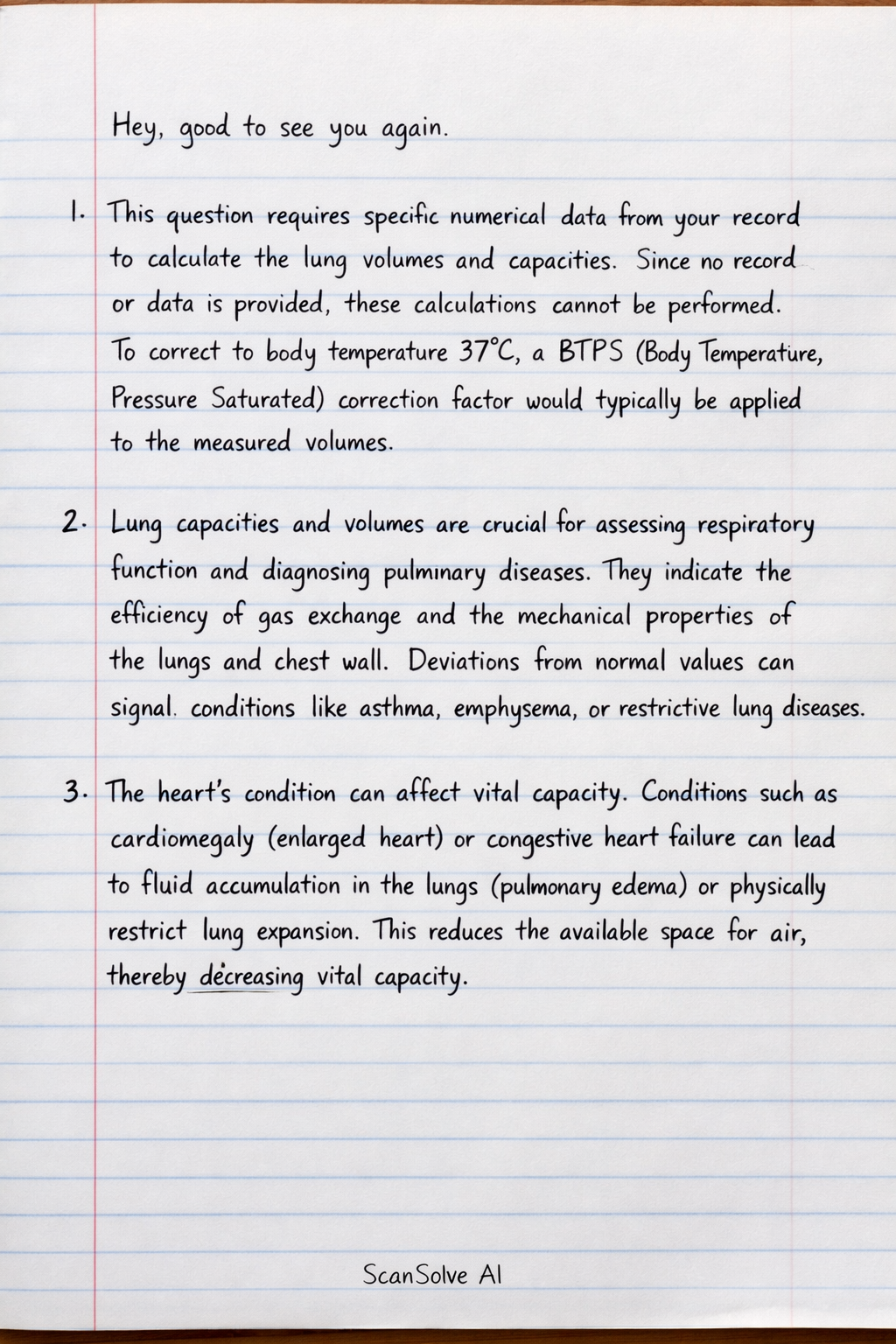
This question requires specific numerical data from your record to calculate the lung volumes and capacities. Since no record or data is provided, these calculations cannot be performed. To correct to body temperature 37°C, a BTPS (Body Temperature, Pressure Saturated) correction factor would typically be applied to the measured volumes.
-
Lung capacities and volumes are crucial for assessing respiratory function and diagnosing pulmonary diseases. They indicate the efficiency of gas exchange and the mechanical properties of the lungs and chest wall. Deviations from normal values can signal conditions like asthma, emphysema, or restrictive lung diseases.
-
The heart's condition can affect vital capacity. Conditions such as cardiomegaly (enlarged heart) or congestive heart failure can lead to fluid accumulation in the lungs (pulmonary edema) or physically restrict lung expansion. This reduces the available space for air, thereby decreasing vital capacity.
-
Vital capacity is greater in standing posture because gravity pulls the abdominal contents downwards, allowing the diaphragm to descend more fully during inspiration. In sitting and especially supine positions, the abdominal organs push upwards against the diaphragm, restricting its movement and reducing the maximum volume of air the lungs can hold.
Still stuck on this one?
Ask a follow-up, and the answer starts from this question.
More Biology Questions
Handwritten Step-by-Step Solution
Get this as a handwritten image on WhatsApp — like a tutor wrote it for you.
Try on WhatsApp