
We read your photo as:
Which strategy would BEST reduce hospital-acquired (nosocomial) infections, and which enzyme helps bacteria spread through connective tissue?
Biology
ScanSolve AI Answer
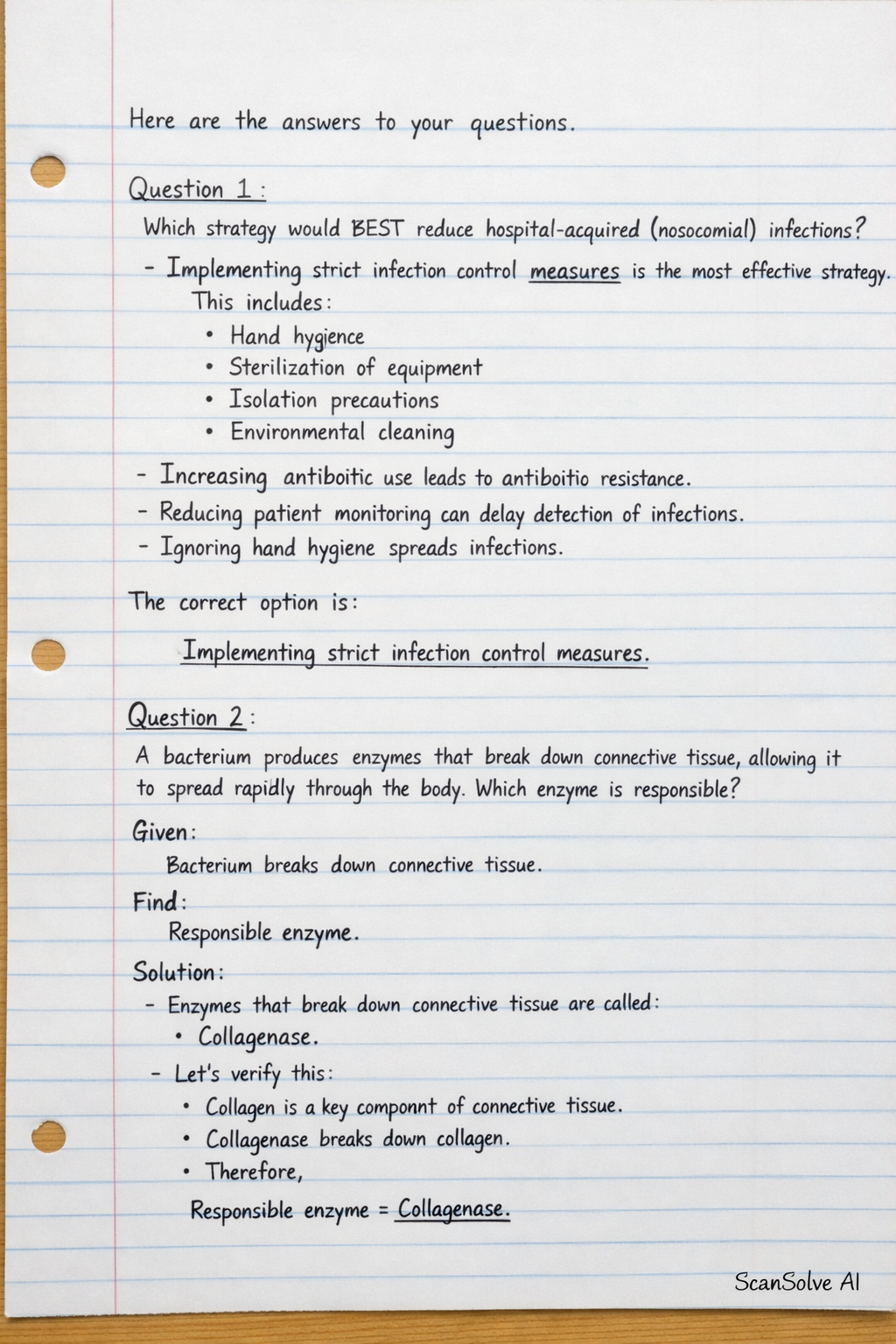
Here are the answers to your questions.
Question 1:
Which strategy would BEST reduce hospital-acquired (nosocomial) infections?
- Implementing strict infection control measures is the most effective strategy. This includes practices like hand hygiene, sterilization of equipment, isolation precautions, and environmental cleaning, all of which directly prevent the transmission of pathogens within a healthcare setting.
- Increasing antibiotic use indiscriminately contributes to antibiotic resistance, making infections harder to treat.
- Reducing patient monitoring would likely lead to delayed detection and treatment of infections.
- Ignoring hand hygiene protocols would significantly increase the spread of infections.
The correct option is:
- Implementing strict infection control measures
Question 2:
A bacterium produces enzymes that break down connective tissue, allowing it to spread rapidly through the body. Which enzyme is responsible?
- Hyaluronidase is an enzyme produced by some bacteria that breaks down hyaluronic acid, a key component of the extracellular matrix and connective tissue. This action allows bacteria to spread more easily through tissues, acting as a "spreading factor."
- Catalase breaks down hydrogen peroxide.
- Lipase breaks down lipids.
- Coagulase causes blood plasma to clot.
The correct option is:
- Hyaluronidase
Was this helpful?
Still stuck on this one?
Ask a follow-up, and the answer starts from this question.
Got a different question?Ask your own question
More Biology Questions
QA bacterium produces enzymes that break down connective tissue, allowing it to spread rapidly…QWhat is an effective way to prevent the spread of infection?QWhich strategy would BEST reduce hospital-acquired (nosocomial) infections? 1 point Reducing patient…QWhat are the answers to these biology questions about bacterial staining, cellular classification…QInfection control in medicine: Fleming, Lister, and antiseptic methods.
Handwritten Step-by-Step Solution
Get this as a handwritten image on WhatsApp — like a tutor wrote it for you.
Try on WhatsApp