
Which strategy would BEST reduce hospital-acquired (nosocomial) infections? 1 point Reducing patient monitoring Implementing strict infection control measures Increasing antibiotic use indiscriminately Ignoring hand hygiene protocols Assertion (A): Yeasts reproduce by budding. Reason (R): Yeasts are multicellular filamentous organisms. 1 point Both A and R are true, but R does NOT explain A Both Assertion (A) and Reason (R) are true, and R correctly explains A A is true, but R is false A is false, but R is true The cell wall of most bacteria is primarily composed of: 1 point Cellulose and lignin Proteins and nucleic acids Peptidoglycan and lipids Chitin and sterols A bacterium produces enzymes that break down connective tissue, allowing it to spread rapidly through the body. Which enzyme is responsible? 1 point Coagulase Hyaluronidase Catalase Lipase A laboratory report shows pink-colored bacilli after Gram staining. These bacteria are most likely: 1 point Gram-positive cocci Gram-negative bacilli Acid-fast bacteria Spore-forming bacteria Which group of microorganisms is classified as acellular? 1 point Bacteria and fungi Algae and fungi Viruses and prions Protozoa and helminths Which factor would MOST likely inhibit bacterial growth in food preservation? 1 point Neutral pH Warm temperature High moisture content High salt concentration A 25-year-old patient presents with urethral discharge. Microscopy shows Gram-negative intracellular diplococci. The likely diagnosis is: 1 point Tuberculosis Syphilis Gonorrhea Candidiasis Name and Index Number Assertion (A): Gram-negative bacteria appear pink after staining. Reason (R): They have a thin peptidoglycan layer and lose crystal violet during decolorization. 1 point A is true, R is false Both A and R are true, and R explains A A is false, R is true Both A and R are true, but R does not explain A Assertion (A): Parasites benefit from the host. Reason (R): The host benefits equally from the parasite. * 1 point Both A and R are true, but R does NOT explain A Both Assertion (A) and Reason (R) are true, and R correctly explains A A is true, but R is false A is false, but R is true Never submit passwords through Google Forms. This content is neither created nor endorsed by Google. - Contact form owner - Terms of Service - Privacy Policy
ScanSolve AI Answer
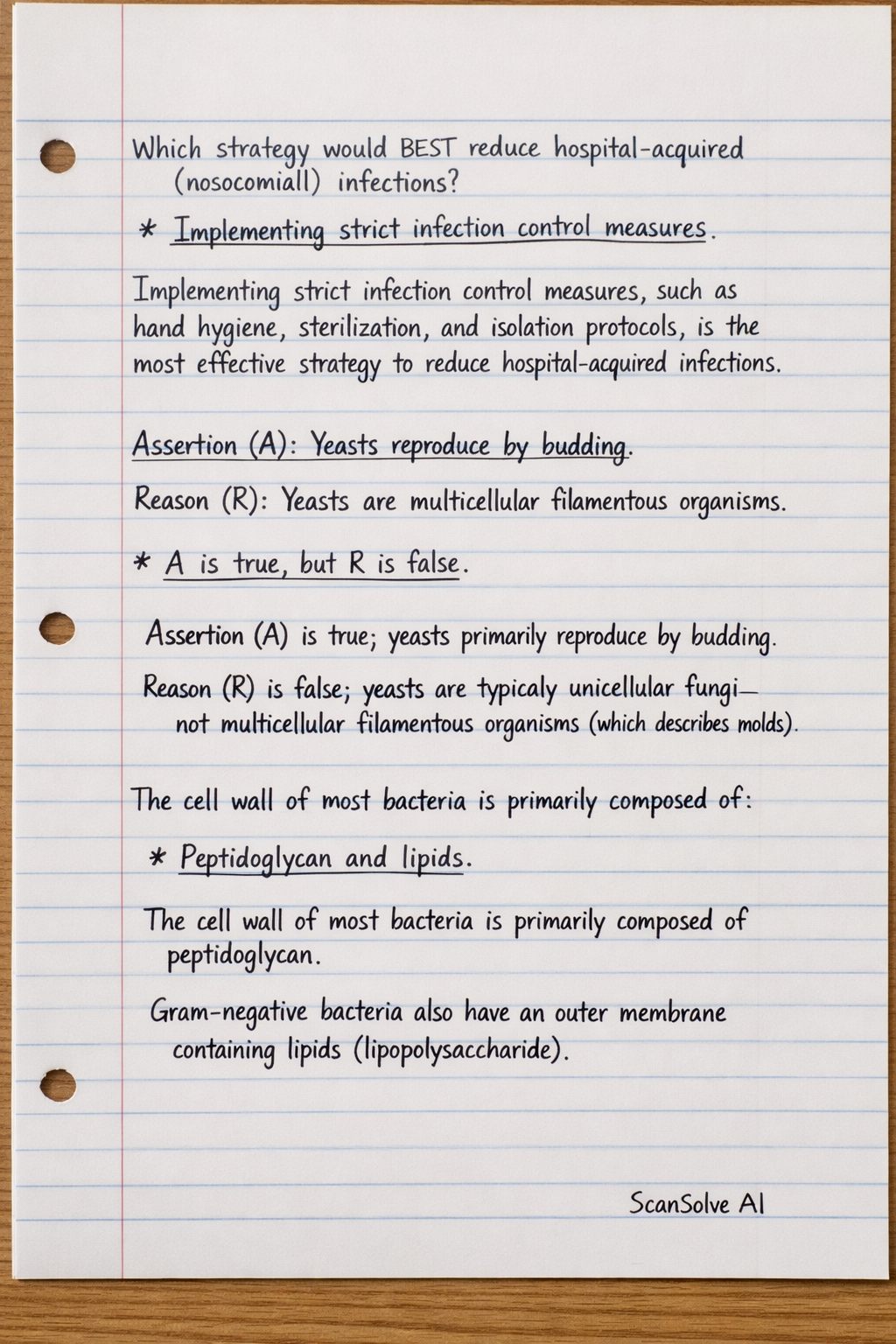
Which strategy would BEST reduce hospital-acquired (nosocomial) infections?
- Implementing strict infection control measures Implementing strict infection control measures, such as hand hygiene, sterilization, and isolation protocols, is the most effective strategy to reduce hospital-acquired infections.
Assertion (A): Yeasts reproduce by budding.
Reason (R): Yeasts are multicellular filamentous organisms.
- A is true, but R is false Assertion (A) is true; yeasts primarily reproduce by budding. Reason (R) is false; yeasts are typically unicellular fungi, not multicellular filamentous organisms (which describes molds).
The cell wall of most bacteria is primarily composed of:
- Peptidoglycan and lipids The cell wall of most bacteria is primarily composed of peptidoglycan. Gram-negative bacteria also have an outer membrane containing lipids (lipopolysaccharide).
A bacterium produces enzymes that break down connective tissue, allowing it to spread rapidly through the body. Which enzyme is responsible?
- Hyaluronidase Hyaluronidase breaks down hyaluronic acid, a component of connective tissue, allowing bacteria to spread.
A laboratory report shows pink-colored bacilli after Gram staining. These bacteria are most likely:
- Gram-negative bacilli Gram-negative bacteria stain pink/red and are often rod-shaped (bacilli).
Which group of microorganisms is classified as acellular?
- Viruses and prions Viruses and prions are acellular, meaning they lack cellular structures and are not considered living organisms in the traditional sense.
Which factor would MOST likely inhibit bacterial growth in food preservation?
- High salt concentration High salt concentration creates a hypertonic environment, drawing water out of bacterial cells and inhibiting their growth (osmotic stress).
A 25-year-old patient presents with urethral discharge. Microscopy shows Gram-negative intracellular diplococci. The likely diagnosis is:
- Gonorrhea The presence of Gram-negative intracellular diplococci in urethral discharge is a classic microscopic finding for Neisseria gonorrhoeae, which causes gonorrhea.
Assertion (A): Gram-negative bacteria appear pink after staining.
Reason (R): They have a thin peptidoglycan layer and lose crystal violet during decolorization.
- Both A and R are true, and R explains A Assertion (A) is true; Gram-negative bacteria stain pink/red. Reason (R) is also true and correctly explains A; their thin peptidoglycan layer allows the crystal violet-iodine complex to be washed out during decolorization, making them counterstain with safranin (pink).
Assertion (A): Parasites benefit from the host.
Reason (R): The host benefits equally from the parasite.
- A is true, but R is false Assertion (A) is true; parasites obtain nutrients and shelter from their host. Reason (R) is false; the host is typically harmed or negatively affected by the parasite, not equally benefited.
Still stuck on this one?
Ask a follow-up, and the answer starts from this question.
More English Questions
Handwritten Step-by-Step Solution
Get this as a handwritten image on WhatsApp — like a tutor wrote it for you.
Try on WhatsApp