
We read your photo as:
Describe the structure and function of proteins, and list seven roles of carbohydrates in a plant.
Biology
ScanSolve AI Answer
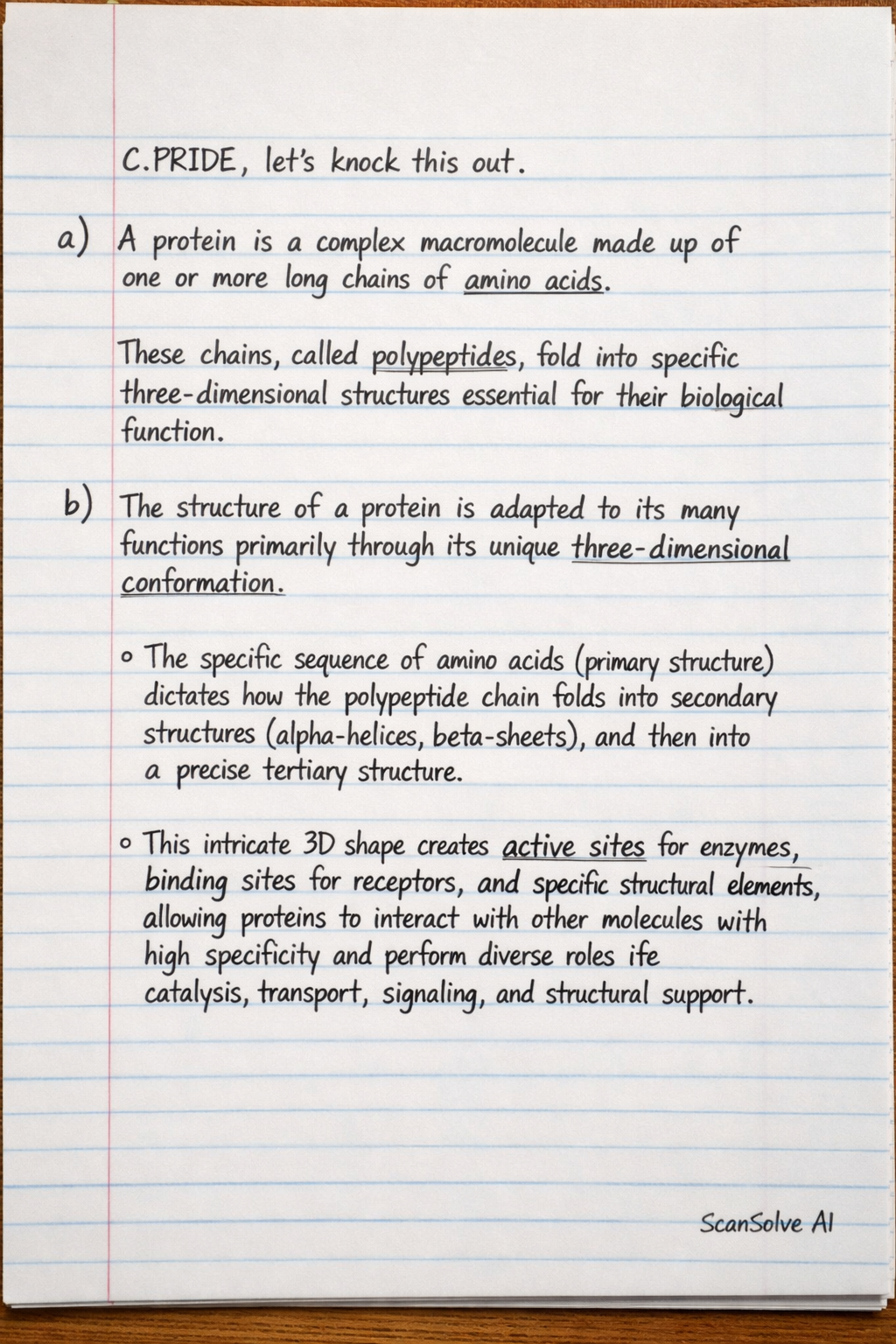
a) A protein is a complex macromolecule made up of one or more long chains of amino acids. These chains, called polypeptides, fold into specific three-dimensional structures essential for their biological function.
b) The structure of a protein is adapted to its many functions primarily through its unique three-dimensional conformation.
- The specific sequence of amino acids (primary structure) dictates how the polypeptide chain folds into secondary structures (alpha-helices, beta-sheets), and then into a precise tertiary structure.
- This intricate 3D shape creates active sites for enzymes, binding sites for receptors, and specific structural elements, allowing proteins to interact with other molecules with high specificity and perform diverse roles like catalysis, transport, signaling, and structural support.
c) Here are seven roles of carbohydrates in a plant:
- Energy storage: Starch serves as the primary long-term energy reserve.
- Structural support: Cellulose is the main component of plant cell walls, providing rigidity and strength.
- Transport: Sucrose is the main form in which sugars are transported throughout the plant.
- Cell recognition: Glycoproteins and glycolipids on cell surfaces can be involved in cell-to-cell communication.
- Components of nucleic acids: Ribose and deoxyribose are essential sugars in RNA and DNA, respectively.
- Osmotic regulation: Sugars contribute to maintaining turgor pressure within plant cells.
- Precursors for other molecules: Carbohydrates can be converted into other organic molecules like amino acids and lipids.
d) The structural differences between cellulose and starch are:
- Glycosidic Linkage: Cellulose consists of glucose units linked by , while starch (amylose and amylopectin) consists of glucose units linked by (and in amylopectin).
- Branching: Cellulose is an , forming long, straight chains. Starch, on the other hand, can be or .
- Overall Structure: The -linkages in cellulose allow for extensive hydrogen bonding between parallel chains, forming strong, rigid microfibrils. The -linkages in starch cause the polymer to coil into a helical structure, making it more compact and easily digestible.
Was this helpful?
Still stuck on this one?
Ask a follow-up, and the answer starts from this question.
Got a different question?Ask your own question
More Biology Questions
QThe diagram below represents a plant cell. (a) Name a carbohydrate which forms part of the structure…QPlant Cell Structure, Tissues, and Their Functions Plant Cell Organelles List and explain the…QIdentify the organelles and processes involved in photosynthesis and cellular respiration, and the…QWhat are the main components of a plant cell and their functions?QWhat are the main functions of carbohydrates in the human body and in biological systems?
Browse by topic:Biochemistry
Handwritten Step-by-Step Solution
Get this as a handwritten image on WhatsApp — like a tutor wrote it for you.
Try on WhatsApp