
We read your photo as:
Describe the structure of a mould fungus and explain the differences between parasitism and saprophytism, giving examples of fungi useful and harmful to humans.
ScanSolve AI Answer
Step-by-step solution
6 stepsJUNE 2013 SECTION A
-
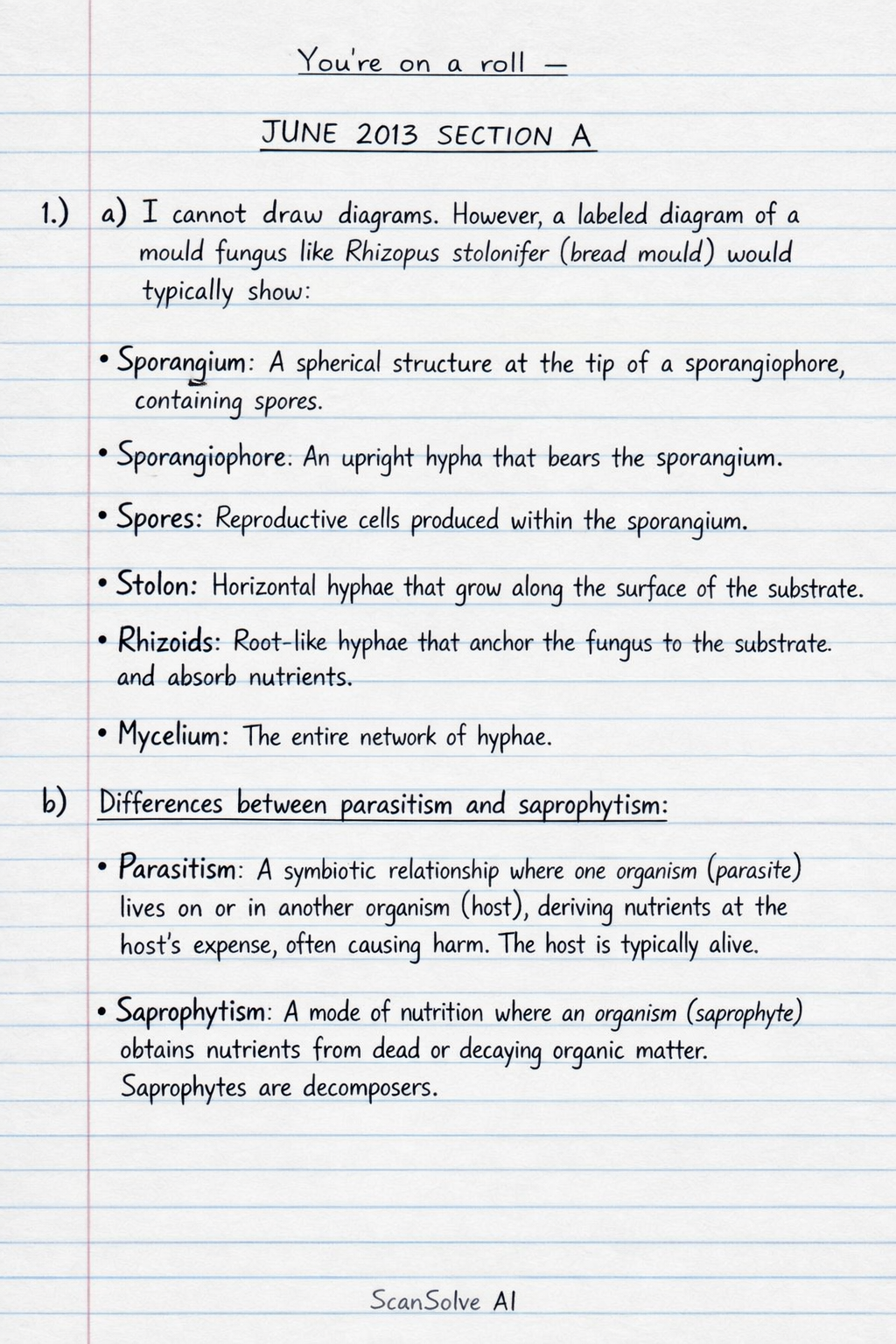
a) I cannot draw diagrams. However, a labeled diagram of a mould fungus like Rhizopus stolonifer (bread mould) would typically show:
- Sporangium: A spherical structure at the tip of a sporangiophore, containing spores.
- Sporangiophore: An upright hypha that bears the sporangium.
- Spores: Reproductive cells produced within the sporangium.
- Stolon: Horizontal hyphae that grow along the surface of the substrate.
- Rhizoids: Root-like hyphae that anchor the fungus to the substrate and absorb nutrients.
- Mycelium: The entire network of hyphae.
b) Differences between parasitism and saprophytism:
- Parasitism: A symbiotic relationship where one organism (parasite) lives on or in another organism (host), deriving nutrients at the host's expense, often causing harm. The host is typically alive.
- Saprophytism: A mode of nutrition where an organism (saprophyte) obtains nutrients from dead or decaying organic matter. Saprophytes are decomposers.
c) Fungi are both useful and harmful to humans:
- Useful aspects:
- Food: Mushrooms (e.g., button mushrooms, shiitake) are consumed as food. Yeast (Saccharomyces cerevisiae) is used in baking (bread) and brewing (beer, wine).
- Medicine: Penicillin, an antibiotic, is produced by the fungus Penicillium chrysogenum. Other fungi produce immunosuppressants (e.g., cyclosporine).
- Decomposition: Saprophytic fungi break down dead organic matter, recycling nutrients back into the ecosystem, which is vital for soil fertility.
- Biocontrol: Some fungi are used as biological pesticides to control insect pests.
- Harmful aspects:
- Diseases: Fungi cause various diseases in humans (e.g., athlete's foot, ringworm, candidiasis) and in plants (e.g., rusts, smuts, blights), leading to crop losses.
- Food spoilage: Fungi cause food spoilage, making food inedible and sometimes producing toxins (mycotoxins).
- Allergies: Spores from some fungi can trigger allergic reactions in sensitive individuals.
- Structural damage: Some fungi can cause rot and decay in timber and other materials.
-
a) Water is important to animals in several ways:
- Solvent: It acts as a universal solvent, allowing metabolic reactions to occur and transporting nutrients, gases, and waste products.
- Transport medium: It is the main component of blood and lymph, facilitating the transport of substances throughout the body.
- Temperature regulation: Water has a high specific heat capacity and latent heat of vaporization, helping to regulate body temperature through sweating or panting.
- Lubrication: It lubricates joints, eyes, and other body parts.
- Structural support: It provides turgor pressure in cells and helps maintain the shape of some organisms.
- Reactant: It is a reactant in many biochemical reactions, such as hydrolysis.
- Excretion: It helps in the excretion of waste products through urine.
b) Adaptations of fish to life in water:
- Streamlined body shape: Reduces drag and allows for efficient movement through water.
- Gills: Specialized respiratory organs for extracting dissolved oxygen from water.
- Fins: Provide propulsion, steering, and stability in water.
- Swim bladder: An air-filled sac that helps control buoyancy, allowing fish to maintain depth without expending much energy.
- Lateral line system: A sensory organ that detects vibrations and pressure changes in the water, helping with navigation and detecting predators/prey.
- Scales and mucus: Provide protection and reduce friction, while mucus also protects against pathogens.
- Osmoregulation: Specialized kidneys and gills help maintain water and salt balance in freshwater or saltwater environments.
c) Economic importance of fish:
- Food source: Fish are a major source of protein and essential nutrients for human consumption worldwide.
- Employment: The fishing industry provides jobs for millions of people in fishing, processing, and related sectors.
- Trade and income: Fish and seafood products are significant commodities in international trade, generating income for many countries.
- Aquaculture: Fish farming contributes to food security and economic development.
- By-products: Fish yield valuable by-products such as fish oil (rich in omega-3 fatty acids), fishmeal (for animal feed), and fertilizers.
- Tourism and recreation: Recreational fishing and marine tourism contribute to local economies.
-
a) Respiration is the biochemical process by which living organisms obtain energy (in the form of ATP) from the breakdown of organic substances (like glucose), typically involving the uptake of oxygen and release of carbon dioxide and water.
b) Experiment to show that carbon dioxide is released during aerobic respiration:
Take two conical flasks, A and B.
In flask A, place a quantity of germinating maize seeds.
In flask B, place an equal quantity of boiled and cooled maize seeds (dead seeds), treated with an antiseptic to prevent bacterial decomposition.
Place a small test tube containing limewater (calcium hydroxide solution) into each flask, ensuring it does not touch the seeds.
Seal both flasks tightly with rubber stoppers.
Leave the apparatus undisturbed for 24-48 hours in a warm, dark place.
Observation: After the incubation period, the limewater in flask A (with germinating seeds) will turn **milky/cloudy**, indicating the presence of carbon dioxide. The limewater in flask B (with dead seeds) will remain clear. Conclusion: The change in limewater in flask A demonstrates that carbon dioxide is produced by germinating seeds during respiration. c) Effects of smoke on the respiratory system:- Irritation and inflammation: Smoke contains irritants that inflame the lining of the respiratory tract, leading to coughing and increased mucus production.
- Damage to cilia: Toxins in smoke paralyze and destroy the cilia (tiny hairs) that line the airways, impairing their ability to sweep away mucus, dust, and pathogens. This leads to a buildup of mucus and increased risk of infections.
- Reduced lung function: Long-term exposure can lead to chronic bronchitis, emphysema (damage to alveoli), and reduced lung capacity, making breathing difficult.
- Increased risk of cancer: Carcinogens in smoke can cause mutations in lung cells, significantly increasing the risk of lung cancer and other respiratory cancers.
- Reduced oxygen transport: Carbon monoxide in smoke binds irreversibly to hemoglobin, reducing the blood's oxygen-carrying capacity.
-
a) Define the following terms: i) Pollution: The introduction of harmful substances or products into the environment, causing adverse effects on living organisms and the ecosystem. ii) Environment: The sum total of all living (biotic) and non-living (abiotic) factors and conditions that surround an organism and influence its survival, growth, and development.
b) Effects of the following on the environment:
i) Deforestation: - Loss of biodiversity: Destroys habitats, leading to the extinction of plant and animal species. - Climate change: Reduces the absorption of carbon dioxide, contributing to increased greenhouse gases and global warming. - Soil erosion: Removes tree cover, making soil vulnerable to erosion by wind and rain, leading to loss of fertile topsoil. - Disruption of water cycle: Reduces transpiration and rainfall, leading to drier climates and increased risk of droughts. - Desertification: Can lead to the degradation of land in arid and semi-arid areas. ii) Overfishing: - Depletion of fish stocks: Reduces fish populations to unsustainable levels, threatening the long-term viability of species. - Disruption of marine ecosystems: Removes key species from the food web, impacting predator-prey relationships and overall ecosystem balance. - Bycatch: Non-target species (including endangered ones) are often caught and discarded, further impacting biodiversity. - Habitat destruction: Certain fishing methods (e.g., bottom trawling) can destroy marine habitats like coral reefs and seagrass beds. - Economic impact: Leads to job losses and reduced income for fishing communities in the long run. iii) Use of pesticides: - Water and soil pollution: Pesticides can leach into groundwater and run off into surface water bodies, contaminating drinking water and harming aquatic life. - Harm to non-target organisms: Can kill beneficial insects (e.g., pollinators), birds, and other wildlife, disrupting ecosystems. - Bioaccumulation and biomagnification: Pesticides can accumulate in the tissues of organisms and become more concentrated at higher trophic levels in the food chain, posing risks to top predators and humans. - Pesticide resistance: Overuse can lead to pests developing resistance, requiring stronger or new chemicals. - Human health risks: Exposure to pesticides can cause various health problems in humans, including neurological issues, reproductive problems, and cancer.
SECTION B
-
a) Differences between mitosis and meiosis:
- Purpose: Mitosis is for growth, repair, and asexual reproduction, producing identical daughter cells. Meiosis is for sexual reproduction, producing gametes (sperm/egg) or spores with half the chromosome number.
- Number of divisions: Mitosis involves one nuclear division. Meiosis involves two nuclear divisions (Meiosis I and Meiosis II).
- Number of daughter cells: Mitosis produces two diploid (2n) daughter cells. Meiosis produces four haploid (n) daughter cells.
- Chromosome number: Mitosis maintains the chromosome number of the parent cell. Meiosis halves the chromosome number of the parent cell.
- Genetic variation: Mitosis produces genetically identical daughter cells. Meiosis introduces genetic variation through crossing over and independent assortment of chromosomes.
- Location: Mitosis occurs in somatic cells. Meiosis occurs in germline cells (gonads).
b) A test cross is a genetic cross between an individual with an unknown genotype (but expressing a dominant phenotype) and a homozygous recessive individual. Its purpose is to determine the unknown genotype of the dominant-phenotype individual. If any recessive offspring are produced, the unknown individual must be heterozygous.
c) In a family, the gene for black hair is dominant and the gene for brown hair is recessive.
Let B = allele for black hair (dominant)
Let b = allele for brown hair (recessive)Father: Homozygous for black hair = BB
Mother: Heterozygous for black hair = Bbi) Genetics of the cross between the father and the mother:
Parental Genotypes: Father (BB) Mother (Bb)
Gametes from Father: B, B
Gametes from Mother: B, bPunnett Square:
Offspring Genotypes: 50% BB, 50% Bb
Offspring Phenotypes: All (100%) will have black hair.ii) If the offspring from the cross above mate with a double recessive individual:
The offspring from the first cross are either BB or Bb. Since the question asks "If the offspring from the cross above mate...", it implies a general case or one of the types. Given the context of genetics problems, it usually refers to the heterozygous offspring if a recessive phenotype is to be observed in the next generation. Let's assume one of the heterozygous offspring (Bb) mates with a double recessive individual (bb).Parental Genotypes: Offspring (Bb) Double recessive (bb)
Gametes from Offspring: B, b
Gametes from Double recessive: b, bPunnett Square:
Phenotype and Genotype of the offspring:
Genotypes: 50% Bb, 50% bb
Phenotypes: 50% black hair, 50% brown hair
Therefore, the phenotype and genotype of the offspring would be:- Phenotype: 50% black hair, 50% brown hair
- Genotype: 50% Bb, 50% bb
-
a) Functions of the mammalian brain
Still stuck on this one?
Ask a follow-up, and the answer starts from this question.
More Biology Questions
Handwritten Step-by-Step Solution
Get this as a handwritten image on WhatsApp — like a tutor wrote it for you.
Try on WhatsApp