
We read your photo as:
Describe the structure of an Asconoid sponge and list five economic and three ecological importance of sponges.
ScanSolve AI Answer
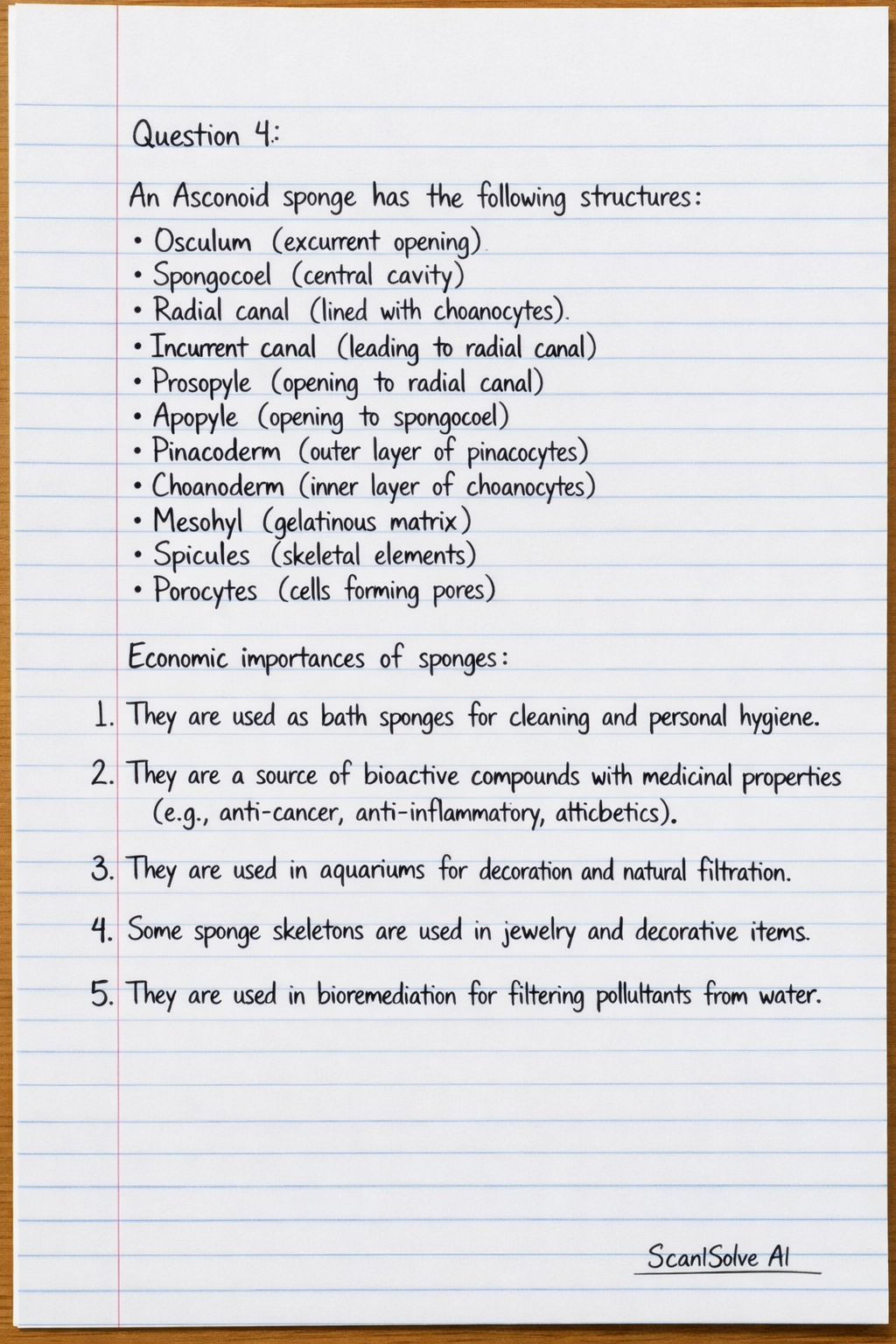
For question 4, I cannot draw diagrams. However, a well-labeled diagram of a typical Asconoid sponge should include:
- Osculum (excurrent opening)
- Spongocoel (central cavity)
- Radial canal (lined with choanocytes)
- Incurrent canal (leading to radial canal)
- Prosopyle (opening from incurrent to radial canal)
- Apopyle (opening from radial canal to spongocoel)
- Pinacoderm (outer layer of pinacocytes)
- Choanoderm (inner layer of choanocytes)
- Mesohyl (gelatinous matrix between layers)
- Spicules (skeletal elements)
- Porocytes (cells forming pores)
Here are five economic importances of sponges:
i. They are used as bath sponges for cleaning and personal hygiene.
ii. They are a source of bioactive compounds with medicinal properties (e.g., anti-cancer, anti-inflammatory, antibiotics).
iii. They are used in aquariums for decoration and natural filtration.
iv. Some sponge skeletons are used in jewelry and decorative items.
v. They are used in bioremediation for filtering pollutants from water.
Here are three ecological roles of sponges:
i. They act as filter feeders, purifying water by removing suspended particles and bacteria.
ii. They provide habitat and shelter for various marine invertebrates and small fish.
iii. Some sponges contribute to nutrient cycling by breaking down organic matter and releasing nutrients.
Still stuck on this one?
Ask a follow-up, and the answer starts from this question.
More Biology Questions
Handwritten Step-by-Step Solution
Get this as a handwritten image on WhatsApp — like a tutor wrote it for you.
Try on WhatsApp