
We read your photo as:
Substances can move into and out of cells by a variety of mechanisms. (a) Explain the factors that affect the rate of movement of substances into and out of cells. (b) Describe the difference between diffusion and active transport.
Biology
ScanSolve AI Answer
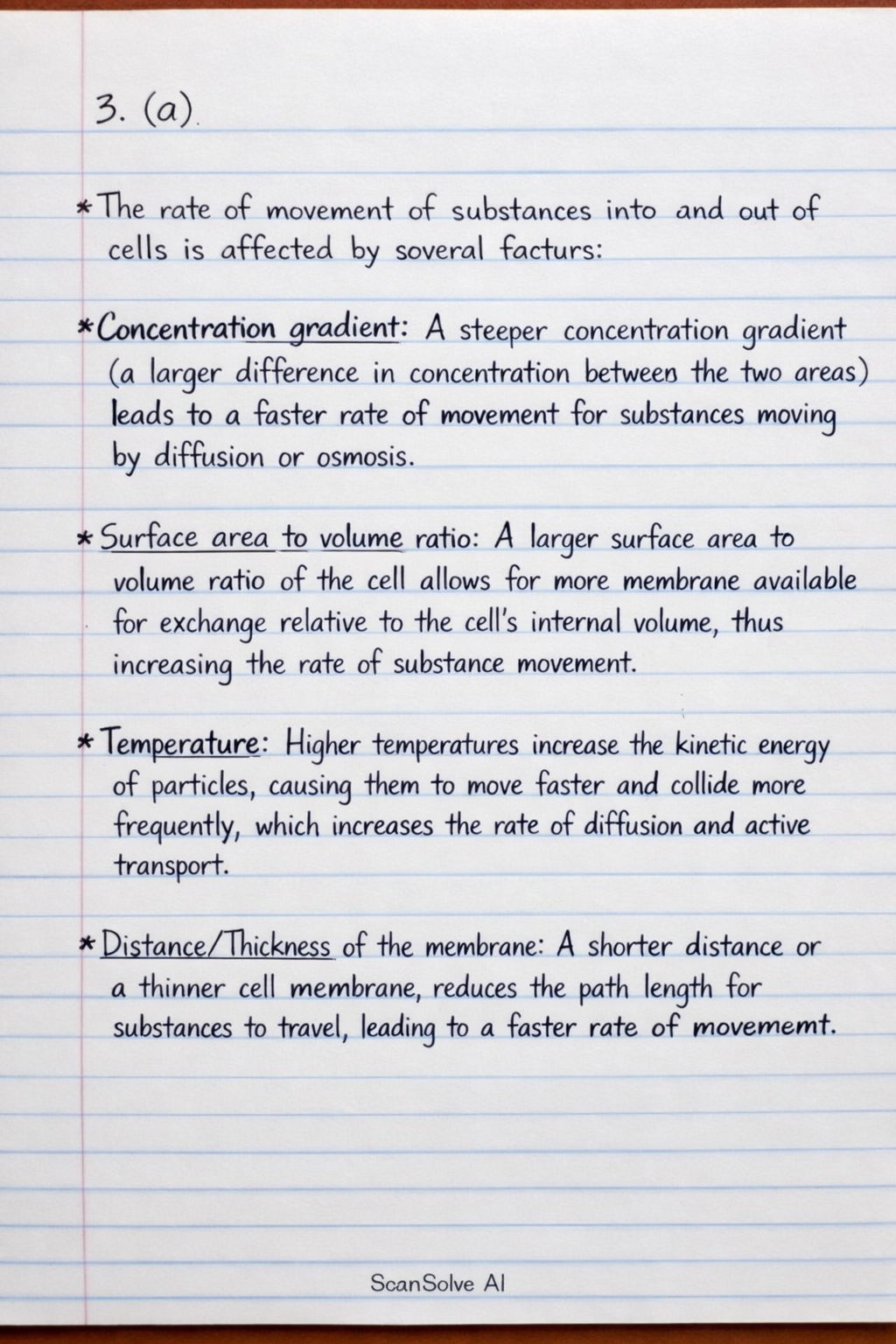
3. (a)
The rate of movement of substances into and out of cells is affected by several factors:
- Concentration gradient: A steeper concentration gradient (a larger difference in concentration between the two areas) leads to a faster rate of movement for substances moving by diffusion or osmosis.
- Surface area to volume ratio: A larger surface area to volume ratio of the cell allows for more membrane available for exchange relative to the cell's internal volume, thus increasing the rate of substance movement.
- Temperature: Higher temperatures increase the kinetic energy of particles, causing them to move faster and collide more frequently, which increases the rate of diffusion and active transport.
- Distance/Thickness of the membrane: A shorter distance or a thinner cell membrane reduces the path length for substances to travel, leading to a faster rate of movement.
- Presence of transport proteins: For processes like facilitated diffusion and active transport, the number and efficiency of specific carrier proteins or channel proteins in the cell membrane directly affect the rate of transport.
3. (b)
The main differences between diffusion and active transport are:
- Movement relative to concentration gradient: Diffusion is the net movement of particles from an area of higher concentration to an area of lower concentration (down the concentration gradient). Active transport is the movement of particles from an area of lower concentration to an area of higher concentration (against the concentration gradient).
- Energy requirement: Diffusion is a passive process that does not require metabolic energy (ATP). Active transport is an active process that requires metabolic energy (ATP) to move substances.
- Carrier proteins: While facilitated diffusion uses carrier proteins, simple diffusion does not. Active transport always requires specific carrier proteins or pumps embedded in the cell membrane to move substances.
Was this helpful?
Still stuck on this one?
Ask a follow-up, and the answer starts from this question.
Got a different question?Ask your own question
More Biology Questions
Qb) Movement of Materials in and out of the cell. 1. What is diffusion? Give one example of diffusion…QExplain diffusion and active transport, including factors affecting diffusion and examples of active…QHere are MCQs on Cell Physiology (no answers included, as for exam practice): 🧬 Cell Physiology…QExplain the factors affecting diffusion and the state of particles in liquids and gases.QExplain the three factors that affect the rate of diffusion, according to the provided notes.
Handwritten Step-by-Step Solution
Get this as a handwritten image on WhatsApp — like a tutor wrote it for you.
Try on WhatsApp