
We read your photo as:
Summarize the chromosomal basis of inheritance, including meiosis II, and types of chromosomal alterations.
Biology
ScanSolve AI Answer
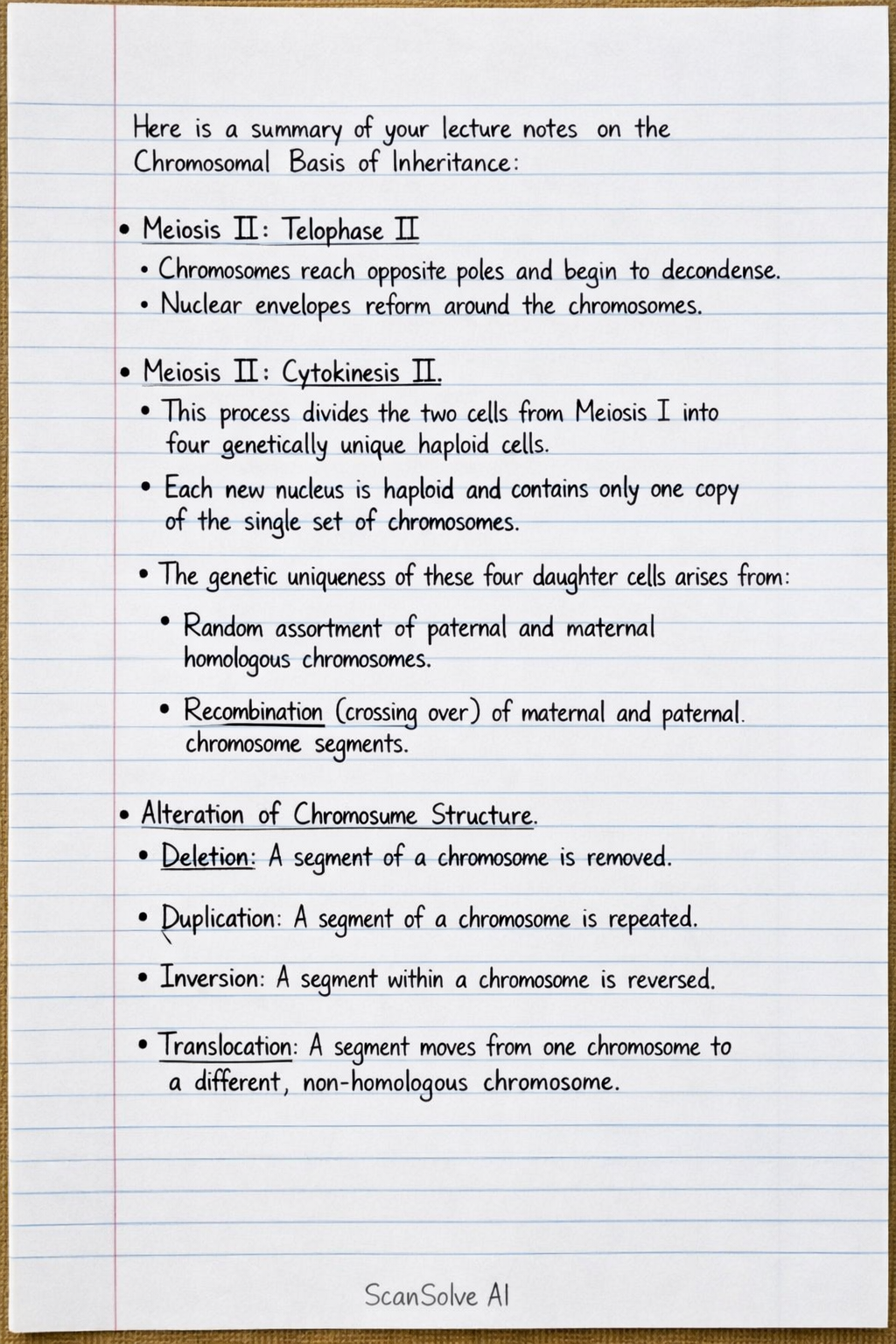
Here is a summary of your lecture notes on the Chromosomal Basis of Inheritance:
-
Meiosis II: Telophase II
- Chromosomes reach opposite poles and begin to decondense.
- Nuclear envelopes reform around the chromosomes.
-
Meiosis II: Cytokinesis II
- This process divides the two cells from Meiosis I into four genetically unique haploid cells.
- Each new nucleus is haploid and contains only one copy of the single set of chromosomes.
- The genetic uniqueness of these four daughter cells arises from:
- Random assortment of paternal and maternal homologous chromosomes.
- Recombination (crossing over) of maternal and paternal chromosome segments.
-
Alteration of Chromosome Structure
- Deletion: A segment of a chromosome is removed.
- Duplication: A segment of a chromosome is repeated.
- Inversion: A segment within a chromosome is reversed.
- Translocation: A segment moves from one chromosome to a different, non-homologous chromosome.
-
Alteration of Chromosome Number
- Any change in the normal chromosome number is called heteroploidy.
- Polyploidy: A condition where an organism has one or more extra complete sets of chromosomes (e.g., Triploidy - 3 sets, Tetraploidy - 4 sets).
- Aneuploidy: A condition where there is a missing or extra individual chromosome (e.g., Trisomy 21, which is an extra copy of chromosome 21).
Was this helpful?
Still stuck on this one?
Ask a follow-up, and the answer starts from this question.
Got a different question?Ask your own question
More Biology Questions
QExplain the genetic basis of sex determination and inheritance patterns, including autosomes, sex…QHere's a summary of the provided lecture notes on Meiosis I (Prometaphase I and Metaphase I)…QSummarize sex-linked genes and abnormalities, including X-linked inheritance patterns in males and…QThe diagram below represents chromosomes arrangement in somatic cells of a female suffering from a…QExplain the events of Prometaphase I and Metaphase I during Meiosis I, focusing on how they…
Browse by topic:Genetics
Handwritten Step-by-Step Solution
Get this as a handwritten image on WhatsApp — like a tutor wrote it for you.
Try on WhatsApp