
We read your photo as:
What symptoms indicate excessive bleeding after a caesarean section, and what methods are used to control bleeding?
ScanSolve AI Answer
Answer
I and III
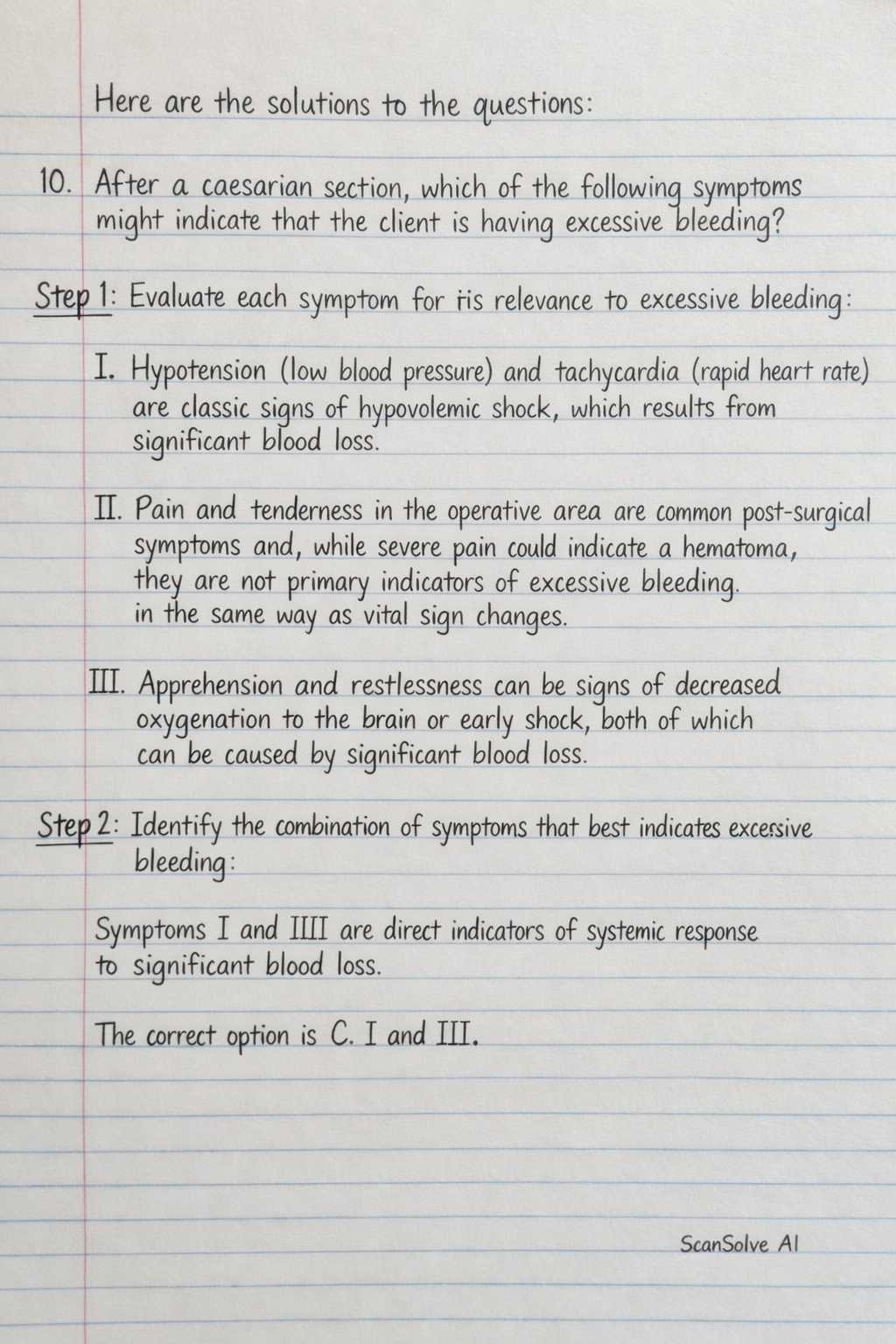
Here are the solutions to the questions:
10. After a caesarian section, which of the following symptoms might indicate that the client is having excessive bleeding?
- Step 1: Evaluate each symptom for its relevance to excessive bleeding.
- I. Hypotension (low blood pressure) and tachycardia (rapid heart rate) are classic signs of hypovolemic shock, which results from significant blood loss.
- II. Pain and tenderness in the operative area are common post-surgical symptoms and, while severe pain could indicate a hematoma, they are not primary indicators of excessive bleeding in the same way as vital sign changes.
- III. Apprehension and restlessness can be signs of decreased oxygenation to the brain or early shock, both of which can be caused by significant blood loss.
- Step 2: Identify the combination of symptoms that best indicates excessive bleeding. Symptoms I and III are direct indicators of systemic response to significant blood loss.
The correct option is C. I and III.
11. In caring for a mother who has been delivered by caesarian section, which of the following are usually employed to keep the uterus contracted and control bleeding?
- Step 1: Assess each method for its role in uterine contraction and bleeding control.
- I. Oxytocic drugs (e.g., oxytocin) are medications specifically used to stimulate uterine contractions, which compress blood vessels and prevent postpartum hemorrhage. This is a primary method.
- II. An ice bag to the operative area is used to reduce pain and swelling at the incision site, not to contract the uterus or control internal uterine bleeding.
- III. A pressure dressing and tight abdominal binder provide support to the incision, reduce swelling, and offer comfort. They do not directly cause uterine contraction or control internal uterine bleeding.
- Step 2: Determine which methods are directly employed for uterine contraction and bleeding control. Only oxytocic drugs directly achieve this.
The correct option is A. I Only.
12. Which of the following is NOT a post episiotomy site care measures to be instituted by the midwife?
- Step 1: Review each option to determine if it is a standard post-episiotomy care measure.
- A. Discourage early ambulation: Early ambulation (getting up and moving around soon after surgery/delivery) is generally encouraged to prevent complications like deep vein thrombosis (DVT) and promote recovery. Therefore, discouraging it is not a correct measure.
- B. Ensure perineal care and personal hygiene: This is crucial for preventing infection and promoting healing of the episiotomy site.
- C. Encourage client to eat balanced diet: Good nutrition is essential for wound healing and overall recovery.
- D. Keep wound site clean and dry: This is fundamental for preventing infection and facilitating healing.
- Step 2: Identify the option that is not a correct care measure.
The correct option is A. Discourage early ambulation.
Try one yourself
A new problem that tests the same skill.
Still stuck on this one?
Ask a follow-up, and the answer starts from this question.
More Biology Questions
Handwritten Step-by-Step Solution
Get this as a handwritten image on WhatsApp — like a tutor wrote it for you.
Try on WhatsApp