
We read your photo as:
Describe the systematic approach to interpreting chest X-rays (ABCDE) and the key features of normal, pneumonia, and pulmonary edema.
Biology
ScanSolve AI Answer
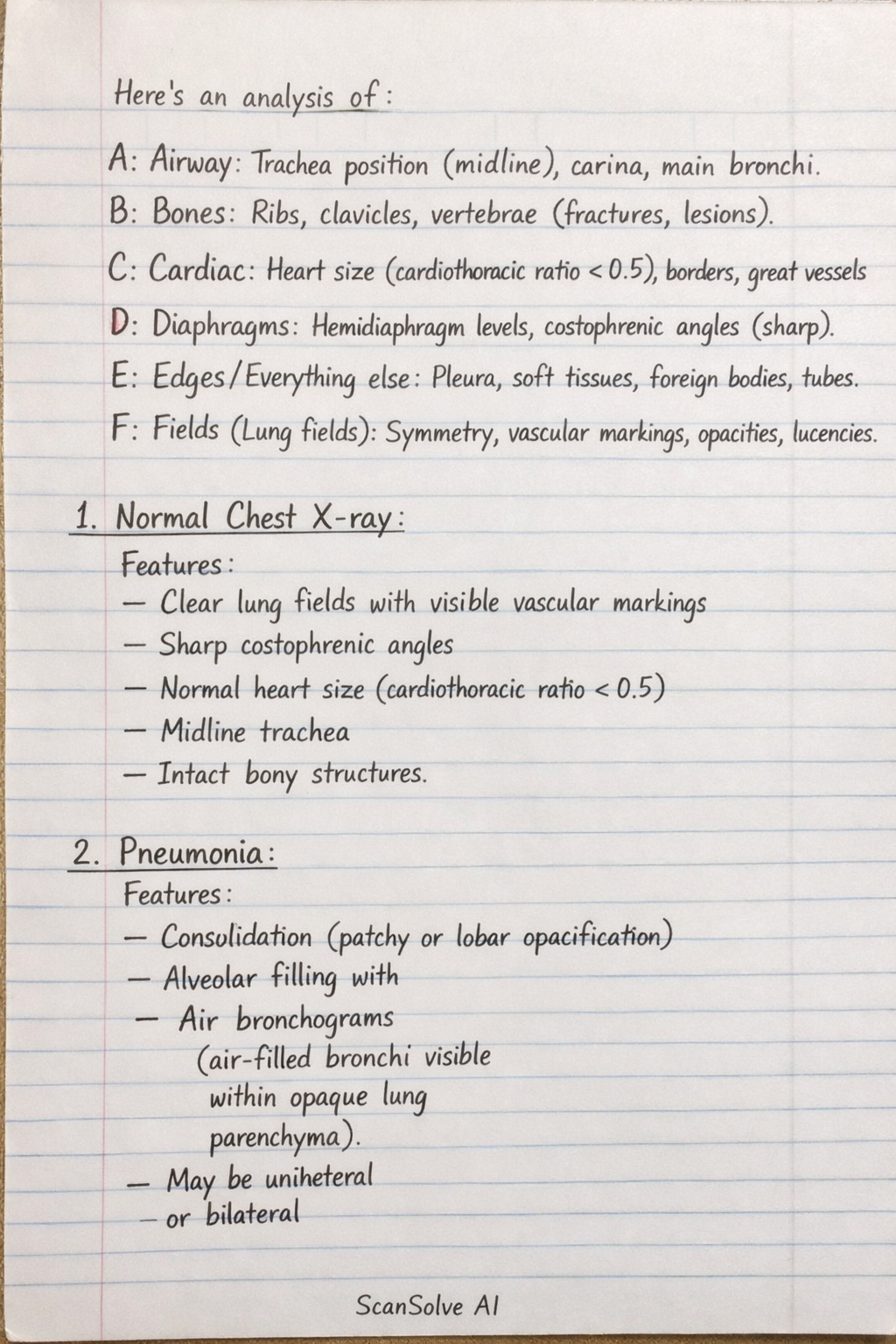
When interpreting chest X-rays, a systematic approach is key. Look for:
- Airway: Trachea position (midline), carina, main bronchi.
- Bones: Ribs, clavicles, vertebrae (fractures, lesions).
- Cardiac: Heart size (cardiothoracic ratio < 0.5), borders, great vessels.
- Diaphragms: Hemidiaphragm levels, costophrenic angles (sharp).
- Edges/Everything else: Pleura, soft tissues, foreign bodies, tubes.
- Fields (Lung fields): Symmetry, vascular markings, opacities, lucencies.
Here are the features for each condition:
-
Normal Chest X-ray:
- Features: Clear lung fields with visible vascular markings, sharp costophrenic angles, normal heart size (cardiothoracic ratio typically less than 0.5), midline trachea, and intact bony structures.
-
Pneumonia:
- Features: Consolidation (patchy or lobar opacification) representing alveolar filling, often with air bronchograms (air-filled bronchi visible within the opaque lung parenchyma). May be unilateral or bilateral.
-
Pulmonary Edema:
- Features: Often described as "ABCDE" findings: Alveolar edema (fluffy, ill-defined opacities, often perihilar "bat-wing" appearance), B-lines (Kerley B lines - short, horizontal lines at lung periphery), Cardiomegaly (if cardiac cause), Dilated upper lobe vessels (cephalization), Effusions (pleural effusions).
-
Pleural Effusion:
- Features: Blunting of the costophrenic angles (usually posterior first, then lateral), meniscus sign (curved upper border of fluid), and homogeneous opacification of the lung base. Large effusions can cause mediastinal shift.
-
Pneumothorax:
- Features: A visible visceral pleural line (thin white line) separated from the chest wall, with an absence of lung markings distal to this line. The affected lung may appear collapsed. In tension pneumothorax, there is mediastinal shift away from the affected side and diaphragmatic flattening.
-
DDx Globular Heart and Boat Heart:
- Globular Heart:
- Features: A diffusely enlarged, rounded cardiac silhouette, often seen with pericardial effusion (fluid around the heart) or dilated cardiomyopathy. The heart appears like a "water bottle" or "flask" shape.
- Boat Heart (Boot-shaped heart):
- Features: A specific cardiac contour seen in Tetralogy of Fallot. It is characterized by an upturned cardiac apex due to right ventricular hypertrophy and a concave pulmonary artery segment, giving the heart the appearance of a boot.
- Globular Heart:
Was this helpful?
Still stuck on this one?
Ask a follow-up, and the answer starts from this question.
Got a different question?Ask your own question
More Biology Questions
QProvide a detailed interpretation of the provided chest X-ray image, including patient and…QA chest X-ray shows a large, dense, and irregular white area in the upper-to-mid field of the left…Q¿Podrías describir una radiografía de tórax estándar (AP/PA y lateral)?QList 4 microscopic features of bronchiectasis, and state one microscopic feature important in the…QDifferentiate between CT scan, MRI, X-ray, and Ultrasound medical imaging techniques.
Handwritten Step-by-Step Solution
Get this as a handwritten image on WhatsApp — like a tutor wrote it for you.
Try on WhatsApp