
Can you teach me how to use a mathematical table to find the square root, squares and cubes of numbers
ScanSolve AI Answer
Step-by-step solution
7 stepsUsing a mathematical table (often called a four-figure table or log table) to find squares, square roots, and cubes involves locating the number in the table and reading the corresponding value.
How to find Squares using a Mathematical Table
Mathematical tables usually have a section for "Squares."
Locate the number in the "Number" column.
Find the number whose square you want to find in the main column (usually labeled "N" or "Number").
Read the value in the "Squares" column.
Once you've found your number, look across the row to the column labeled "Squares" (or ). The value there is the square of your number.
Example: Find the square of 25.
- Locate 25 in the "Number" column.
- Read the value in the "Squares" column corresponding to 25. It will be 625. So, .
How to find Square Roots using a Mathematical Table
Mathematical tables have sections for "Square Roots" which are often divided into and to handle numbers of different magnitudes.
Determine which column to use ( or ).
- If the number has an odd number of digits before the decimal point (e.g., 4, 144, 2.5), use the column.
- If the number has an even number of digits before the decimal point (e.g., 16, 2500, 0.36), use the column.
- For numbers between 1 and 100, if the number is between 1 and 9.99, use . If it's between 10 and 99.9, use .
Locate the number in the "Number" column.
Find the number (or its significant digits) in the "Number" column.
Read the value in the appropriate "Square Roots" column.
Read the value in the or column corresponding to your number. Adjust the decimal point based on the original number's magnitude.
Example 1: Find the square root of 64.
- 64 has an even number of digits (two) before the decimal point. Use the column.
- Locate 64 in the "Number" column.
- Read the value in the column. It will be 8.000. So, .
Example 2: Find the square root of 2.25.
- 2.25 has an odd number of digits (one) before the decimal point. Use the column.
- Locate 2.25 (or 225 and adjust) in the "Number" column.
- Read the value in the column. It will be 1.500. So, .
How to find Cubes using a Mathematical Table
Mathematical tables usually have a section for "Cubes."
Locate the number in the "Number" column.
Find the number whose cube you want to find in the main column (usually labeled "N" or "Number").
Read the value in the "Cubes" column.
Once you've found your number, look across the row to the column labeled "Cubes" (or ). The value there is the cube of your number.
Example: Find the cube of 4.
- Locate 4 in the "Number" column.
- Read the value in the "Cubes" column corresponding to 4. It will be 64. So, .
Still stuck on this one?
Ask a follow-up, and the answer starts from this question.
More Biology Questions
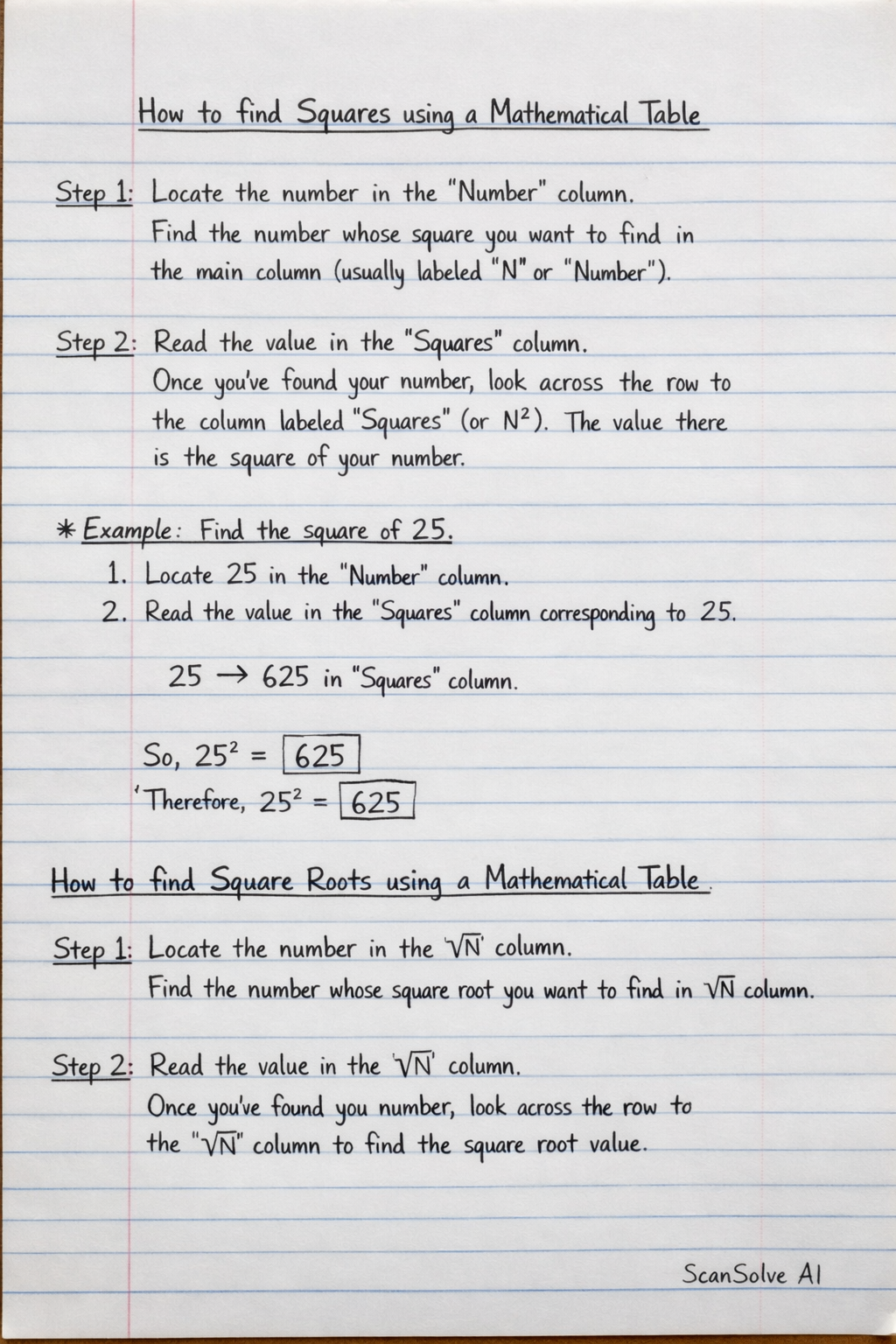
Handwritten Step-by-Step Solution
Get this as a handwritten image on WhatsApp — like a tutor wrote it for you.
Try on WhatsApp